Who Is Caishen? Three Things to Know About the Chinese God of Wealth
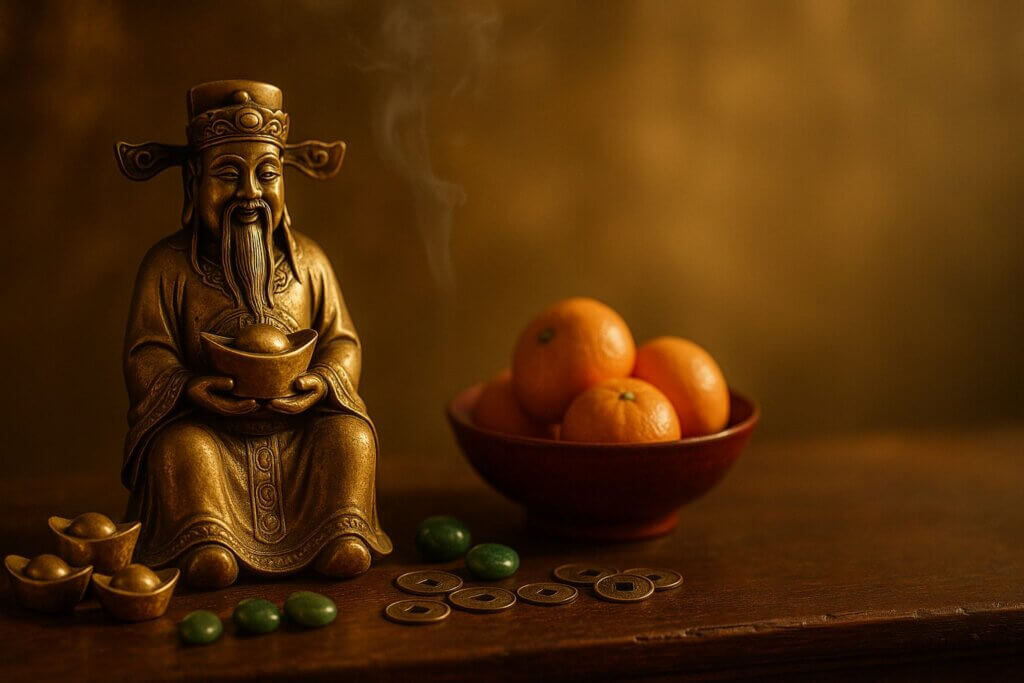
If you’ve ever grabbed dinner at a Chinatown restaurant here in the US, you’ve probably spotted a little statue parked near the register — a smiling figure in a red robe, holding up a gold ingot, a couple of oranges set out in front of him. That’s Caishen, the Chinese god of wealth. In the Chinese-speaking world, he’s about as recognizable as a figure gets; practically every Chinese kid can name him on sight. But if you didn’t grow up around that, he’s genuinely hard to place. He’s not quite a mythological character, and he’s not quite the founder of a religion. So let’s sort out three things.
1. Where He Sits in Chinese Folk Religion
To get Caishen, you first have to get the shape of Chinese folk religion, which works nothing like a monotheistic faith. There’s no single scripture, no unified church, and no expectation that you pick one god and stay loyal. Think of it more as a huge, open-ended roster of deities, each one handling a department of life: one covers exams, another childbirth, another safe passage at sea, another the kitchen, another the land itself. Big test coming up? You go to the god of scholarship. Heading out on the water? Mazu. Running a business? Caishen. It has something in common with the Greek and Roman pantheons, but it’s woven much further into daily life, and it’s far less remote.
So Caishen isn’t “the Chinese God” — he’s the guy on that roster who runs the finance department. And the way people relate to him is interesting all on its own: respectful, but not awestruck. Familiar, even a little teasing. Someone might say, half-joking, that Caishen skipped their house this year — not the kind of line you’d use about a solemn religious figure. That easy familiarity tells you a lot about what this tradition actually is. It’s part of everyday life, not a list of commandments.
2. What He Actually Governs
The short answer is money. But traditionally, his territory has been understood as a bit wider than that — closer to the English word “fortune,” which carries wealth and luck at the same time. A business owner isn’t just asking for better numbers on a balance sheet. They’re asking for things to go smoothly: shipments arriving, invoices getting paid, partners turning out to be reliable, the right opportunity not slipping past. Some of that is skill. Some of it is luck — and luck is exactly the part Caishen is said to oversee.
Here’s a detail worth holding onto: in the traditional understanding, Caishen doesn’t conjure money out of thin air. He’s more like the hand that nudges an opportunity in front of you — a customer walks in, the right person shows up, you happen to catch the news at the right moment. Whether you can actually grab what comes your way is still on you. That distinction matters, because it keeps the whole tradition from collapsing into a wish-granting machine. What people ask for is the encounter, not a pass on the work.
3. Why There’s More Than One Caishen
Here’s the part that trips up newcomers: who is Caishen, exactly? The answer is that he isn’t one person. “Caishen” works more like a job title, and over the centuries several historical figures have been placed in that role, with the specifics shifting from region to region. The broad split is between the civil god of wealth and the martial god of wealth. The civil god of wealth is usually a figure remembered for moral character or financial skill, depicted as scholarly and holding a gold ingot or an account book. The martial god of wealth wears armor and carries a weapon, carrying the sense of standing guard and protecting what you’ve built up. Beyond those two, there’s also the tradition of the Five Paths gods of wealth (wu lu cai shen), representing the money energy — the idea that wealth behaves like a current rather than a pile — flowing in from the four directions plus the center.
That flexibility — one office, multiple candidates — would be nearly impossible inside a monotheistic framework, but in Chinese folk religion it’s completely ordinary. And it reveals the underlying logic of the system: gods are elevated by what people need, not designated by scripture. Whichever figure’s story best carries a community’s idea of what wealth means is the one who ends up on the home altar.
From Mortals to Gods: 3 Main Threads in the Origins of Caishen
Here’s what makes the stories behind Caishen, the Chinese god of wealth, worth your time: most of these figures were never born divine. They were real people from history or legend, carried up onto the altar by generation after generation of ordinary believers. And who got promoted tells you a lot. The candidates weren’t the richest men anyone could name. They were the men who best embodied a particular quality of character. Look at which three made the cut and you can more or less reconstruct what Chinese culture imagines a person who deserves wealth actually looks like.
1. The Loyal Minister Whose Heart Was Cut Out: A Heart That Cannot Play Favorites
The civil god of wealth most often named is Bigan, a senior royal official at the end of the Shang dynasty. As the legend goes, he kept speaking plainly to a tyrannical king, warning him again and again, until the king finally ordered his heart cut from his chest. On its face, the story has nothing to do with money. But folk tradition later gave it a beautifully strange twist: with no heart left in him, Bigan had no capacity for favoritism either, which made him the fairest possible distributor of wealth. Nobody could be shown preference, because there was nothing left in him to do the preferring.
That’s a big leap of association, and yet it lands on something psychologically true. The deepest anxiety people carry about money usually isn’t “I’m not working hard enough.” It’s “this isn’t fair” — why did the opportunity go to him and not to me? Casting the god of wealth as an absolutely impartial distributor amounts to saying that somewhere in this world there’s at least one point in the machinery where connections don’t count and background doesn’t count. That’s a consolation. It’s also a demand.
2. The Strategist Who Quit Office for Trade: The Man Who Gave Away His Fortune Three Times
Another figure regularly counted among the civil gods of wealth is Fan Li, a strategist of the Spring and Autumn period who helped his king recover a lost kingdom. When the campaign succeeded, he didn’t stick around to collect his reward. He quietly took his family and left, changed his name, and went into business. Tradition credits him with an extraordinary sense of timing and price. Three times he built an enormous fortune, three times he handed the money out to his neighbors and to the poor, and three times he started over.
Choosing this man as a god of wealth lays out a very concrete model of what mastery means: the real skill isn’t holding on to money, it’s being able to earn it back on demand — and once you can earn it back, giving it away stops being frightening. He’s also one of the few merchants that traditional China portrayed in a genuinely favorable light. In a society that spent centuries looking down on commerce, Fan Li’s story effectively won a measure of dignity for the whole business of buying and selling.
3. The Marshal on the Black Tiger and the General Who Kept His Word: The Martial Branch
The martial god of wealth comes out of Daoism and folk legend instead. The most common figure is Zhao Gongming, a marshal in the Daoist pantheon, depicted with a dark face and a heavy beard, riding a black tiger and carrying an iron whip. His portfolio covers driving off evil, ending plagues, and “bringing profit to those who buy and sell” — in other words, keeping trade fair and keeping it moving. The other widely honored figure is Guan Yu, the Three Kingdoms general famous for loyalty and honor, and merchants in particular have long favored him.
Why merchants picked Guan Yu is the part worth sitting with. He was no financial genius. What he was known for is that his word held. In an era with no developed system of contracts and no court that could get you paid quickly, whether business was possible at all came down almost entirely to whether the other party kept his promises. Elevating a man famous for keeping his word to the position of god of wealth is essentially a declaration of business ethics: this is the standard I honor, and this is the standard I hold myself to.
From the Altar to Everyday Life: 3 Ideas About Money Hidden Inside the Caishen Tradition
Now for the practices. One thing to get straight up front: what follows is a description of how people have traditionally done things and what those customs were reaching for — not a suggestion that you go do any of it. The rituals were never the interesting part anyway. The interesting part is the set of instincts about money that piled up around those customs over centuries. Even if you never set out a single offering, these three ideas hold up as a way to audit your own financial habits.
1. Money Has to Move: Why the Tradition Puts So Much Weight on Circulation
Almost every Lunar New Year custom tied to Caishen, the Chinese god of wealth, comes back to one idea: movement. There’s a designated day for welcoming the god of wealth during the New Year stretch, and traditionally people throw open their doors and set off firecrackers that morning to bring him inside. Shops pick an auspicious day to reopen, on the logic that you don’t want business sitting idle too long. Elders hand red envelopes to the younger generation, so money runs downhill from one generation to the next. Some families make a point of buying something new over the holiday, on the idea that money is only alive when it’s coming in and going out. The through line is remarkably consistent: wealth gets imagined as something that flows, like water or like qi, and something that spoils when it stops.
That instinct turns out to be a pretty modern one. Personal finance says the same thing today — cash parked somewhere that earns nothing is quietly losing value. So does macroeconomics: when the loop of spending and investment stalls, the whole system contracts. The tradition reaches for a metaphor, money energy — the idea that wealth behaves like a current rather than a pile — but it’s pointing at the same conclusion. Holding on as tightly as you can isn’t automatically the safe play.
2. Sharing Is What Gets the Snowball Rolling: The People Worth Investing In Aren’t the Richest Ones
There’s a Chinese folk idea worth knowing here — not as a financial rule, but as a cultural lens on wealth: when Caishen extends money energy to you, it’s an act of trust, because the expectation is that you’ll put it to work and pass some of it back out. And “passing it back out,” as people understand it, was never about earning a hundred dollars and giving away ninety. That’s not circulation, that’s bleeding out. What it actually means is keeping the energy moving outward. Sharing something you’ve learned with a friend counts. Giving your time as a volunteer counts. What comes back is a positive loop, a snowball picking up mass on every turn.
Here’s the most interesting layer. The tradition holds that the best thing you can share isn’t money at all — it’s the knowledge that makes people wealthy. Because other people got richer through you, some portion of that loop eventually swings back around to you. In today’s language, that’s a network effect: over a long enough horizon, the person who teaches the method collects more than the person who only runs it quietly on their own. Which is why there’s an old saying that lands in roughly the same place — getting rich yourself isn’t the impressive part, and being able to lift the people around you along with you is what makes you worth investing in. From Caishen’s vantage point, after all, backing the first type returns fifty cents on the dollar, and backing the second returns ten to one.
3. Credit Outranks Profit: Why Merchants Chose a God Known for Keeping His Word
Come back to that loyal general the shopkeepers picked. When a traditional business kept Caishen on a home altar in the shop, it wasn’t only a request for good sales — there was a self-disciplining edge to it. The figure you face every morning stands for a standard: you do what you said you’d do. Some accounts go further and hold that a merchant who cheats, who shorts the scale, isn’t someone the god of wealth looks after. What the belief is really doing there is running as a built-in professional ethic.
Translate that forward. Over a short horizon, sure, the person cutting corners does make money faster. Stretch the timeline out, though, and the only thing that makes people willing to work with you again and again is predictability. You deliver what you promised. The numbers you quote are real. When something breaks, you don’t vanish. None of that shows up on the P&L of any single transaction, and all of it decides how many people still call you ten years from now. The tradition puts it as “the god of wealth doesn’t protect the dishonest,” but what it’s describing is compounding: credit is the one asset that appreciates on its own just by surviving time.
5 Common Questions About Caishen
These are the five questions that come up most often the first time somebody stumbles into this subject. Here’s the thing, though — most of them aren’t really religious questions. They’re questions about how to read a culture. When a belief system grew out of a background nothing like your own, the hard part is figuring out where to file it in your head so you don’t misread it. The answers below start from how people have traditionally thought about this, not from what you ought to do.
Q1: Is Caishen one god or many?
The most accurate way to put it: “Caishen” is a job title, and several figures have held it. The civil god of wealth, the martial god of wealth, and the Five Paths gods of wealth (wu lu cai shen) point to different historical figures or to directional symbolism, and the object of the offerings isn’t the same everywhere. What’s common in the south may not be what’s common in the north. If you’re coming from a monotheistic frame, that looks like chaos. In Chinese folk religion, it isn’t a contradiction at all — no central authority ever existed to standardize the version.
A different angle makes it click. Instead of treating Caishen as one specific character, treat him as a cultural container, and what’s inside is each era’s answer to the question of who deserves to have money. One era picked a selfless official who died for speaking honestly. Another picked a strategist who was good at business and willing to give his fortune away. Another picked a general known for keeping his word. Different people — but the values they point toward line up almost exactly.
Q2: I’m not Chinese and I don’t believe any of this — what do I get out of reading it?
Every civilization handles money anxiety differently, and the method it picks ends up shaping how people behave. Norse myth explained your circumstances through fate and destiny. The Protestant ethic tied hard work and restrained spending to salvation. Japan’s lucky cat turned good fortune into a small, appealing object you set by the door. The Chinese choice was to personify wealth as a deity with principles — one who has moods, holds standards, and pays attention to how you handle your money.
The advantage of personifying wealth is that an abstract principle becomes something you can feel. Reminding yourself daily to protect your credit and keep resources moving is hard. Remembering that Caishen doesn’t care for people who cut corners is easy. So even if you don’t believe for a second that this deity exists, watching how a culture designs him is watching how that culture converts its values into habits people can actually run on a Tuesday. That’s worth something to anybody.
Q3: Did people traditionally believe that making offerings to Caishen would actually make them rich?
The popular attitude is more practical than you’d expect. There’s a widely repeated saying: do everything a person can do, then leave the rest to heaven. Not one ounce of the effort you owe gets skipped, and only the part genuinely outside your control gets handed off. Traditionally, nobody thought praying often enough would turn a business around on its own. The more common understanding was that you’d already done what could be done, too many variables were still in play, and you needed somewhere to put the anxiety.
Seen that way, making offerings to Caishen works more like a psychological ritual. Before a risky decision, a fixed sequence of actions settles you down, and then you commit. Functionally, it isn’t far off from an athlete’s pregame routine or the small habit a founder repeats before signing. The ritual doesn’t change the odds. It changes the state of the person executing, and state does affect outcomes.
Q4: Why does Caishen get so much attention at Lunar New Year?
Because Lunar New Year is traditionally the settle-up-and-restart point for the whole year. Old debts get cleared before the year turns, the new year starts from zero, and every expectation anyone holds about the future gets packed into that handful of days. Caishen is the one in charge of wealth, so he naturally became one of the most visible characters in the holiday customs. Welcoming the god of wealth, shopkeepers picking a date to reopen, handing out red envelopes, saying auspicious phrases — it all clusters in that window.
The psychology is close to that of a New Year’s resolution. People need a clear dividing line to convince themselves that what came before no longer counts and things start differently now, and a moment the entire society agrees on works far better than a date you pick at random. Chinese culture turned that reset into a festival everyone takes part in, then cast Caishen as the lead of the occasion. The result is one collective reminder a year: think about how you plan to treat money this time around.
Q5: Isn’t this just worshipping money?
On the surface, a deity you go to specifically for money is easy to read that way. But look closely at the backgrounds of the figures who got the job, and not one of them was chosen for being rich. One was a loyal official who died for telling a ruler the truth. One was a strategist who gave away his entire fortune three times over. One was a general famous for keeping his word. The selection criteria are themselves a statement: wealth ranks behind character, and the order doesn’t reverse.
Here’s the closer reading. What you’re looking at is a cultural imagination about how wealth moves and what kind of person deserves to hold it. It doesn’t dodge money, and it doesn’t treat talking about money as shameful — but it insists throughout that money can’t sit still, can’t be hoarded by one person, and can’t come from dishonest methods. Break those conditions down and you get liquidity, generosity, and credit, none of which need a deity to hold them up. And that’s probably the most intriguing thing about Caishen as a figure: a god who looks like he’s strictly about getting rich has spent several centuries talking about something else entirely.