What Is a Treasure Bowl (Ju Bao Pen)? Three Basics to Know First
You’ve probably seen a Japanese lucky cat waving from a shop counter, or heard the Irish legend about the pot of gold at the end of the rainbow. Chinese culture has an object in the same family: the treasure bowl (ju bao pen), a vessel said to multiply whatever is placed inside it. The legend is simple. Drop a single coin into the bowl at night, and by morning it’s brimming with coins. Before getting into where a ju bao pen is traditionally placed, it helps to back up a step and look at where it sits in Chinese folk belief, and how it relates to Caishen, the Chinese god of wealth.
1. Think Container, Not Deity: A Bowl That “Grows” Wealth
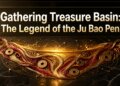
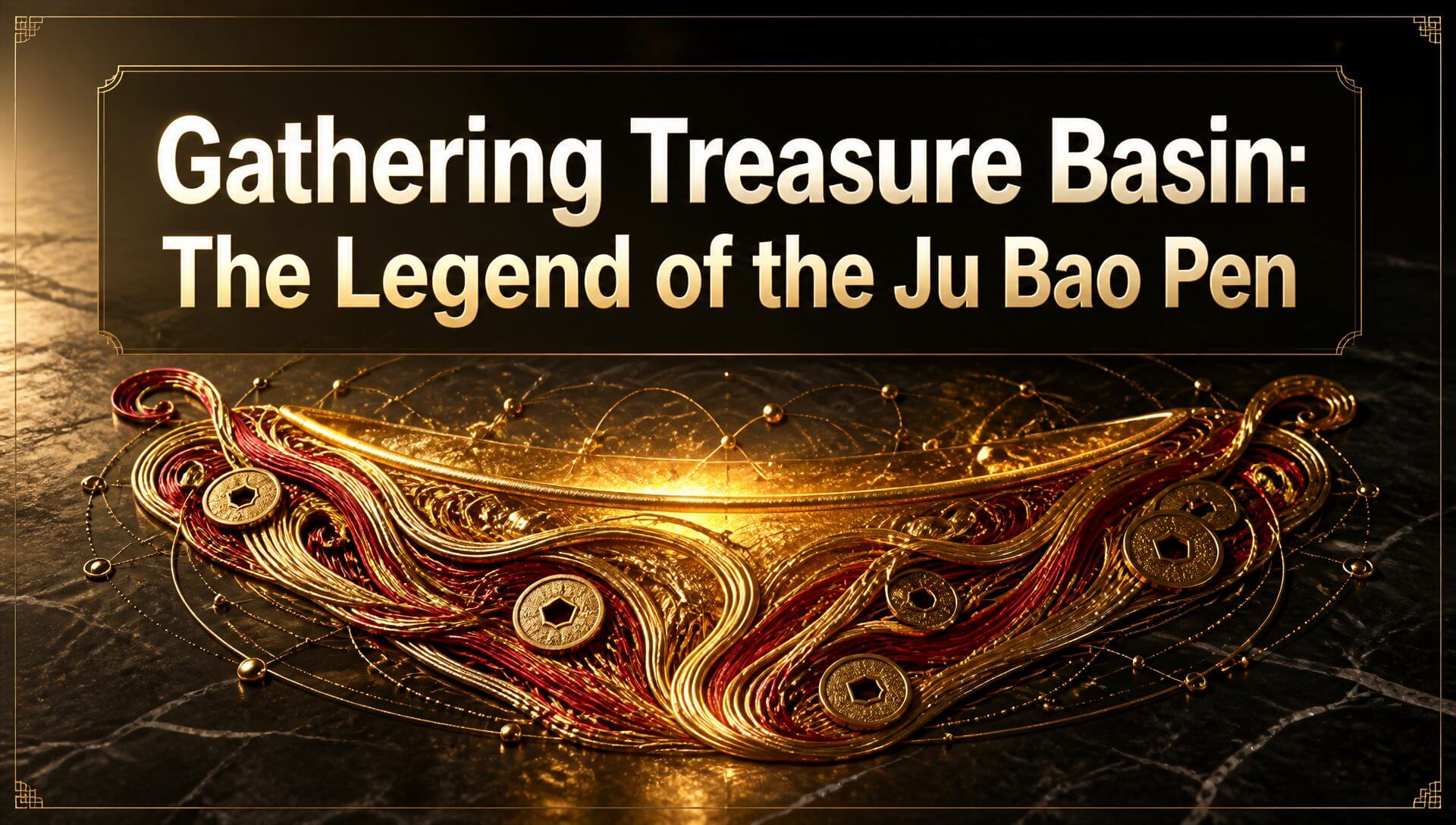
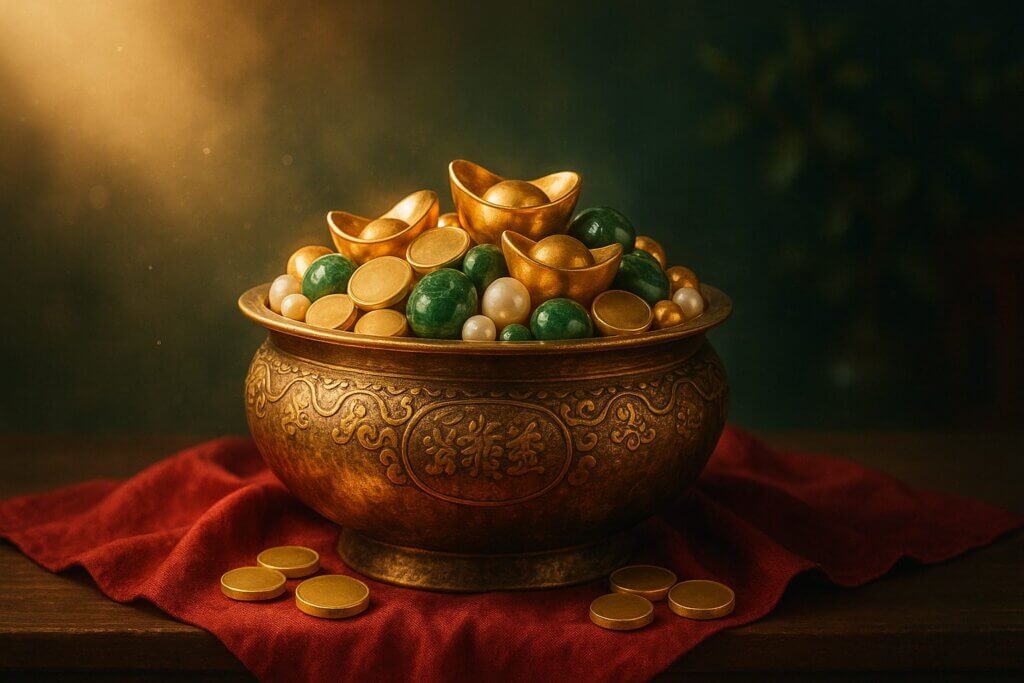
First things first: the ju bao pen is a symbol. Nobody prays to a bowl. It’s usually drawn as a round basin with a wide mouth and a deep belly. In traditional New Year prints, it’s heaped with gold ingots, copper coins and branches of coral, with rays of light rising off the top. To a Chinese viewer, the message of the image is plain: wealth has somewhere to gather.
That word, “gather,” is the one that matters. Traditional Chinese thinking treats money as a form of qi, the moving energy that Chinese tradition sees running through everything. Folk culture even has a name for this particular kind: money energy — the idea that wealth behaves like a current rather than a pile. And here’s the thing about a current: it flows in, and it flows back out just as easily. The ju bao pen is the vessel that gives that current a place to settle.
2. Who Is Caishen? A Group of Deities in Charge of How Wealth Is Distributed
Chinese folk religion has no single god at the center. Picture a heavenly civil service with a finely divided org chart: one office handles rain, another handles exams, another handles marriage, and another handles wealth. The deities in that last department are known collectively as Caishen. That’s right, there’s more than one of them. Some started out as generals, some were civil officials remembered for their fairness, and some were hugely successful merchants during their lifetimes.
In New Year prints, Caishen is often shown with an attendant at his side holding a ju bao pen. The folk reading of that picture is a division of labor: Caishen does the giving, and the bowl does the receiving. Money energy handed down from above needs something to land in. Without it, you’re standing in a rainstorm with no bucket, and all that water simply runs off.
3. A Gift from Caishen Is Understood as a Form of Trust
People tend to picture a wealth god as some kind of wish-granting machine. The Caishen of folk belief looks a lot more like an investor. Within this worldview, he directs money energy toward a person because he trusts that person. He’s betting that they’ll put the resources to good use and pay them forward, through good deeds, to the people around them.
So does the bowl make you rich just by sitting on a shelf? In the traditional telling, no such luck. The bowl is only a container. Whether money energy keeps arriving depends on what the person who received it goes on to do with it. The legend that follows is about exactly that.
Where the Ju Bao Pen Comes From: Three Turns in the Legend of Shen Wansan
Almost every ju bao pen story circles back to one man: Shen Wansan. He was a real person, a merchant in the Jiangnan region of southern China in the fourteenth century, right as the Yuan dynasty was falling apart and the Ming was taking over. He was also one of the richest men of his era. Regular folks couldn’t wrap their heads around how anybody got that rich, so a story grew up to explain it. He must have owned something magic. The legend comes in plenty of versions, and the one below is the most widely told.
The First Turn: One Kind Impulse Saves a Basket of Frogs
When the story opens, young Shen Wansan doesn’t have money yet. One day on the road he passes a fisherman hauling a big basket of frogs off to be slaughtered and sold. He can’t stand the thought. So he pays for the whole basket, carries it to a pond, and sets every last frog free.
That night the pond erupts in croaking, loud enough that he can’t sleep. At dawn he walks over to take a look and finds the frogs gathered around an old clay basin, refusing to leave it. Puzzled, he takes the basin home and puts it to work as a washbowl.
Pay attention to where the story starts. Nobody here is hunting for treasure. Shen Wansan helps a few small creatures that have nothing to do with him, and that’s the whole setup. In the folk telling, wealth begins with a kindness that expects nothing back, and that’s a deliberate choice on the storytellers’ part.
The Second Turn: A Silver Ornament Falls Into the Basin
One day his wife is washing her hands when a piece of silver jewelry slips into the basin. She reaches in to fish it out and finds the basin full to the brim with identical silver pieces. Naturally, the couple starts experimenting. They toss in copper coins and get a basin of copper coins. They toss in gold and get a basin of gold. From then on, Shen Wansan is the richest man for miles around.
Here’s the detail that tends to get skipped over: the basin never makes money out of nothing. Somebody has to put something in first, and whatever goes in is exactly what multiplies. Is that a lottery win? Hardly. In modern terms it reads as a parable about principal and compound interest. An empty basin stays empty forever. All it can do is amplify what you’ve already put in.
The Third Turn: What Happens After He Becomes as Rich as the Throne
The second half of the story is a lot less cheerful. Zhu Yuanzhang, the founding emperor of the Ming dynasty, sets out to build the city walls of Nanjing. Shen Wansan pays for a large stretch of them, and he’s said to have offered, without anyone asking, to fund a bonus for the imperial army too. No emperor was going to put up with a commoner who could outspend him. In the legend, Shen’s estate is confiscated and he’s exiled to Yunnan, in the far southwest. The emperor takes the ju bao pen and buries it beneath one of Nanjing’s city gates, which people later called Jubao Gate (ju bao men, “the gate of gathered treasure”).
Folk tradition kept that ending in the story for a reason. Shen Wansan had the basin and still couldn’t hang on to his fortune, which tells you that gathering wealth is only half the job. Past a certain point, wealth that piles up on one person and gets shown off turns into a disaster.
The Chinese traditions around Caishen carry a core idea, and it’s worth knowing not as a financial rule, but as a cultural lens on wealth. Getting rich on your own account doesn’t count for much. The person thought worth trusting with more is the one whose prosperity lifts the people around them too. The legend of Shen Wansan shows what happens when that idea gets ignored.
3 Traditional Spots for a Ju Bao Pen, and the Thinking Behind Them
Walk into a Chinese home or shop today and the ju bao pen you’ll see is a decorative vessel, usually ceramic, brass, or wood. Where it goes is another story. Feng shui tradition has a surprisingly detailed set of conventions on that point, and what follows describes what people have traditionally done and how they thought about it. You don’t have to buy into feng shui for any of this. The psychology and plain common sense underneath these habits are interesting in their own right.
1. The three traditional spots: the wealth corner, the counter, the desk
Here are the three placements you’ll run into most often:
- The living room’s “visible wealth corner” (ming cai wei): In feng shui, this is the corner diagonally across from the front door as you walk in. The traditional explanation goes like this: qi enters through the door, then slows down and settles in that far diagonal corner. That makes it the spot in the room best able to hold on to things.
- The checkout counter in a shop: Families who run a business often set the ju bao pen on the counter or just behind it. The reasoning is simple: that’s where money physically comes in and goes out.
- The study or the office desk: People who make their living from their minds and their expertise put it where they work. It’s a way of saying “this is where the income comes from.”
Notice the pattern. Each of the three spots is either a calm corner that foot traffic doesn’t disturb or the place where a person actually generates their income.
Tradition also has a few places it steers clear of. The bowl doesn’t go directly facing the front door, where qi is said to rush in and shoot straight back out. It doesn’t go in a bathroom or a corner piled with clutter, and it doesn’t go in a hallway. Read with modern eyes, that’s a reminder that the things you value belong somewhere you’ll take good care of them. And here’s the thing: if the object that stands for someone’s finances is surrounded by overdue bills and cardboard boxes, their relationship with money is probably a mess too.
2. Which way the bowl faces, and what goes inside
Some ju bao pen have a built-in direction. There may be a toad crouched on the rim, for instance, or a mouth that tilts at an angle. Traditionally the opening is turned toward the inside of the home, away from the front door, so that wealth is gathered in and never poured out. Can anyone verify a physical effect? Of course not. The symbolic meaning is what counts: what you earn ought to stay with you.
What goes inside varies from region to region. Loose coins are common, and so are rice or mixed grains. Some people add a few coins from the first money they ever earned through their own work. The grain makes sense once you remember that in a farming society, rice and grain were the most tangible wealth there was. They stand for the most basic kind of abundance, which is having enough to eat.
Plenty of families keep a charming habit: every day when they get home, they empty the change from their pockets into the bowl. In feng shui terms, this keeps something flowing into the bowl so it stays “alive.” In behavioral terms, it’s a small savings ritual that happens every single day, with results you can see. Modern personal finance books teach you to “pay yourself first.” Chinese grandmothers got the same result with nothing but a bowl, and with a little sense of ceremony thrown in.
3. The rule that matters most: never empty, never full
The folk saying is that a ju bao pen shouldn’t sit empty. An empty bowl has nothing to “grow” from, just as Shen Wansan’s bowl needed that first coin dropped in. But the bowl shouldn’t stay stuffed to overflowing, either, because a full bowl can’t receive anything new. So traditionally, people take the money out from time to time to spend it, put it into savings, or give it away. Then they start building it up again.
If that sounds familiar, it’s the same idea as “rolling” money energy in the folk beliefs surrounding Caishen. In that worldview, Caishen hands out money energy hoping it will be put to use and reach more hands. When the person who receives it passes some of it along, the energy keeps circulating and grows the way a snowball does as it rolls.
“Sharing” in this tradition doesn’t mean you have to give away ninety dollars of every hundred you make. It means keeping the energy moving. Volunteering your time counts as sharing. So does teaching your friends and family what you’ve learned about handling money or running a business. That second kind is considered the best of all, because once the people around you are better off because of you, some of the opportunities, connections, and trust find their way back to you.
Think like an investor and it clicks right away. Put a resource into someone who looks out only for themselves, and the return stops with them. Put it into someone who lifts everyone around them, and the return multiplies. Folk belief holds that Caishen “doubles down” on the second kind of person. You don’t have to believe in any deity here. It’s still hard to deny that trust and opportunity work much the same way in the real world.
So if you take one thing away from the custom of placing a ju bao pen, feel free to let go of the particular corner and the particular direction. Look at the shape of the bowl. The top is open, so things can come in and things can be taken out. A healthy relationship with money probably looks much the same. There’s a place for it to accumulate, the opening stays open, and what’s inside keeps moving.
5 Common Questions About Placing a Ju Bao Pen
Run into this custom for the first time and the practical questions show up fast. Do you have to believe in feng shui? Can you keep one if you aren’t Chinese? How is it any different from a lucky cat or a money frog? Here are the five that come up most often. The answers stick to the same approach as the rest of this article: they lay out what the tradition says and the thinking behind it. Whether you believe it, and whether you adopt any of it, is your call.
Q1: Does a ju bao pen have to be placed according to feng shui rules? Is there any point in having one if you don’t believe in feng shui?
Feng shui rules have never been one-size-fits-all. They vary from region to region and from school to school. Even the “visible wealth corner” (ming cai wei) can be located by more than one method, and Chinese families aren’t all working from the same manual. Where the different versions mostly agree is on a few principles. The bowl sits somewhere stable, clean, and within your own line of sight. It stays out of cluttered spots. And it doesn’t sit directly in line with the front door.
Don’t believe in feng shui? No big deal. You can treat the bowl as a visual cue. One often-cited observation in psychology is that a physical object you see every day holds a habit in place better than a reminder buried in your phone. Suppose a bowl gets you to drop in your loose change every evening, and brings your financial goals to mind each time you walk past it. That effect has nothing to do with energy fields, and it’s happening all the same. The tradition wraps the behavior in a good story, and the story itself makes people more willing to keep the habit going.
Q2: I’m not Chinese. Would keeping a ju bao pen in my home be cultural appropriation?
It’s a considerate thing to ask. Generally speaking, Chinese people are quite open to outsiders enjoying their good-luck traditions. A ju bao pen is no statue of a deity, and no sacred object reserved for people of a particular standing. It belongs to the category of folk good-luck objects, right alongside Spring Festival couplets, red lanterns, and the lucky cat. When people around the world hang red lanterns at Lunar New Year, most Chinese people are glad to see it.
When people do get bothered, it’s usually about the attitude behind the display. Treating the bowl as a joke. Using it as an exotic curiosity. Or knowing nothing about it and repackaging it as mysterious Eastern magic to sell. Now flip that around. If you know its story, know who Shen Wansan was, and understand why the bowl is never left empty and never allowed to overflow, then you understand this object better than plenty of people who keep one only because their elders did. Displaying something after you’ve taken the time to understand it is appreciation, not appropriation.
Q3: How is a ju bao pen different from a lucky cat or a money frog?
All three are about drawing in wealth, but each stands for a different action. The lucky cat comes from Japan, and its raised paw is beckoning. Its job is to wave customers and opportunities through the door, which is why it usually sits at a shop entrance, facing out. The money frog, typically shown with three legs and a coin in its mouth, comes from the Chinese legend of Liu Hai and the golden toad. Its job is to carry money back in its mouth. In some places the custom is to turn its head toward the door by day and toward the inside of the house at night, to show it heading out to find money and bringing it home.
So what does the ju bao pen do? It receives, and it nurtures. It doesn’t go out looking, and it doesn’t wave at anyone outside. It sits quietly deep inside the house, catches what comes in, and lets it slowly multiply. Put the three side by side and they look like a complete financial workflow. The lucky cat opens up new sources of income, the money frog brings the earnings home, and the ju bao pen handles accumulation and growth. That also explains why the ju bao pen’s traditional place is a settled corner inside the house, and why the doorway is never its spot: its job is to hold on to what has already come in.
Q4: Does tradition say you can take money out of a ju bao pen and spend it? Wouldn’t that be “taking the wealth away”?
Chinese people ask this one themselves all the time. One strand of folk belief does hold that the “mother coins” (qian mu), the first few coins placed in the bowl, are best left alone. They stay as seed, just as in the legend a coin has to be in the bowl before there’s anything to multiply.
Everything that builds up afterward is a different story. Most versions of the tradition say that money can be moved, and that the bowl should be cleared out on a regular basis. Depositing the money in the bank, putting it toward an expense that means something to you, or giving it to someone who needs it all count as acceptable. The reason came up earlier: a bowl that’s overflowing can’t receive anything new.
In the worldview behind Caishen folk belief, money is by nature a kind of moving qi. Wealth that just sits in a pile is called “dead money,” and it’s actually considered unlucky. You keep the seed, let the rest flow out and do some good, and then build the bowl up again. If that rhythm sounds familiar, it should. It’s nearly the same thing modern investors mean by “preserve the principal and put the returns to work,” and it got there a few hundred years earlier.
Q5: Does the legend really claim a bowl can make someone rich? How do Chinese people themselves see it?
Most Chinese people relate to the ju bao pen about the way many Americans relate to a lucky penny or a four-leaf clover. Nobody seriously expects it to change a bank balance. But having it around feels reassuring, and on the off chance there’s something to it, why not? It’s a cultural habit of inviting good fortune, and how seriously people take it varies from person to person.
The legend itself doesn’t really support a “get the bowl, get rich” reading either. Shen Wansan’s bowl came to him because of a kind impulse, when he saved the frogs. Something had to go into it before anything came out. And here’s the kicker: although he owned the most powerful ju bao pen in the world, he still lost his entire fortune in the end. If the story only meant to say that a magic object brings riches, it wouldn’t need that ending.
Folk tradition has kept that ending for hundreds of years because the whole story is about the relationship between wealth and people. Wealth arrives through goodwill, and it grows only when you put something in. Hoarding it and flaunting it are how it gets lost. It lasts when you let it circulate, and let the people around you prosper along with you.