Kai Yun and Caishen: Two Ideas Behind the Chinese Culture of Seeking Wealth
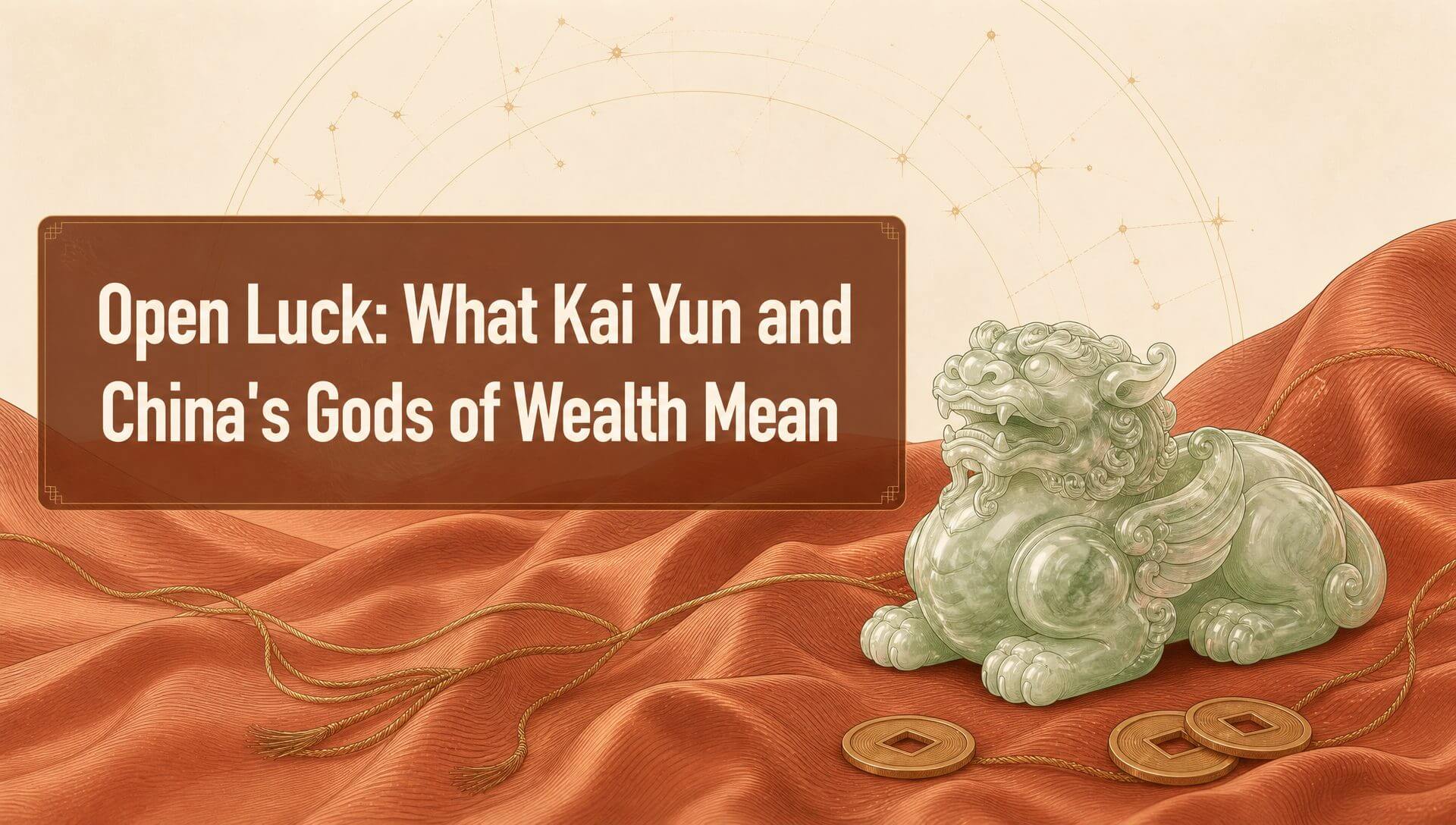
If you’re into Norse mythology, or you’ve ever parked a Japanese lucky cat on a shelf at home, there’s a good chance the Chinese tradition around Caishen, the Chinese god of wealth, will pull you in just as fast. Before we get to him, though, you need one term in your pocket: kai yun (literally “opening your luck”). This section covers what kai yun actually means and where Caishen sits within Chinese folk religion. Get those two pieces in place, and the stories and customs that come later will make a whole lot more sense.
What “Kai Yun” Is Really Saying
Kai means “to open.” Yun means “luck” or “fortune.” Put them together and you get “opening up your luck.” Keep your eye on that verb. The phrase could have been built around “getting” good luck, or “buying” it. It wasn’t. The word is “opening,” and that choice tells you something about how Chinese tradition thinks: good fortune isn’t an object that drops out of the sky. It’s more like a road. Most of the time that road may be blocked, and your job is to clear it so good things have a way to reach you.
That’s why, in the traditional view, kai yun is rarely a one-and-done act. The top-to-bottom house cleaning families do before Lunar New Year, paying off outstanding debts, making peace with a relative or friend after a falling-out — all of these are traditionally counted as part of it. What do they have in common? Each one clears a blockage: clutter blocks your space, debt blocks your credit and good name, and a grudge blocks a relationship. Seen this way, kai yun has less to do with mysterious ritual and more to do with a habit of putting your life in order on a regular schedule. It just happens to be expressed in the language of luck.
Where Caishen Fits in Chinese Folk Religion
Chinese folk religion works very differently from the monotheistic faiths you may know better. Picture a vast bureaucracy. The heavens are staffed with all kinds of deities, each assigned a department of their own: one oversees exams, another marriage, another safety and protection. Caishen is the one running the wealth department.
Here’s where it gets interesting: “Caishen” isn’t one god. It’s a job title. Over the centuries, several historical figures came to be honored as gods of wealth after their deaths, each with a specialty of their own. Most of them started out as human beings — a general, a loyal court official, a merchant. People make offerings to them because the character they showed or the things they did in life happened to embody an ideal of how wealth ought to be earned. In other words, look at what kind of wealth god a culture honors, and you’ll see what kind of person that culture believes deserves to be wealthy.
The Origins of 3 Gods of Wealth: How Mortals Became Deities
Here’s something that surprises most newcomers: Caishen is a title, and a whole roster of figures holds it. This section covers the three most representative, and their résumés could hardly have less in common. One is a general who rides a black tiger. One is a loyal minister whose heart was cut out. One is a merchant who gave away his entire fortune three times. Line the three stories up, though, and a pattern comes into focus. Chinese tradition has a remarkably consistent take on what wealth actually is.
Zhao Gongming: The Martial God of Wealth on a Black Tiger
Zhao Gongming is the most widely recognized god of wealth in Chinese folk tradition, and he’s hard to miss: a dark face, a thick beard, an iron whip in his hand, and a black tiger beneath him. He looks a lot more like a battlefield commander than anybody you’d put in charge of money. Most of his story comes from Investiture of the Gods (Fengshen Yanyi), a Ming dynasty novel of gods and demons. In the novel he’s an accomplished Taoist adept who gets pulled into the great war between the Shang and Zhou dynasties and dies in defeat. When the war ends, Jiang Ziya, the strategist who presides over the appointment of the fallen as gods, grants him a divine office along with four subordinates. Their names stand for summoning treasure, gathering valuables, attracting wealth, and bringing profit. Together, the five of them are what folk tradition calls the Five Paths gods of wealth (wu lu cai shen).
So why put a general in charge of money? The traditional explanation is that the greatest threat to commerce is unfairness: people who refuse to pay what they owe, people who cheat, people who use their power to push others around. A deity who is both fearsome and just is exactly the figure to keep all of that in check. What Zhao Gongming oversees, then, is less “getting rich” than “fair dealing.” There’s a very practical idea underneath all this: order comes before wealth. Money shows up only once trade is fair.
Bigan: The Civil God of Wealth Who Had No Heart
Bigan was a senior minister of the royal house in the final years of the Shang dynasty, serving King Zhou, one of the most notorious tyrants in Chinese history. Time and again he called out the king’s conduct in blunt terms, until he finally pushed the king into a rage. According to legend, King Zhou sneered and said, “I’ve heard that a sage’s heart has seven openings. I’d like to see for myself.” And with that, he had Bigan’s heart cut out.
How does a story that grim end up attached to a god of wealth? The folk logic is wonderfully clever. In Chinese, the word for favoritism literally means “a heart that leans to one side,” so a man with no heart has no favoritism either. Someone without a heart won’t play favorites, which makes him the fairest possible person to hand out wealth. And so, in later generations, this loyal minister became the civil god of wealth, pictured as a gentle-faced elder dressed in the robes of a court official.
At bottom, Bigan’s story is about integrity. In Chinese tradition, the first question about anyone entrusted with money is whether that person is dependable and whether they’ll bend the rules for their own side. Modern life really is no different. When you hand your money to a bank, an accountant, or a fund manager, you’re counting on exactly the same kind of trust.
Fan Li: The Merchant Who Gave Away His Fortune Three Times
Fan Li was a real historical figure of the Spring and Autumn period who lived roughly 2,500 years ago. He started out as a strategist for the state of Yue, where he helped King Goujian pull his kingdom back from the brink of destruction and ultimately wipe out its powerful rival, the state of Wu. Then, at the very moment of triumph, he walked away. He’d sized up his boss: this was a king you could share hardship with, but not prosperity.
After leaving, he changed his name and went into business, and before long he’d built up enormous wealth. What happened next is the reason he’s still remembered. According to the Records of the Grand Historian (Shiji), he made a vast fortune three separate times, and three times he gave the money away to friends, neighbors, and the poor, then moved somewhere new and started from scratch. Every single time, he got rich again. Later generations honored him with the title Tao Zhu Gong (Lord Zhu of Tao), revered him as the founding patron of merchants, and counted him among the gods of wealth.
Of the three stories, Fan Li’s is the one that matters most. Its message: giving wealth away doesn’t make a person poor. The truly valuable things are the skill of making money and the trust other people place in you, and neither of those can be given away. That idea sits at the heart of the customs covered in the next section.
How People Traditionally Welcome Caishen: 3 Customs and the Thinking Behind Them
So you’ve got the stories behind Caishen. Next question: what have people traditionally done about him? The three customs below have been making the rounds in Chinese communities for a very long time. The plan here is simple: describe what people do, then dig into why they do it. You don’t have to believe in any deity to find, in the ideas underneath these customs, a few observations about money that still hold up.
Welcoming the God of Wealth on the Fifth Day of the Lunar New Year: Marking a Fresh Start
The fifth day of the Lunar New Year is traditionally regarded as Caishen’s birthday. It’s also the day businesses wrap up their holiday break and reopen. In many places, shopkeepers throw their doors open early that morning and set off firecrackers, a gesture that symbolizes inviting Caishen inside. Some families also set out offerings during the New Year period as a way of voicing their hopes for the year ahead.
Strip away the religious layer and what this custom does is pretty simple: it builds a ritual around going back to work. After several days off, people need a clear signal that a new round has begun. Plenty of cultures have some version of this. Writing down goals on New Year’s Day and holding a company kickoff meeting in January serve exactly the same function. The Chinese phrase for improving your fortune, kai yun, literally means “opening your luck,” and here the “opening” is about as literal as it gets: you open the door.
Passing Money Energy Along: The Idea That Wealth Should Circulate
This is arguably the most interesting part of the whole Caishen tradition. It rests on a Chinese folk idea worth knowing, not as a financial rule but as a cultural lens on wealth: money energy, the idea that wealth behaves like a current rather than a pile. In the traditional telling, good fortune with money is an expression of trust, and that trust comes with strings attached. You’re expected to use it well and to return something to the community through good deeds. Put more bluntly, whatever comes your way arrives so that you can help get good things done. That’s why, the tradition says, you pass it along once you receive it, and why passing it along is what makes it grow.
A lot of people misread this. They assume sharing means earning a hundred dollars and giving away ninety, and the tradition says nothing of the kind. The point is circulation, and there are many ways to circulate. Teaching someone else what you’ve learned about managing money or running a business is one form of sharing. Putting in hours as a volunteer is another. The form traditionally considered best of all is sharing useful knowledge with the family and friends around you, so that they get a shot at a better life too.
The logic underneath is a lot like investing. There’s a charming folk saying on this point: to the gods of wealth, one person getting rich is no big deal, because before they became gods they mostly kept company with the wealthy anyway. The person worth doubling down on is the one who helps other people get rich as well. With someone else, a dollar in might bring back fifty cents; with you, a dollar in brings back ten. And when the people you’ve helped start doing well, part of that benefit tends to find its way back to you through partnerships, referrals, and returned favors. The result is a positive cycle that grows the way a snowball does as it rolls. Sound familiar? It’s exactly what Fan Li did.
Honoring Your Word and Fulfilling Your Vows: Doing What You Said You’d Do
Chinese folk religion has a practice of fulfilling a vow, known as huan yuan. Traditionally, when people make a wish before a deity, they attach a promise to it. They might promise, for example, to come back and give thanks once the wish comes true, or to perform a certain number of good deeds. When the wish is granted, they have to return and make good on the promise, and that’s what fulfilling the vow means. In the traditional view, making a vow and never honoring it is a very serious breach of faith.
You can think of it as a training exercise in credibility. The person making the wish is really signing a contract with themselves, with the deity acting as witness. Think back to what the three gods of wealth have in common. Zhao Gongming presides over fairness, Bigan stands for selflessness, and Fan Li built everything on the trust people placed in him. The whole tradition keeps circling back to one idea: money follows credibility. Only when someone keeps their word do other people feel safe handing them opportunities and resources. That’s just as true in today’s business world. We’ve simply swapped out the vocabulary, and now we call it a credit score, goodwill, or word of mouth.
5 Common Questions About Kai Yun and Caishen
Newcomers to this subject don’t tend to pull punches. Isn’t this just superstition? If I don’t buy any of it, why bother learning about it? Is Caishen basically Japan’s lucky cat with a beard? Fair questions, all of them. Here are the five that come up most often, answered from a cultural point of view. Nobody’s trying to convert you here. The goal is to give you a fuller picture of how this tradition thinks.
Is kai yun just superstition?
That depends on which layer you’re asking about. If someone claims a particular act guarantees you’ll get rich, there’s no evidence for that, and the more thoughtful voices inside the tradition never saw it that way either. An old Chinese saying puts it like this: do everything humanly possible, then leave the rest to heaven. You handle your own part as well as it can be handled first. Only what’s left over gets handed to luck. Within that framework, kai yun was never a substitute for effort.
A fairer reading is that these customs turn abstract principles into concrete actions. Keep your word. Share what you have. Put your life in order on a regular basis. Everybody already knows this stuff, and knowing it changes nothing. What a ritual does is remind you to act on it, on a schedule. Seen that way, it sits pretty close to modern habits like keeping a gratitude journal or doing a year-end review. You can set the supernatural explanation aside and still appreciate what the practice does psychologically and socially.
How is Caishen different from Japan’s lucky cat?
Both have to do with attracting money, but they’re very different kinds of things. The lucky cat (maneki-neko) is a mascot. It comes out of folk legends from Japan’s Edo period, and its raised paw symbolizes beckoning customers and good fortune through the door. That’s the whole job. It has no life story, and it doesn’t stand for any particular quality of character.
Caishen is a title held by figures with names and full biographies. Zhao Gongming, Bigan and Fan Li each have a story of their own, and people make offerings to them because of the values they stand for: fairness, integrity, generosity. That gives the Caishen tradition a moral layer the lucky cat doesn’t have. It says “I hope money comes,” sure, and it also says something about what kind of person deserves wealth. If you want a comparison, the lucky cat is closer to a good-luck charm. Caishen is closer to a role model honored by later generations, a figure onto whom people have projected their ideas about the ethics of wealth.

Why is there more than one Caishen?
Because no single institution ever designed Chinese folk religion. It built up bit by bit over thousands of years, with people in many different places pitching in. Different regions and different trades each elevated the figure they found most worthy of respect, and the result was several gods of wealth instead of one.
They’re usually sorted into two groups, the civil god of wealth and the martial god of wealth. The civil figures, such as Bigan and Fan Li, are gentle and scholarly in image. Traditionally they’ve been favored by people in desk jobs and by ordinary households. The martial figures, such as Zhao Gongming, look fierce and commanding. Merchants hold them in especially high regard, because a marketplace needs someone to keep dealings fair. There are also a number of regional wealth gods, which we won’t list one by one here. The fact that they all coexist says a lot about the temperament of folk religion. It has no interest in a single correct answer, and it’s happy to let people in different circumstances each find the figure who resonates most with their own lives.
What kind of person is Caishen traditionally said to favor?
Gather up the various folk accounts and the answer turns out to be surprisingly consistent. You’d probably guess Caishen favors whoever is best at making money. The stories point somewhere else: to the person who is best at keeping wealth moving.
In the traditional telling, when Caishen hands money energy to someone, it’s an act of trust. The expectation is that the person will put it to good use and send some of it back out into the world. Someone who only gets rich for their own sake isn’t special in this view, because people who can make money are a dime a dozen. The rare one is the person who teaches others their methods and their knowledge and lifts up the people around them as they go. The folk version puts it vividly: to Caishen, a person like that is the investment with the highest return, so he keeps adding to his position.
The other condition that comes up again and again is integrity. The custom of returning to give thanks once a wish has been granted stresses keeping your word and dealing fairly, and so do the stories of the three figures. Bottom line, the ideal person in this tradition is someone whose word is good and who takes real pleasure in helping other people succeed.
If I don’t believe in gods, what do I get out of understanding kai yun culture?
You can treat it as a mirror and hold it up against your own beliefs about money. Every culture carries default assumptions about money, and because we live inside our own, we usually don’t notice them. It takes seeing someone else’s version to realize money can be thought about in an entirely different way.
The version that Caishen culture offers has a few distinctive features. First, it treats wealth as something that flows. Money that sits hoarded and motionless reads as a blockage in this view, however safe it may feel. Second, it ties wealth to credit and reputation, holding that money is what trust produces. Third, it measures how rich a person is by how many people they’ve helped, right alongside the number in their account.
You don’t have to sign on to all of these ideas. But if you’ve ever felt anxious about money, felt that no amount saved is ever enough, the view of wealth as trust in motion may give you another way to think. You can ask how much you own, and you can also ask how much value is flowing through you to other people. Twenty-five hundred years ago, Fan Li gave away his entire fortune three times and rebuilt it three times, and he spent a lifetime demonstrating exactly this. Kai yun means, literally, opening up your luck. That’s probably the most practical thing the old idea leaves to modern readers: open the way, and let good things flow in and flow back out.