Who Is the Lucky Cat? Two Things to Know If You’re Starting From Zero
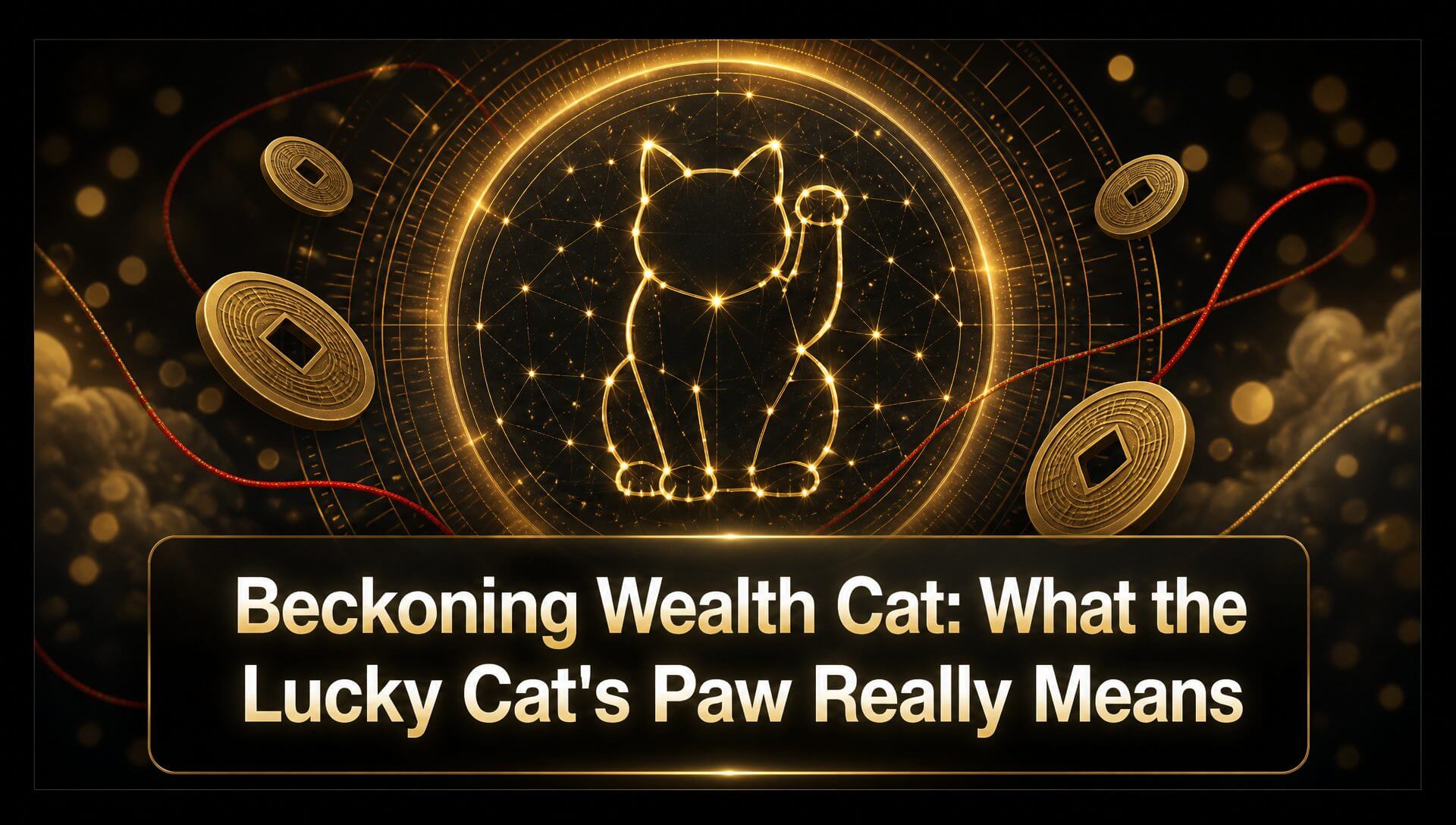
If you’ve ever picked up takeout from a Chinese restaurant or wandered the aisles of an Asian grocery store, you’ve probably spotted it: a little white cat parked next to the cash register, one paw raised, rocking back and forth. Most people figure it’s saying hello. Nope. Before you can really get to know the lucky cat, two things need clearing up. First, where it comes from. Second, what role it actually plays in the Chinese culture of seeking wealth.
That Paw Isn’t Waving. It’s Calling You In
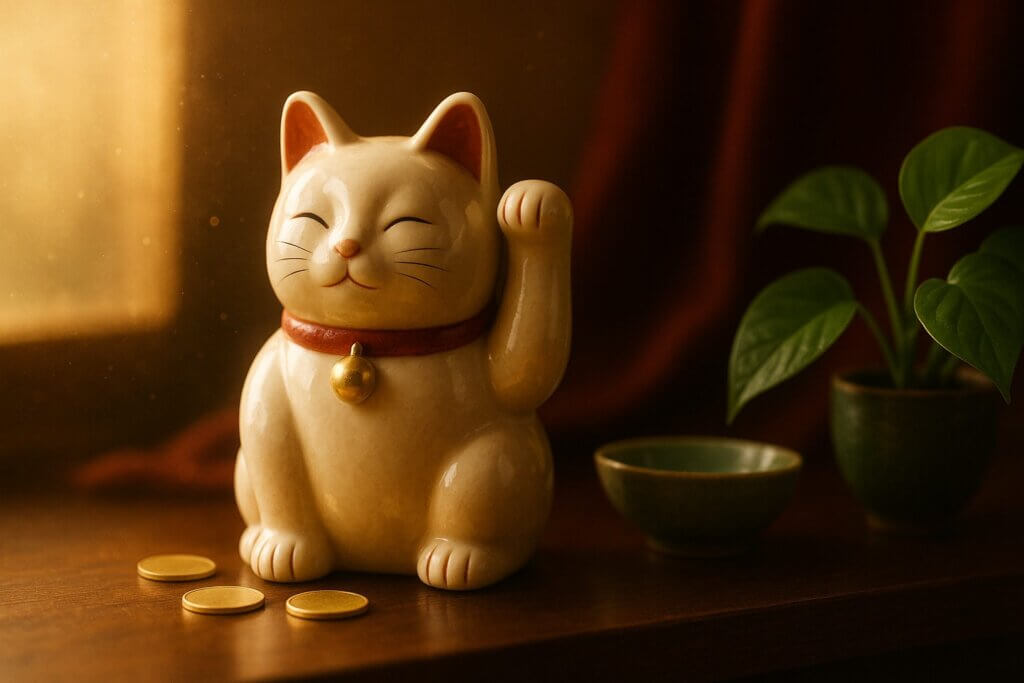
The first mix-up comes down to the gesture. In the United States, you call someone over with your palm up, curling your fingers toward yourself. In Japan and in Chinese communities, the same message gets sent with the palm facing down and the fingers flicking downward, which to American eyes looks exactly like waving goodbye. That East Asian beckoning motion is what the lucky cat is doing, and it means “come, come, come in and sit down.” The name gives it away, too: in Japanese it’s maneki-neko, which literally translates to “beckoning cat.” And here’s a fun detail. Some versions made for export to Europe and America deliberately flip the paw so the palm faces backward, so customers won’t think they’re being shooed away.
The second mix-up is about origins. Plenty of people file the lucky cat under “Chinese things,” and that’s an easy mistake to make. It was actually born in Japan, in the late Edo period, around the nineteenth century. From there it traveled with trade and migration to Taiwan, Hong Kong and Southeast Asia, and then followed Chinese restaurants and grocery stores into Chinatowns all over the world. So there’s nothing strange about finding it in a Chinese restaurant. Think of it as an immigrant, one that’s lived in its new culture for so long that everyone has gradually forgotten it came from somewhere else.
Meet the Greeter Who Stands Next to a God
To understand where the lucky cat fits in a Chinese-run shop, you first need to meet Caishen, the Chinese god of wealth. The name is a little misleading, because in Chinese folk religion Caishen is really a whole group of gods who preside over wealth. Most of them are figures from history or legend who came to be honored as gods because of the character they showed while they were alive. One was a loyal court official famous for his fairness. Another was a merchant who made a fortune and then gave it away to help others. And one was a general known for keeping his word and honoring his obligations. Merchants hold that general in especially high regard, and it’s not hard to see why: nothing matters more in business than being someone whose word is good.
Here’s the thing worth holding onto. You might expect a tradition’s gods of wealth to be “the richest people” it could find. What this tradition chose instead were people whose way of handling money was worth learning from. The lucky cat doesn’t belong to that company. Nobody prays to it, and it has no divine standing. It’s closer to a mascot, a decoration that carries a good omen. In many Chinese-run shops, you’ll see a statue of Caishen set in a home altar mounted on the wall, while the lucky cat sits on the counter facing the front door. In the traditional imagination, the god’s concern is whether you’re someone who can be trusted with wealth. The cat’s job is simpler: welcome people through the door.
Where the Lucky Cat Came From: Two Japanese Legends and One Old Chinese Saying
Ask where the lucky cat came from and you won’t get one settled answer. Japan has several competing versions, and more than one place claims to be the birthplace. Here are the two stories that have traveled the farthest. After those comes a Chinese saying more than a thousand years old, and it goes a long way toward explaining why this Japanese cat got such a quick welcome once it reached the Chinese-speaking world.
Legend One: The Cat at the Gate of a Run-Down Temple Who Beckoned a Benefactor Inside
The story is set in the seventeenth century, on the outskirts of Edo, the city we now call Tokyo. A small temple there was so poor it was barely hanging on. The abbot didn’t have enough to eat himself, and he still shared his rice with the cat he kept. One day a feudal lord, riding home from a hunt, passed the temple and stopped to rest under a big tree. He spotted a cat at the temple gate with one front paw raised, as if it were waving him over. Amused, he got up and walked toward it. He’d barely stepped away when the sky turned, and a bolt of lightning struck the very tree he’d been standing under.
The lord believed the cat had saved his life. He paid to rebuild the temple and made it his family’s ancestral temple, and from then on it prospered. When the cat died, the temple put up a statue in its honor, and that statue is said to be the original model for the lucky cat. Here’s the thing worth noticing: the good fortune in this story starts with a poor abbot who was willing to share his meal. Something is given away first and comes back only later. Keep an eye on that order of events, because you’ll keep running into it from here on.
Legend Two: The Cat in the Old Woman’s Dream
The other story belongs to an ordinary person. An old woman in Edo had grown so poor she couldn’t afford to keep the cat she loved anymore, and she gave it up in tears. That night the cat came to her in a dream and told her, “Make a figure in my likeness, and it will bring you good fortune.” When she woke up, she shaped a cat out of clay and took it out to the street to sell. The figures were a hit, and her life turned around because of them.
This version is refreshingly honest. It all but admits that the lucky cat was a small business from day one: a person with no options left found a way through with her own hands and a flash of inspiration. In this telling, wealth comes from making something other people want, not from asking anyone to hand it to you.
One Old Chinese Saying: When the Cat Washes Its Face, a Guest Is Coming
A thousand years before the lucky cat showed up, a Tang dynasty collection of notes and curiosities called Youyang Zazu (Miscellaneous Morsels from Youyang) recorded a piece of folk wisdom. The gist: when a cat washes its face and its paw sweeps up past its ear, a guest is on the way. And if you’ve ever watched a cat lift a front paw to wash, you know it really does look a lot like a cat waving someone over. The saying later made its way to Japan too, and quite a few scholars think the lucky cat’s raised-paw pose grew out of this very observation.
So when the lucky cat arrived in Chinese communities, it didn’t feel foreign to anyone. The link between a cat raising its paw and a guest showing up was already sitting in the cultural memory. And if you run a shop, the logic finishes itself: business arrives only when the customers do.
How Is a Lucky Cat Traditionally Displayed? 3 Customs and the Money Philosophy Behind Them
A lucky cat looks like a cute shelf ornament and nothing more. Traditionally, though, there’s a whole body of lore about which paw it raises, what color it is, and where it sits. You don’t have to buy that any of that lore “works.” Here’s the part worth your attention: each custom carries an idea about where money comes from, built up over generations of merchants.
Custom 1: The Left Paw Beckons People, the Right Paw Beckons Money
The most common version goes like this: a cat with its left paw raised calls in customers, and a cat with its right paw raised calls in financial luck. Restaurants, shops, and other businesses that live on foot traffic have traditionally favored the left-pawed cat. Some owners hedge their bets and set out one of each. But ask the owners of long-established shops, and many will tell you that if you can have only one, you take the one that beckons people.
The thinking behind that choice is about as practical as it gets. Money arrives by following people, and you can’t beckon money directly, so the “people” end is the only one you can actually work on. The Chinese folk tradition around Caishen runs on the same logic: what the deity is said to weigh is how you treat people and whether you keep your word. How badly you want money doesn’t enter into it. In today’s terms, take your eyes off the revenue number for a minute and ask, “Who would walk through my door because of what I do?”
Custom 2: Colors and Gold Coins, Each With Its Own Wish
The traditional lucky cat is a calico, white with black and orange patches. Male calicos are extraordinarily rare in real life, and Japanese sailors have long treated them as a sign of good fortune. A whole range of colors came later. Gold stands for wealth, black for warding off misfortune and harm, red for the wish for good health, and pink for love. The cat often clutches a koban, an oval gold coin from Japan’s Edo period, inscribed with “ten million ryo.” That sum is so wildly inflated it’s practically a joke.
All those colors reflect something people figured out very early: money is only one kind of good luck. Merchants wanted wealth, sure. They also wanted safety and an uneventful year, because a single disaster could wipe out years of savings. To pick a color, you first have to answer the question “What do I actually need most right now?” Plenty of people skip right past that question when they talk about money.
Custom 3: Facing the Door, So Wealth Can Flow In and Out
Traditionally, a lucky cat sits where it can see the entrance, usually on the counter or in the entryway, facing the direction people come in from. A greeter should face the guests, so that part’s a no-brainer. But the door means something deeper in the Chinese view of wealth. It’s a channel for movement, and wealth that comes in through it also goes out through it. In this way of thinking, only what moves counts as wealth. Money that comes in and never goes out doesn’t qualify.
There’s a Chinese folk idea worth knowing here, offered as a cultural lens on wealth and nothing like a financial rule. In folk tradition, when Caishen grants someone a share of money energy, it’s an act of trust. The expectation is that the person will use it well and then let it move on to others. People hear “sharing” and tend to picture earning $100 and donating $90. The traditional idea covers far more ground than that. Teaching a friend what you’ve learned about managing money counts, and so does volunteering your time, or helping someone younger get a start in your field. The traditional claim is that this kind of circulation snowballs, growing larger the longer it rolls. When the people you’ve helped begin to thrive, part of the benefit finds its way back to you through all sorts of channels.
There’s also a wonderfully shrewd piece of folk reasoning here. To the gods of wealth, the story goes, a person who gets rich alone is nothing remarkable, since the company they kept before becoming gods was already all wealthy people. The person truly worth “investing” in is the one who can make the people around them rich too. Take the deities out, and the statement still holds. In any industry, opportunity tends to flow toward those who leave the people around them better off. Think back to the poor abbot from earlier. The bowl of rice he shared with the cat follows the same principle.
5 Common Questions About the Lucky Cat
People who are new to the lucky cat tend to land on the same handful of questions. Which country is it actually from? Does it have anything to do with religion? Is it rude for a non-Asian person to display one? Here are the five that come up most. Fair warning: none of them gets a flat “yes” or “no.” Each answer leans on the cultural background, because that’s where the interesting part is.
Q1: Is the lucky cat Japanese or Chinese?
Japanese, and scholars don’t really argue about it. The earliest surviving records and physical examples all come from nineteenth-century Edo, and the name, the legends, and the gold coin it holds are all Japanese. The raised paw is a little more tangled. It may well trace back to a saying from Tang-dynasty China: “when a cat washes its face past its ears, guests will arrive.” That saying reached Japan very early. Then, in the twentieth century, the lucky cat made the return trip, traveling back into Chinese communities along the trade routes. Shopkeepers took to it right away and set it side by side with the homegrown Caishen tradition.
So here’s the more accurate way to put it: the cat is a Japanese invention, and today it’s a cultural symbol shared across all of East Asia. You might spot one in a Chinese restaurant, a Vietnamese pho shop, or a Thai massage parlor. Culture spreads like this all the time. A symbol that’s easy to understand and hard to dislike slips across borders without much trouble, and every place it lands gives it a local meaning. In Chinese-run shops, it got folded into an imagined division of labor: Caishen looks after the big picture, and the cat greets the customers.
Q2: Is the lucky cat a religious object? Does displaying one count as making offerings to a god?
Generally, no. Some of its origin legends involve a temple, but the cat itself has no divine status, and traditionally nobody prays to it, burns incense for it, or sets out offerings in front of it. Think of it as a cousin of the horseshoe over the door or the four-leaf clover. It’s a folk good-luck charm that carries a friendly wish, and nobody treats it as an object of faith.
Caishen is a different story. In Chinese folk religion, he’s a deity people genuinely make offerings to, with fixed festival days, rituals, and a set of expectations about personal character. The two often show up in the same shop, but the owner keeps them clearly apart: the cat is decoration, and the home altar is something else entirely. This kind of layering, where faith is one thing and a nice good-luck wish is another, is very common in everyday East Asian life. A person can believe in no religion at all and still feel that a waving cat on the counter brightens the day. No conflict there.
Q3: Why does the paw keep moving? Does it matter how high it’s raised?
The moving arm is a modern invention. Traditional lucky cats, made of pottery or porcelain, don’t move at all. Only later did manufacturers add a battery or a small solar panel to keep the arm swinging at a steady rhythm. The design got so popular in the second half of the twentieth century that plenty of people now assume the cat always moved.
As for height, the folk explanation is that the higher the paw, the farther away the good fortune and customers it calls in. That’s why some cats raise a paw past the ear, and a few stretch it comically high above the head. None of this is a rule, of course, but the picture behind it is charming. It treats beckoning as a signal that can carry a long way: the more generous your greeting, the more people hear it. Anyone who has run a shop or built a career from scratch will probably nod along. If you don’t reach out first, it’s very hard for anyone to know you’re there.
Q4: I’m not Asian. Is it disrespectful to keep a lucky cat at home or in my shop?
Generally speaking, no. The lucky cat has been a commercial product since day one. It was made to be sold, to be given away, and to be put on display. There’s nothing sacred about it, and no rule that only certain people may own one. In Japan and in Chinese communities, giving a friend a lucky cat when they open a new shop is a perfectly ordinary way to wish them well.
Where respect really comes in is how you understand it. Treating it as a cultural object with a story behind it sits better than treating it as a “mysterious trinket from the East.” And you’re already ahead of the game. You know the cat is beckoning, even though it looks like a wave goodbye to American eyes. You know it comes from Japan, even though you’re most likely to meet it in a Chinese restaurant. And you know the gold coin is stamped with a half-joking, astronomical sum. Knowing that much already means you’ve taken it more seriously than most people do. Taking the people and stories behind a symbol seriously is usually what respect amounts to.
Q5: If I don’t believe in luck at all, does the lucky cat still mean anything for me?
It does, and maybe something more interesting. Set aside the question of whether it “works.” The lucky cat and the Caishen tradition that sits beside it add up to a philosophy of money that generations of merchants have tested over and over. It just happens to come in the shape of a cat.
That philosophy boils down to roughly three points. First, people come before profit, so what you’re calling in is people, and what you’re building is trust. Second, money is only one kind of good fortune, so it’s worth getting clear on what you actually need right now. Third, wealth has to circulate in order to grow. The bowl of rice the poor abbot shared, an idea you teach a friend, an hour you spend on someone else: all of these keep it moving. In the eyes of this tradition, getting rich on your own is nothing remarkable. Wealth is said to stay most willingly with the person who helps the people around them do better too.
So the next time you see that cat on a restaurant counter, beckoning one stroke at a time, you can read it as a reminder that’s been around for several hundred years. In the East Asian tradition, money doesn’t come to those who simply guard what they have. It comes when you open the door, welcome people in, and are willing to let things flow out as well.