The BaZi Logic Behind Lucky Indoor Plants: 3 Basics to Learn First
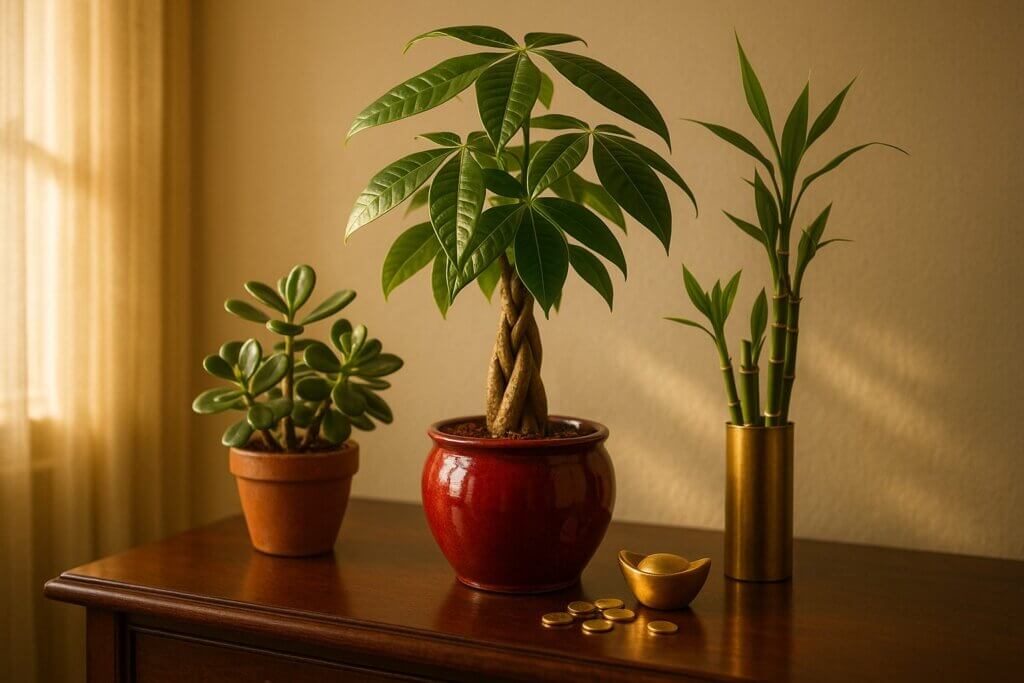
Money tree, ZZ plant, golden pothos. If you’ve spent any time browsing houseplant advice, you’ve seen all three pitched as indoor plants that attract wealth. Here’s the thing, though: seen through BaZi (the Chinese birth chart built from your birth year, month, day and hour), a plant doesn’t carry money through your front door. What it stands for is wood, one of the five elements (wood, fire, earth, metal, water). And whether wood means wealth, support or pressure for you depends on your birth chart. Get three concepts straight first, and the rest of this article, along with your own chart, will make sense.
What BaZi Is: The Chinese Counterpart to a Natal Chart
If you’ve ever pulled up your Western natal chart, you know it’s drawn from where the planets were at the moment you were born. BaZi starts from your birth time too, but it leaves the planets out of it. Instead, it converts the year, month, day and hour into two characters each, one called a Heavenly Stem and one called an Earthly Branch. Four pairs make eight characters, which is what “BaZi” literally means. In English, you’ll often see the system called the Four Pillars. Every one of those characters belongs to one of the five elements. So where Western astrology asks which sign and which house a planet falls in, BaZi asks how the elements of these eight characters feed one another and hold one another in check. The two systems run on different underlying logic. Go ahead and borrow the idea of a “natal chart” as your way in, but leave your zodiac sign’s traits at the door.
The Day Master: The Character in the Chart That Stands for You
The Heavenly Stem sitting on top of the day pillar is called the Day Master, and the entire chart is read with it at the center. It plays a role somewhat similar to the Sun in a Western natal chart, since both stand for “me,” but it’s used differently. People tend to expect the Day Master to describe their personality directly. Think of it as the origin point of a coordinate system. Whether each of the other seven characters supports you, drains you or falls under your control is worked out starting from the Day Master’s element. There are ten Day Masters in all: Jia (甲, Yang Wood) and Yi (乙, Yin Wood); Bing (丙, Yang Fire) and Ding (丁, Yin Fire); Wu (戊, Yang Earth) and Ji (己, Yin Earth); Geng (庚, Yang Metal) and Xin (辛, Yin Metal); Ren (壬, Yang Water) and Gui (癸, Yin Water). Figuring out which one is yours is step one in reading BaZi.
The Wealth Element: The Element Your Day Master Controls
The five elements include a cycle of control: wood controls earth, earth controls water, water controls fire, fire controls metal, and metal controls wood. In BaZi, the element your Day Master controls is called the wealth element. The traditional reading is that wealth is something you have to spend effort to get hold of and manage, so it stands for both the chance to earn money and the work you have to put in. No free lunch, in other words. This is exactly where lucky indoor plants get interesting in BaZi. Plants belong to wood, and wood is the wealth element only for people with a metal Day Master. For every other Day Master, wood stands for something else entirely.
3 Steps to Find Your Wealth Element and the Role of Wood in Your Own Birth Chart
Time to pull up your own chart. All you need is your birth date, and a birth time helps if you’ve got one. Set aside about ten minutes. By the end, you’ll know two things: which of the five elements is your wealth element, and what role wood plays in your birth chart. That second answer is the one that tells you what a money-drawing houseplant actually symbolizes for you.
Step 1: Cast the Chart and Find Your Day Master
Search online for “BaZi calculator” or “Four Pillars calculator.” Enter your birth date, time and place of birth, and you’ll get the Four Pillars. Find the pillar labeled Day. The character on top is your Day Master. Most tools spell out its element for you, such as Geng (Yang Metal) or Gui (Yin Water). Two things to watch for here. BaZi months follow the solar terms of the traditional calendar, so they don’t line up with the first of each month. The BaZi year has its own starting line too: it begins at the Start of Spring (Lichun) in early February, weeks after January 1. So let the calculator do the heavy lifting, and skip the temptation to work it out yourself from your Chinese zodiac sign.
Step 2: Look Up Your Wealth Element
- Wood Day Master — Jia (甲, Yang Wood) or Yi (乙, Yin Wood): your wealth element is earth
- Fire Day Master — Bing (丙, Yang Fire) or Ding (丁, Yin Fire): your wealth element is metal
- Earth Day Master — Wu (戊, Yang Earth) or Ji (己, Yin Earth): your wealth element is water
- Metal Day Master — Geng (庚, Yang Metal) or Xin (辛, Yin Metal): your wealth element is wood
- Water Day Master — Ren (壬, Yang Water) or Gui (癸, Yin Water): your wealth element is fire
Got it? Now count how many times that element shows up among the other seven characters in your chart. The Earthly Branches also carry concealed Heavenly Stems, which most tools list as “hidden stems,” and those count too. What if your wealth element doesn’t appear at all? That’s no verdict on your wealth potential. In BaZi, it’s usually read as a sign that money is a subject that doesn’t come naturally to you, so you make it up through your luck pillars or through deliberate effort. And if it appears three times or more, don’t start celebrating yet, because that doesn’t guarantee you’ll be rich either. The next section explains why.
Step 3: See What Wood Means to Your Day Master
- Metal Day Master: wood is your wealth element, standing for opportunity and resources you have to manage
- Water Day Master: wood is what you produce, standing for talent, self-expression and output
- Wood Day Master: wood is your own kind, standing for peers and partners, who are also your competitors
- Fire Day Master: wood is what feeds you, standing for learning, support and helpful mentors
- Earth Day Master: wood is what keeps you in check, standing for rules, responsibility and pressure
So here’s the takeaway: the traditional reading of the very same money tree changes depending on who owns it. For a metal Day Master, it’s a symbol of wealth itself. For a water Day Master, it’s a reminder to put your talent out into the world. Follow the chain and you’ll see why. Water produces wood, wood in turn produces fire, and fire is exactly the water Day Master’s wealth element. BaZi has a name for this pathway: the Eating God and Hurting Officer generating wealth (shi shang sheng cai). In plain terms, your work and your output are what drive your income.
3 Common Wealth Star Patterns, and What to Adjust in Each
So you’ve figured out which element is your wealth star. Now comes the question that matters more: how does its strength stack up against your Day Master’s? BaZi describes the Day Master as either “strong” or “weak.” When the chart is full of elements that support or feed the Day Master, it leans strong; when most of the chart controls or drains it, it leans weak. The three patterns below get stuck in different places, so the role a plant can play is different in each one. Think of the plant as a reminder you see every day, not the mechanism itself.
Strong Day Master, Weak Wealth: Plenty of Ability, No Channel to Cash It In
In this kind of chart, the elements that match or feed the Day Master show up everywhere, while the wealth star appears only once, or not at all. The traditional reading is that a person like this has energy to spare and strong opinions, but money tends to leak away among peers. Think of a partnership where nobody spelled out the split, a loan to a friend, or skills that never quite get noticed. Those are all typical examples. The adjustment is to open up the “output” stage: turn what you know into finished work other people can actually see. Write it down, build a portfolio, and quote your price before anyone asks.
There’s a Chinese folk idea worth knowing here — not as a financial rule, but as a cultural lens on wealth: money grows only when it’s shared. You already have words for this. It’s reciprocity, or givers gain. Teach the people around you what you’ve learned, and once resources start circulating, your relationships and opportunities begin to compound. And no, sharing doesn’t mean giving away ninety percent of your income. Volunteering your time counts, and so does passing useful knowledge along to a friend. If you keep a pothos, snipping off a cutting and handing it to a friend is about as concrete as practicing the idea gets.
Abundant Wealth, Weak Day Master: Lots of Opportunities, Not Enough Hands to Catch Them
In this kind of chart, the wealth star turns up three or four times while the Day Master stands alone with nothing backing it. BaZi generally reads this structure as someone who never runs short of opportunities. What’s missing is the capacity to carry them. They take on too many projects and launch too many side hustles, and none of them goes deep. The money that comes in goes right back out just to keep all the plates spinning. The fix is the exact opposite of the previous pattern: subtract first. Cut your income streams down to the number you can genuinely look after, then put the time you free up into whatever supports the Day Master. That means further training, a mentor, or a partner who can share the load. A plant makes a good mirror here too. Skip the lineup of ten pots and raise one well. Do you have the bandwidth to water a single plant on schedule? That’s roughly the answer to whether you have the bandwidth to take on one more project right now.
Day Master and Wealth in Balance: A Steady Structure Where Timing Is Everything
When the Day Master and the wealth star are close in strength, BaZi considers the structure one that can build wealth steadily. So where do people with this chart get stuck? On timing, since the birth chart itself isn’t holding them back. The luck pillars change every ten years, and the annual pillar shifts every year on top of that. Conceptually this works much like transits in Western astrology, and it can tip a balanced chart temporarily toward one side. A decade in which the wealth star grows heavier favors expansion. A decade in which the Day Master grows heavier favors building skills and relationships. In practice, that means taking stock once a year. Ask yourself whether your time this year is going toward expanding or toward laying groundwork, and whether that matches the direction your current cycle is pointing. The day you repot your plant makes a natural annual checkpoint.
5 Common Questions About Lucky Indoor Plants and Your BaZi Wealth Element
Once beginners look up their wealth element, the same five questions tend to show up right behind it. The first three are practical: plants, and casting the chart. The last two put BaZi back where it belongs, so you know what it can tell you and where it runs out of road.
Can I still find my wealth element if I don’t know my birth time?
Yes. Your Day Master is set by the day you were born and nothing else, and your wealth element is derived from your Day Master. With a birth year, month and day in hand, you can finish the first two steps. One group does need to be careful: people born around midnight. In many BaZi schools the day changes at 11 p.m. rather than at midnight, so if you were born near that window, your Day Master could be off by a day. Cast the chart both ways and compare the results. So what do you lose without the hour pillar? A reliable read on whether your Day Master is strong or weak. With two of the eight characters missing, it’s easy to misjudge which way it leans. Western astrology has the same problem: without a birth time you can’t calculate a rising sign or houses. BaZi works much the same way. The core is still there, but the resolution drops. If that’s your situation, treat any strong-or-weak conclusion as provisional, and don’t hang a major financial decision on it.
Wood is an unfavorable element in my birth chart. Does that mean I shouldn’t keep plants?
You can relax on this one. Wood in BaZi is a category within a symbolic system, one that covers qualities like growth, planning and reaching outward. An actual potted plant is just one of the many everyday things that category maps onto. The tradition does speak of a favorable element and an unfavorable element, meaning the elements that help balance a chart or weigh it down. But those labels describe the broad tendencies of a life, such as the kind of industry that suits you or the pace you work best at. They don’t mean that one more monstera in your living room will hurt your financial outlook. If you like plants, keep plants. For an earth Day Master, wood stands for rules and responsibility, so you could even treat plant care as a small daily exercise in discipline. Think of the plant as a sticky note to yourself. That’s a symbolic reading within the tradition, and it comes with no promise of cause and effect.
My lucky plant died. Is that a sign I’m about to lose money?
That belief does exist in Chinese folk tradition, but from a BaZi standpoint, the condition of a houseplant falls outside anything a birth chart calculates. The only data BaZi uses is your birth time, plus the passage of time through your luck pillars and the annual pillar. No step in the process factors in whether the plants in your home are thriving or dying. A plant that withers usually has a problem with light, watering or drainage. Want to take something useful from it anyway? Here’s the practical question to ask: have I been so busy lately that I forgot to water it? If the answer is yes, and you happen to be the type with abundant wealth and a weak Day Master, that’s a reminder worth noticing. The plant has no predictions to offer. Your attention is simply stretched so thin that you can’t keep up with what’s right in front of you. Take it as a nudge to look over your calendar, and leave it at that.
Is the BaZi wealth element the same thing as the second house or Venus in Western astrology?
They answer similar questions, but the mechanics are entirely different, and converting one into the other isn’t a good idea. In Western astrology, the second house speaks to your resources and your sense of worth, while Venus speaks to what attracts you and how you relate to pleasure. Both are built on planets and houses. The BaZi wealth element is defined by a relationship instead: it’s the element your Day Master controls. The emphasis falls on the idea that control comes at a cost, which means the real question is whether you have enough strength to manage the resources that land in your hands. That’s why any BaZi discussion of money also takes up how strong or weak the Day Master is, and Western astrology has no close equivalent for that. You can absolutely consult both systems. Think of them as two advisors watching you from different angles. When the two disagree, you don’t have to force them into a single answer. Read each one on its own terms, within its own system.
Can I judge my wealth potential from my Day Master and wealth element alone?
No. What this article teaches is only the first layer of the basics. Reading just your Day Master and wealth element is like looking at only the Sun and one house in a Western chart. It’s worth something, but it’s a long way from a full reading. Every character in a BaZi chart acts on the others. Earthly Branches combine and clash with one another, and a combination can change the element involved. Your birth month determines which element is in season, so the same wood character carries very different strength in a spring birth than in a fall birth. Beyond the wealth element, there are the other Ten Gods, which stand for output, rules and support, and the way they’re arranged decides which road money travels to reach you. Add the luck pillars that change every ten years and the annual pillar that changes every year, and the same chart will bring different themes to the front at different stages of life. No single character and no single one of the Ten Gods shows the whole picture. A birth chart becomes accurate only when all eight characters are read together and then read again against time.