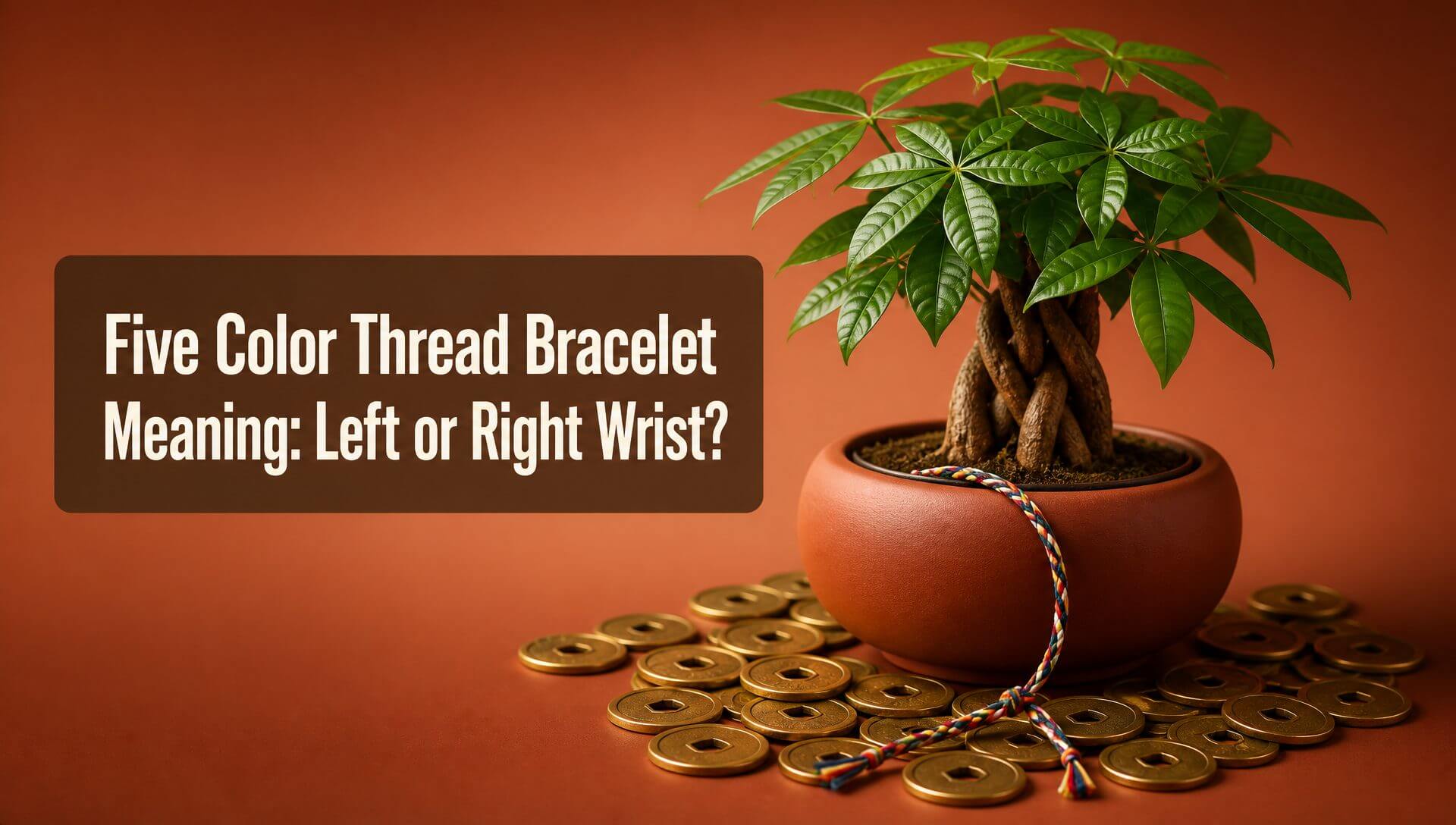
Where the Five-Color Cord and the Left-or-Right Question Come From: 2 Core BaZi Concepts to Understand First
So you went looking for which wrist a five-color cord (wu se xian) goes on, and what it’s supposed to do once it’s there. Chances are you’ve run into this Chinese folk custom somewhere and want to know what’s really behind it. Fair warning: you won’t find wearing instructions here, and nothing’s for sale. What you’ll get is a walk through the two ideas underneath the custom, the five elements (wood, fire, earth, metal, water) and yin and yang. Those same two ideas also happen to be the foundation of BaZi (the Chinese birth chart built from your birth year, month, day and hour).
The Five Colors Are Really the Five Elements: The Building Blocks of Your Birth Chart
If you’ve ever pulled up your Western natal chart, you already know the four elements: fire, earth, air and water. Some people run heavy on fire, others on water. As a starting point, you can think of BaZi as a rough Chinese cousin of the natal chart. It also builds a chart from your time of birth, but it works with five elements where Western astrology has four: wood, fire, earth, metal and water. In this tradition, each element is paired with a color. Wood is blue-green, fire is red, earth is yellow, metal is white, and water is black. The “five colors” simply gather all five elements in one place, as a symbol of completeness and balance.
That comparison only gets you in the door, though. In Western astrology, the four elements describe temperament. In BaZi, the five elements are more about how the elements act on one another. Wood feeds fire, fire creates earth, earth produces metal, metal carries water, and water nourishes wood. That’s the generating cycle. Then there’s the flip side: wood breaks up earth, earth dams water, water puts out fire, fire melts metal, and metal cuts wood. That’s the controlling cycle. When BaZi reads your financial tendencies, these generating and controlling relationships are exactly what it leans on, and you’ll see them put to work later in this article.
Where the Left-or-Right Idea Comes From: Yin, Yang, and “In” Versus “Out”
The left-or-right question traces back to yin and yang. The most common folk saying is “in through the left, out through the right”: the left side stands for receiving, the right side for releasing. There’s also a competing version that assigns the left side to men and the right side to women. Notice the problem? These sayings don’t agree with one another, and they belong to the realm of folk custom. BaZi theory itself has no rule about which side to use for anything.
So here’s the honest answer on which wrist a five-color cord belongs on, and what it does there: BaZi can’t endorse any way of wearing one. The idea of “in” and “out,” however, is well worth holding on to. When BaZi looks at your money patterns, that’s precisely what it’s looking at: how resources come to you, and how they flow back out again. So skip the wrist debate. Pull up your own birth chart and start with how the five elements are distributed in it. That’s the information you can actually work with.
3 Steps to Finding the Five Elements in Your Own BaZi Birth Chart
A BaZi birth chart starts from the same raw data as a Western natal chart: the year, month, day and hour you were born. And no, you don’t need to learn casting the chart yourself. Free online calculators handle that the second you type in your birthday. What’s actually worth learning is where to look once the chart is sitting in front of you. The three steps below will take a total beginner from a blank stare to reading their own five-element makeup in about ten minutes.

Step 1: Cast the Four Pillars and Meet Your Eight Characters
A BaZi chart is built from four “pillars”: the year pillar, the month pillar, the day pillar and the hour pillar. Each pillar holds two characters, one stacked on top of the other. The top one is a Heavenly Stem. The bottom one is an Earthly Branch. Do the math — four pillars times two — and you get eight characters, which is exactly what the name “BaZi” means. Every one of those characters belongs to one of the five elements, and most chart calculators label the element for you, either with color coding or in plain text.
Two things tend to trip up American readers. First, BaZi runs on a solar-term calendar, so the year doesn’t roll over on January 1. In most schools, the new year begins at Li Chun, the “Start of Spring,” which falls around February 4. Born in January? Your year pillar will usually belong to the previous year. Second, the hour pillar requires your time of birth, for the same reason a Western astrologer needs it to calculate your rising sign. Enter the local time at the place where you were born.
Step 2: Find Your Day Master, the Part of the Chart That Is You
Look at the Heavenly Stem sitting on top of the day pillar. That’s your Day Master, and it stands for you personally. While you’re getting your bearings, you can think of it as playing a role somewhat similar to the Sun in a Western natal chart, though its job is more central than that. What the other seven characters in the chart mean is defined entirely by how each one relates to the Day Master.
There are ten possible Day Masters. Each of the five elements comes in a yang and a yin version:
- Wood: Jia (甲, Yang Wood) and Yi (乙, Yin Wood)
- Fire: Bing (丙, Yang Fire) and Ding (丁, Yin Fire)
- Earth: Wu (戊, Yang Earth) and Ji (己, Yin Earth)
- Metal: Geng (庚, Yang Metal) and Xin (辛, Yin Metal)
- Water: Ren (壬, Yang Water) and Gui (癸, Yin Water)
So if your Day Master is Bing, you’re Yang Fire, and if it’s Gui, you’re Yin Water. Go ahead and write down your Day Master’s element now. You’ll need it later, when you go looking for your financial tendencies.
Step 3: Count the Elements, Then Weigh Strength, Not Just Numbers
Next, go through all eight characters and count how many times wood, fire, earth, metal and water each show up. Some people discover that one element is missing entirely. Others find a single element hogging three or four of the eight slots. That count is the first draft of your five-element distribution.
Hold off on drawing conclusions, though, because two details can change the picture. The first: each Earthly Branch carries Heavenly Stems tucked inside it, known as hidden stems. An element that seems to be absent on the surface may actually be sitting inside one of your branches. The second: the Earthly Branch of the month pillar marks the season you were born in, and tradition gives it more weight than any other character in the chart. A fire Day Master born in summer is read as strong even if there’s only one fire character in the chart. A fire Day Master born in winter may be read as on the weak side even with two or three. Treat the count as a clue. What BaZi really reads is strength.
Three Common Money Patterns When the Five Elements Are Out of Balance, and How to Work With Each
Once you know your Day Master, finding your wealth element takes about ten seconds. The BaZi rule is simple: whichever element your Day Master controls is your wealth. For a wood Day Master, wealth is earth. For fire, it’s metal. For earth, it’s water. For metal, it’s wood. For water, it’s fire. In traditional readings, the balance of power between the wealth element and the Day Master tends to fall into a handful of recognizable money patterns. Here are the three you’ll run into most often.
Type 1: A Weak Wealth Element, With Fewer “Contact Points” for Earning
Say your wealth element barely shows up in the chart, and the season you were born in gives it no support. BaZi typically reads this as a lower natural sensitivity to money. Does that mean a lack of ability? No. Your attention simply doesn’t default to turning things into income. The sticking point usually looks like this: you’re excellent at what you do, but you struggle to name a price or negotiate terms, or you find talking about money flat-out awkward.
The fix is to let systems do the work your instincts don’t. Three concrete things worth a shot:
- Set a written floor for your rates or your salary. Write it down before any negotiation, so you never have to decide on the spot
- Pick one fixed day each month to review where your income comes from, and treat it as deliberate practice in “seeing money”
- Team up with a partner who’s good at the business side, and let them handle the stretch you’re not built for
Type 2: Strong Wealth, Weak Day Master, With Plenty of Opportunity and Not Enough Capacity
Now flip the picture. When the wealth element is abundant and strong but the Day Master’s own element is weak, the tradition calls it cai duo shen ruo (literally “much wealth, weak self”). It’s one of the more interesting configurations to read: the money opportunities are visible and within reach, but your personal capacity to carry them falls short. You take on too many projects at once. You spread your investments too thin. And you end up getting dragged along by the opportunities when you should be the one steering them.
With this setup, chasing more opportunities is the last thing you need. Strengthen yourself first. In practice, that means focusing on only one or two income streams at a time, giving yourself a twenty-four-hour cooling-off period before any large financial decision, and putting your time into skills and relationships, the things that actually expand how much you can carry. In BaZi terms, once the Day Master is supported, wealth that used to feel like pressure becomes wealth you can use.
Type 3: Too Much of Your Own Element, So Money Comes In and Goes Right Back Out
The third pattern shows up when the chart is crowded with the same element as the Day Master, which BaZi describes as strong Friend and Rob Wealth. The traditional reading: a strong will, deep loyalty to your people, and a lot of drive. So far, so good. But those same-element stars compete for a share of the wealth element, so money arrives and leaves just as quickly. The usual culprits are stepping up to cover for a friend, partnerships where nobody spelled out who gets what, and impulse spending.
There’s a Chinese folk idea about wealth worth knowing here, not as a financial rule but as a cultural lens: money has to flow outward before it can snowball. In language you already know, that’s reciprocity, or “givers gain.” If Friend and Rob Wealth run strong in your chart, the key is to turn that outflow from an unconscious leak into conscious sharing. You don’t need to give away most of your income. What you share can be knowledge, time and introductions. Teach the people around you the money lessons you’ve learned, connect friends with opportunities, and as their lives improve, trust and opportunity come back to you the way compound interest does. At the same time, keep your basic defenses up: put every partnership in writing, and only lend an amount you can afford to lose.
5 Common Questions About Which Wrist to Wear a Five-Color Cord On, and What BaZi and the Five Elements Have to Say
Is there any basis in BaZi for the idea that a five-color cord works differently on the left or right wrist?
There are two layers to this one. The five colors map to the five elements, and left and right map to yin and yang. Both pairings come out of the same body of traditional thought that BaZi is built on, so it’s fair to say the custom has real cultural roots. Here’s the thing, though: BaZi is a system for analyzing an individual’s makeup from their time of birth. Nothing in its theory addresses which wrist you wear something on or what that would do. And the folk explanations for left versus right come in several versions that flatly contradict one another. The accurate way to put it is that this is a folk custom, not a BaZi conclusion. If the symbolism appeals to you, there’s nothing wrong with treating the cord as a reminder to keep yourself in balance. If what you’re really after is a handle on your money patterns, though, that answer lives in your birth chart. Learning where your five elements run strong and weak, then adjusting how you go about things, is what BaZi can actually offer.
I don’t know what time I was born. Can I still read my BaZi and five elements?
Yes. You’ll just be working with less information. The situation is a lot like Western astrology: without a birth time you still know your Sun and Moon signs, but you can’t calculate your rising sign or your houses. In BaZi, no birth time means no hour pillar, so your eight characters drop to six. The good news? The two most important pieces are still there. The Day Master sits in the day pillar, and the month branch, which tells you the season, sits in the month pillar. That means you can still work out your Day Master’s element, which element represents wealth for you, and roughly how strong your Day Master is. Traditionally the hour pillar is read for the later part of life and for what your efforts finally produce, so without it the reading is coarser. And in charts where the Day Master’s strength is a borderline call, the hour pillar can be the thing that tips the verdict the other way. So it’s worth a shot to ask your family, or track down your birth certificate. Depending on the state, a long-form birth certificate may list the time of birth; your state or county Vital Records office is where to check.
If my birth chart is missing one of the five elements, should I do everything I can to make up for it?
This is the most common beginner misunderstanding, hands down the one that trips up the most people. Newcomers tend to picture the goal as a full set, all five elements present and accounted for. What BaZi actually aims for is balance. The traditional approach is to identify the element a chart needs most, called the favorable element, and that’s not necessarily the one you’re missing. Take a chart born in winter with very strong water. Even if it has no metal at all, it doesn’t need metal, because metal generates water and would only add to something already in excess. What that chart more likely needs is fire for warmth and earth to hold the water back. It works the other way, too: some charts that lack an element turn out to have a cleaner structure and run more smoothly because of it. And as mentioned earlier, the Earthly Branches carry hidden stems, so the element you think is missing may not be missing at all. When you see a claim about what your chart “lacks,” put a question mark next to it first. The better questions are: Is my Day Master strong or weak? Which element would bring the whole chart closer to balance?
My BaZi results don’t match my Western natal chart. Which one should I believe?
Don’t rush to throw either one out. They’re answering different questions. Western astrology works from the positions of the planets along the zodiac, and its strength is describing psychological drives and inner needs. BaZi works from the structure of time as recorded in the stem-and-branch calendar, and traditionally it puts more weight on resources, the roles people play in your life, and the rises and dips across different stages of life. This article borrowed the idea of the natal chart only to give you a way in. The elements of the two systems don’t line up one to one, and fire in BaZi is a different animal from a fire sign. So you might be heavy on earth signs in your natal chart and have no earth at all in your BaZi. No contradiction there. In practice, treat them as two mirrors set at different angles. When both point to the same theme, say both suggest you tend to take on too much where money is concerned, that’s the signal worth dealing with first.
Can I judge my wealth potential just by counting how many of each element I have?
No. Counting elements only gets you through the front door. The three types described in this article are a simplified model meant to give you a sense of direction, and a real assessment is far more involved. The same wealth element means something different in the year pillar than it does in the hour pillar, and the outcome changes again depending on whether the characters next to it generate it or control it. Beyond the chart fixed at birth, BaZi also has luck pillars that change every ten years and the annual pillar that shifts each year, somewhat like transits in Western astrology. A chart with a weak wealth element that moves into a luck pillar supporting that element is traditionally read as capable of a very different financial showing. So keep this in your back pocket: no single character and no single element shows you the whole picture. A birth chart has to be read with all eight characters taken together, then layered with the luck pillars and the annual pillar, before the reading holds up. What you’ve learned so far is how to read the first layer of the map.