Meet Caishen First: 3 Basic Ideas About the Chinese God of Wealth
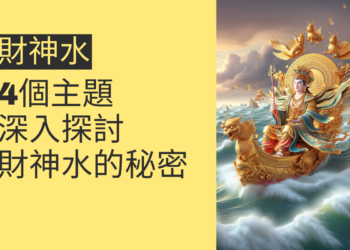
If Chinese folk religion is brand new to you, “god of wealth” probably sounds like a job title — the deity in charge of money. That’s not wrong. It just skips the most interesting part. In this tradition, Caishen, the Chinese god of wealth, isn’t a wishing well, and he isn’t a magician pulling cash out of thin air. He works more like an observer, an auditor, or even an investor. Before any of the customs and stories that follow will make sense, three things need to be clear: what Caishen actually governs, why there’s more than one of him, and where he sits in the larger cast of gods in Chinese folk religion.
1. Caishen Governs Money Energy, Not Money
This is the central point, and the one people most often get backwards. What Caishen is said to hand out is money energy — the idea that wealth behaves like a current rather than a pile. Not cash, in other words, but something closer to opportunity, useful people, good judgment, and the degree to which others trust you. It’s a state in which money becomes easier to make. Think of it as the fertility of the soil rather than the fruit. On rich ground, almost anything you plant takes hold; on poor ground, you can scatter all the seed you want and still bring in a thin harvest.
So in this framework, a sudden lottery win isn’t described as Caishen granting someone an enormous supply of money energy. What earns that description is subtler: you start meeting the right collaborators, you begin recognizing opportunities for what they are, you make the right call at the moment it counts. This also explains why nobody in the tradition expects money to just show up once the offerings are done. Between money energy and actual wealth lies a stretch of road you still have to walk yourself. The gods supply the conditions. The outcome is your department.
2. Caishen Is More Than One Figure: The Civil and Martial Gods of Wealth
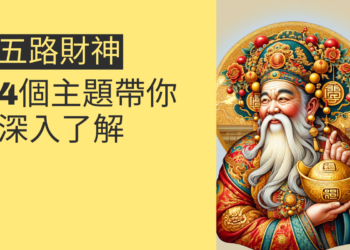
Here’s the thing that trips up most newcomers: Caishen isn’t a single character but a collective name for a whole group of figures. Folk tradition sorts them roughly into two camps, the civil god of wealth and the martial god of wealth. Nearly all of them started out as real historical people or figures from legend, and only later were elevated to divine status — which makes them pretty different from, say, the Norse gods, who were gods from the opening line.
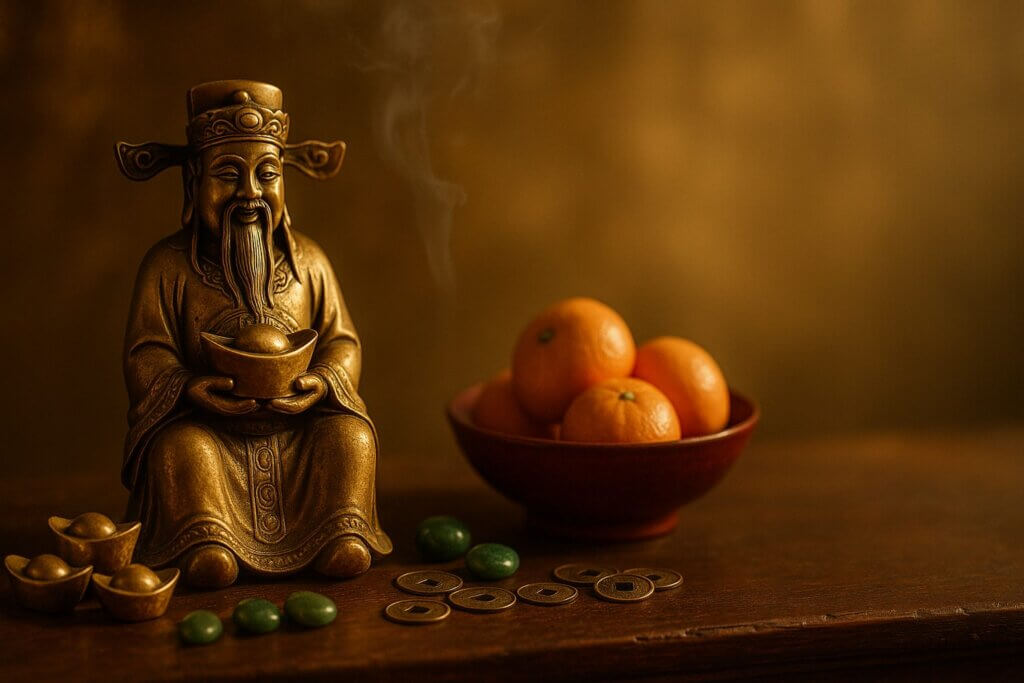
The civil god of wealth is associated with management, financial sense, and business acumen. He’s depicted as a scholarly figure, and he stands for wealth built through intelligence and good character. The martial god of wealth appears in armor with a whip in hand, a general rather than an administrator, and he stands for protection, for putting down threats, and for holding on to what you’ve earned in a cutthroat environment. Merchants have traditionally honored both, on the logic that making money takes brains while keeping it takes muscle. That division of labor between offense and defense is worth noticing on its own: this culture recognized very early that earning wealth and hanging onto it are two entirely separate skills.
3. Where Caishen Fits: The Gods Who Live Close to Daily Life
Chinese folk religion has a distinctive feature — the gods have assigned portfolios, and those portfolios are strikingly domestic. Tudigong, the local earth god, looks after the safety of a particular patch of land. The kitchen god watches over a household’s daily routines and the conduct of the people in it. Individual trades and professions have patron deities of their own. Caishen runs the wealth desk in that same network. He isn’t a supreme creator, and he doesn’t handle the grand questions like the origin of the universe. He’s stationed on the layer of the cosmos that presses right up against ordinary life.
That structure of divided responsibility makes the whole system feel less like one-way devotion and more like an orderly institution. People believe their behavior is seen, recorded, and assessed — what you did this year, how you treated others, whether you kept your word, all of it feeding into how things go for you later. Once you’ve got that underlying setup, you’ll notice something about the customs described below: not one of them is arbitrary.
Where Does Caishen Come From? Three Figures Whose Stories Everyone Knows
Here’s the most interesting thing about Caishen, the Chinese god of wealth: almost every version of him started out as an actual person with an actual life story. Before these figures became gods of wealth, they lived through war, betrayal, ruin, and starting over from nothing. So when people elevated them to preside over money, they were making a value judgment — this is the kind of character that deserves to be in charge of it. The three below are the most widely told versions, and you’ll notice something about all of them. Not one is remembered for being rich. Each is remembered for something else entirely.
1. Zhao Gongming, the martial god of wealth: from the battlefield to the back of the shop
In folk tradition, Zhao Gongming cuts an imposing figure — a dark-faced, heavily bearded general riding a black tiger and carrying an iron whip. His story exists in many versions, but the main thread runs like this: he began as a practitioner of the Dao, got pulled into a great war between gods and demons, was defeated and killed, and was afterward elevated to divine rank. One of his duties became overseeing the circulation of wealth in the human world, with several subordinates under him handling different faces of it — attracting money, bringing in treasure, gathering valuables, turning a profit.
What’s worth sitting with is why anyone would put a warrior in charge of wealth. The traditional reading goes like this: money doesn’t only need to be made, it needs to be defended. Business brings predatory competition, fraud, broken agreements. What a merchant fears most usually isn’t failing to earn — it’s watching what he built get taken from him. The martial god of wealth carries exactly that feeling: I need someone to hold the line for me. The whip in his hand isn’t for seizing anyone else’s money. It’s for keeping the share that’s rightfully his.
2. Bigan, the civil god of wealth: no heart, therefore no favoritism
Bigan was a high official near the end of the Shang dynasty, known for blunt, fearless counsel. The legend holds that he kept remonstrating with a dissolute king until the king had his heart cut out. That brutal ending got transformed by popular imagination into something remarkable — because he has no heart, he cannot play favorites when he distributes wealth.
It’s wisdom that borders on gallows humor. People understood perfectly well that the great problem with how wealth gets handed out has always been partiality: who knows whom, who put in a word for whom. So they picked a man with no heart to be their god of wealth, as a way of stating a wish — that money might flow according to what you actually did, not who you happen to know. You don’t have to believe the legend, but it’s hard not to admire the design of the symbol. It amounts to an ordinary people’s collective vote on the subject of fairness.
3. Fan Li, the civil god of wealth: three fortunes given away, three fortunes rebuilt
Fan Li lived during the Spring and Autumn period. He first served the king of Yue, helping him restore his kingdom — and then, with the victory won, he walked away from the center of power and became a merchant instead. Turns out he was extraordinarily good at it, and he built a staggering fortune. But that’s not what people remember. Three times in his life he gave his wealth away to the poor and to friends and family, and three times he earned it all back on his own. The phrase for it is “three times gathered, three times scattered.”
Fan Li became a civil god of wealth for reasons that have nothing to do with how much money he had. He proved a point — what’s actually valuable isn’t the pile, it’s the person capable of building the pile again. Giving the fortune away held no terror for him because the earning ability and the character behind it were still intact. This story became the source of the central idea running through the whole culture around the gods of wealth: money is supposed to move, and you can afford to let it go out because you know it comes back.
What People Traditionally Do, and the Three Ideas Underneath
Before we get into the customs, one thing needs saying plainly: what follows is a description of what people traditionally do and why they do it, not a set of instructions for you. The outward forms — lighting incense, setting out offerings, picking an auspicious date — may not mean much to someone who doesn’t believe any of it. But underneath each form sits a judgment about how wealth actually behaves, and those judgments hold up surprisingly well under modern scrutiny. The ideas are what’s worth taking with you. The gestures are optional.
1. Why Everything Circles Back to Circulation
There’s a Chinese folk idea worth knowing here — not as a financial rule, but as a cultural lens on wealth. Traditionally, people understood Caishen entrusting you with money energy — the idea that wealth behaves like a current rather than a pile — as an act of trust, the way an investor hands capital to a trader they believe in. What he’s understood to expect in return is that you use it well and keep it moving outward. Put plainly: the money energy is shared with you so you’ll go do more good with it and build up more merit. Whether or not that energy has turned into actual cash yet, the expectation is the same — pass along what you received, and it compounds.
One common misreading is worth clearing up. Sharing doesn’t mean that if you make a hundred dollars, you’re on the hook to give away ninety. What this framework is after is movement, and the forms it accepts are wide. Telling a friend about a good idea you picked up counts. Giving your time as a volunteer counts. The point is simply that you aren’t a pond with an inlet and no outlet.
The kind of sharing traditionally held in highest regard is passing on the useful knowledge you’ve gained from this tradition to the people around you, so they get better off too. Because their improvement came through you, some portion of that money energy is understood to cycle back your way. And when Caishen sees your money energy multiplying, the thinking goes, he adds to your allocation — after all, a dollar placed with most people might return fifty cents, while a dollar placed with you returns ten. The logic hasn’t aged a day. Someone who reliably makes the people around them better off is going to end up with more resources routed their way.
2. Why Trustworthiness Outranks Cleverness Here
Look at the traditions surrounding Caishen and you’ll notice how relentlessly they hammer on honesty: don’t shortchange customers on weight, do what you said you’d do, keep clean books, pay back what you owe. Settling every debt before the new year has long been a serious priority in Chinese communities, on the belief that crossing into a new year still carrying what you owe drags on your fortunes for the twelve months that follow.
What’s underneath that is a very hardheaded observation. In an era with no credit bureaus and no credit scores, your reputation was your entire line of credit. Keep your word and people will extend you goods, go into business with you, send customers your way. Break it once and the whole street knows by dinnertime — and you’re finished. Casting reliability as a matter of “wealth luck” was a way of translating a slow, abstract, long-run effect into language anyone could act on. The tooling has changed since; the mechanism hasn’t. Whether people are willing to work with you again is still one of the biggest assets you have.
3. Why Getting Rich Alone Doesn’t Impress
There’s a clear-eyed judgment embedded in this tradition: from Caishen’s perspective, a person who is merely personally wealthy isn’t especially interesting. Before they became deities, these figures moved among the wealthy as a matter of course — they’ve seen plenty of money. What earns real regard is the person who brings others up with them, because that kind of money energy spreads and replicates. The return profile is entirely different.
Drag that idea into the present and you’ll see it’s really sorting people into two camps. One treats wealth as a pie of fixed size, where every bite someone else takes is a bite off your plate. The other believes the pie can get bigger, and so is glad to teach, glad to make introductions, glad to see other people earn. Over a long enough stretch, the second type accumulates more people and more opportunities around them — and that requires no supernatural explanation whatsoever.
So whether or not you believe there’s a god of wealth keeping score, the vantage point this tradition preserves is worth borrowing. Treat wealth as a resource placed in your hands rather than a trophy to be stockpiled. Make “how many people did I help do better” one of the yardsticks you measure yourself by. A culture that insists money should circulate, should be fairly earned, and should travel with a good name is really saying something pretty ordinary: money gathers around the person who treats it well and treats people well.
Five Questions People Ask Most About Caishen
When you run into an unfamiliar culture, the useful stuff is rarely the beautiful stories. It’s the questions you feel a little awkward asking out loud. The five below are where American readers with no background in Chinese folk religion tend to get stuck. Answering them isn’t about talking you into believing anything. It’s about showing you what people inside this tradition are actually thinking, and letting you decide whether any of it is worth taking with you.
Q1: Is Caishen treated as a literally existing god, or as a symbol?
Both. And the two coexist in the same community without anybody finding it weird. That’s one of the sharpest differences between Chinese folk religion and monotheistic traditions. Some people sincerely believe Caishen exists, responds, rewards, and withholds. Plenty of others treat him as a cultural symbol and a psychological ritual — an annual nudge to keep your word, work hard, and share what you have.
Here’s the thing that matters more: folk religion has no strict doctrinal system and no belief threshold you have to clear for it to count. It works more like a living culture, a blend of historical figures, moral lessons, and everyday habits. So a committed atheist can understand it and even admire it — the same way you don’t have to believe Odin is real to read Norse mythology and come away with a clear picture of how one culture thought about courage and fate. The value judgments Caishen traditions carry and the question of whether you believe in him are two separate things.
Q2: So does making offerings to Caishen actually make people rich?
Even in the most traditional telling, no — at least not as direct cause and effect. As covered earlier, the logic is that what a deity supplies is money energy: opportunity and conditions, not cash. Turning money energy into actual wealth still takes your judgment, your effort, and your willingness to carry risk. No traditional version of this tells you to light incense and then head home and wait for the money to roll in.
If the ritual does anything, the more credible explanation is psychological. Once a year, you formally stop and take stock — your finances, your commitments, who you owe and who you’ve helped. That kind of scheduled self-review has value on its own terms. So instead of asking whether making offerings will make you money, the tradition would rather put a different question to you: have you become the kind of person other people would trust with resources?
Q3: How is Caishen different from the Japanese lucky cat or the Western goddess of fortune?
The big difference is whether there are strings attached. Lucky cats and fortune goddesses are mostly about luck arriving. Luck is random by nature and owes you no explanation — you can’t turn yourself into someone Fortuna favors more, and that’s exactly the appeal.
Caishen is set up completely differently. He’s imagined as a distributor with judgment, almost an investor: he looks at your character, your credit, whether you pass along what you’ve received, and then decides whether to put more in. That means the whole arrangement has a feedback loop — your behavior shapes the outcome. So this isn’t really praying for luck. It’s closer to a long-running performance review. It’s also why stories about Caishen are packed with moral lessons: in this worldview, wealth was never a random event.
Q4: Do you need incense, offerings, and specific dates for it to count?
Traditionally those forms exist, and they’re taken seriously. There are particular days during the lunar new year for welcoming the god of wealth, offerings get chosen for their auspicious meanings, and business owners often rearrange their shop displays and settle their books at certain points in the year. The forms carry a sense of occasion, and they turn something abstract into something you can actually do.
But the forms were never the point. What this culture actually measures is how you conduct yourself and how you do business day to day — whether you cheat, whether you keep your agreements, whether you helped someone out when you had room to. You’ll barely find a traditional story where somebody got rich because the offerings were unusually lavish. What you find instead, over and over, is someone who was decent to people and saw it come back around later. If you’re going to take one thing from this, take that, not any particular arrangement of objects.
Q5: What gets misunderstood most in this way of thinking?
Two things, mainly. The first is treating sharing as writing checks, big ones at that. As noted earlier, what this idea asks for is circulation, not self-emptying. Sharing something that saves a friend a costly detour, or spending your time helping someone out, sits squarely inside it. Narrow it down to a dollar figure and you lose the original meaning.
The second misunderstanding is treating it as a transaction — I put in this much, so I’m owed something of equal value back. But in this logic, you share not to cash in a claim, but because you’ve already been entrusted with something, and circulation is simply the correct way to use it. The return is a natural result of the cycle, not a term you negotiated. Once you can tell those two apart, you’ve genuinely understood what Caishen culture is getting at: it was never about how to ask for wealth, but about what kind of person someone has to become before wealth is willing to stay with them.