Who Is the Heavenly Official Martial God of Wealth? Three Ways In
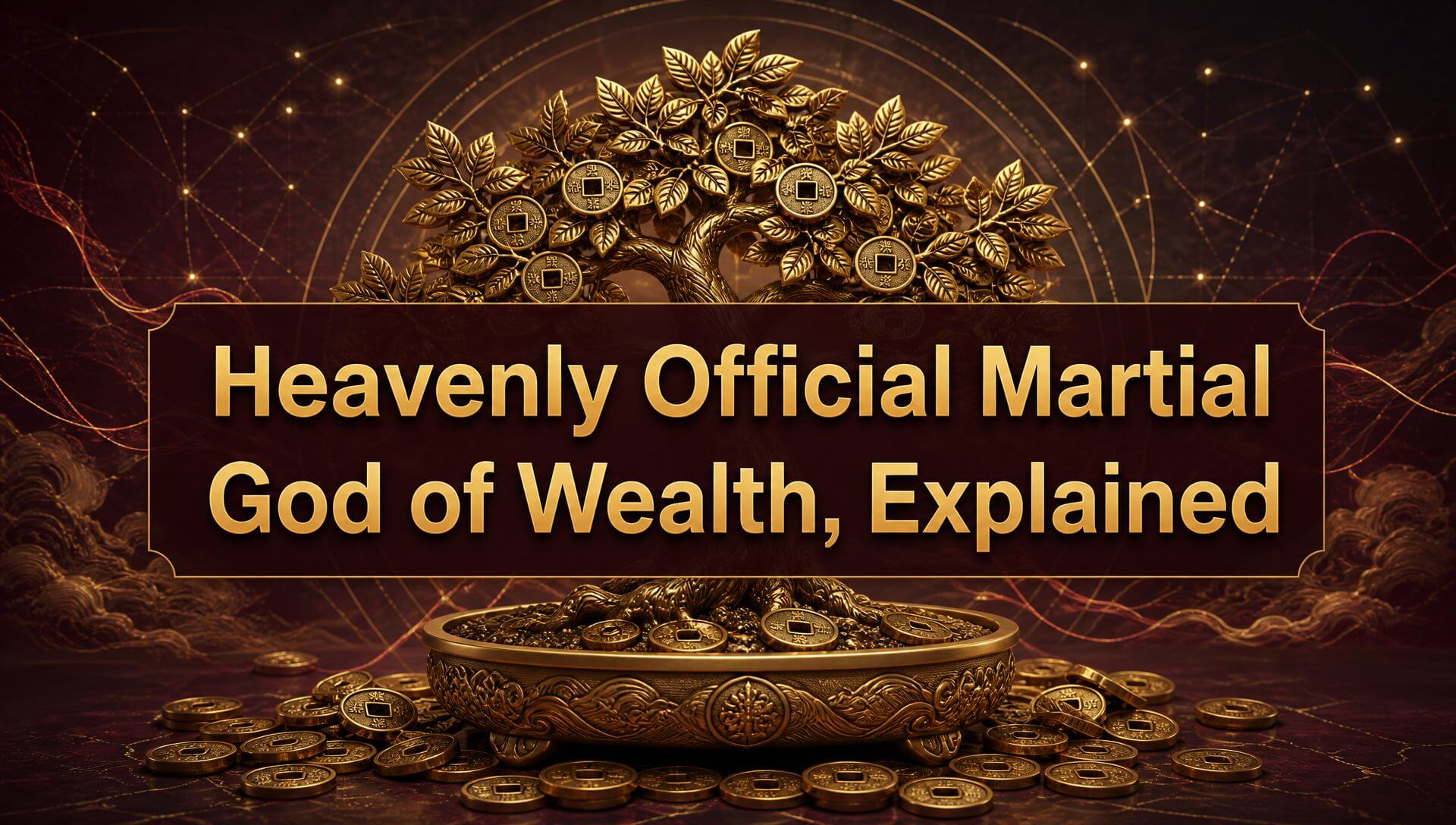
If you’re running into the name “Heavenly Official Martial God of Wealth” for the first time, your gut probably says: cosmic ATM. That’s about half right. In Chinese folk religion, wealth was never imagined as a lottery list — it’s a whole cluster of ideas tangled up with trust, character, and the way things move between people. So here’s a better way in. Set the wish-and-receive framework aside and come at him from three angles instead: where he sits inside the larger system of belief, what his name is actually saying, and what he’s understood to be responsible for.
1. He isn’t the only god of wealth — he’s one position in a whole system
Chinese folk religion doesn’t work much like a monotheistic faith. It looks a lot closer to a vast bureaucracy. Heaven has departments, job titles, and ranks, and different deities handle different portfolios — one oversees examinations and official rank, another safe passage at sea, another the boundaries of a single village. Caishen, the Chinese god of wealth, is likewise not one figure but a whole set of roles, which tradition sorts into two broad categories: the civil god of wealth and the martial god of wealth.
The civil god of wealth is generally associated with the more clerical side of money — managing it, drawing a salary, earning honestly. The martial god of wealth carries a guarding, defending character instead, and is understood to fend off losses that shouldn’t happen and hold on to assets you already have. The Heavenly Official Martial God of Wealth belongs to that second group, but those first two words, “Heavenly Official,” add something. He isn’t merely a folk warrior standing watch over your money; he’s been placed at a higher rank in the celestial court. Picture a figure who is enforcer and grantor at once — he protects your wealth, and he also decides whether money energy — the idea that wealth behaves like a current rather than a pile — gets handed to you in the first place.
2. What “Heavenly Official” and “martial god of wealth” each mean
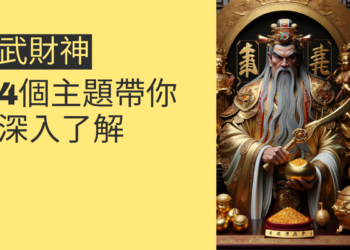
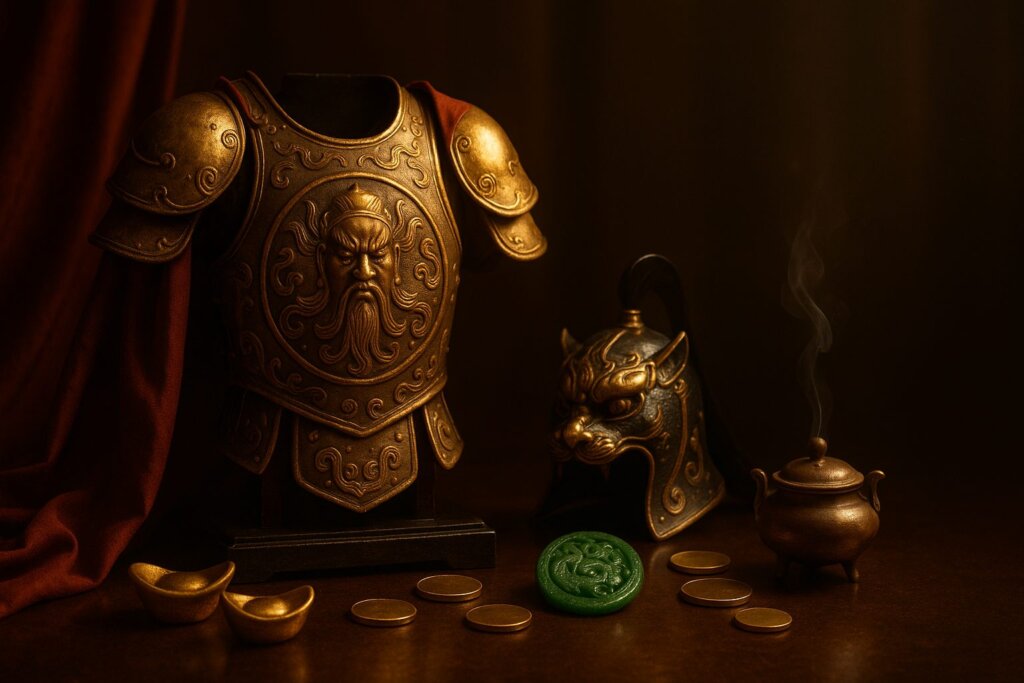
Pull the name apart and it gets much clearer. “Heavenly Official” is traditionally tied to the granting of blessings — a position that carries a sense of favor and of recognition. What he gives isn’t cash; it’s an opening, a form of being deemed trustworthy. The “martial” in martial god of wealth refers to the bearing and protective force of the image: deities of this kind are usually depicted in armor, holding a whip, mounted on a fierce beast. Nothing about the face is gentle.
The combination reveals a pretty sharp cultural intuition: wealth has to be granted, and it also has to be held. Favor without a guard and money arrives only to drain away. A guard without favor and you have no starting resources at all. The Heavenly Official Martial God of Wealth folds both jobs into a single figure — an entire set of observations about money, delivered through one deity’s iconography.
3. What he governs is money energy, which isn’t quite the same as money
Folk religion has a key term here, cai qi, that resists a clean translation — money energy. It isn’t cash. It’s more like momentum toward earning, a density of opportunity, the frequency with which helpful people turn up. In today’s language, it lands somewhere near luck plus network plus the degree to which you’re trusted.
Within this framework, what the Heavenly Official Martial God of Wealth actually distributes is money energy, not bills slipped into your pocket. Converting money energy into real wealth still runs through your own judgment, effort, and choices. That’s also why you’ll traditionally hear very little about making offerings to get rich, and a great deal about how the god of wealth looks at the person — because what he hands out is a form of trust, and trust gets observed, tested, and sometimes taken back.
From Man to God: The 3 Turns That Made the Heavenly Official Martial God of Wealth
Here’s something that surprises a lot of American readers: almost every Chinese god of wealth started out as a person. That’s one of the more distinctive features of Chinese folk religion — the gods are rarely abstractions that simply exist. Most of them were once alive, did something people remembered, and got elevated into divinity over generations. The Heavenly Official martial god of wealth traveled that same road. He began as a figure with a distinctly military character, slowly picked up responsibility over wealth, and eventually got written into the rank sheet of the celestial bureaucracy. The evolution itself tells you a lot about how people in earlier centuries thought about money.
1. How a Man Who Led Troops Became the God Who Handles Money
The most widely told version traces the martial god of wealth back to Zhao Gongming. In the earliest stories, nothing about him has anything to do with money. He’s a figure of force and suppression instead — black-faced, heavily bearded, carrying an iron whip, riding a black tiger, charged with waging battle and driving off malevolent spirits. There are many versions of the story. Some say he was a recluse who cultivated the Way in seclusion; others say he fell in a great war between gods and demons and was granted his title afterward. The details contradict each other, but they agree on the sequence: first he was a man who could fight, and only later did he become the god who manages wealth.
That order is worth sitting with. Wealth in premodern society was wildly unstable — bandits, war, taxation, natural disaster, any one of which could take a family to zero overnight. In that world, the first thing people wanted from wealth wasn’t “more of it” but “keep hold of what I have.” So the figure whose job was protection became the natural candidate to be handed the money portfolio. The warrior image of the Heavenly Official martial god of wealth is, in a real sense, the collective insecurity of an agricultural society projected onto a god.
2. The Step Where “Granting Blessings” and “Guarding Wealth” Merged
Later versions of the legend gave this god a fuller job description: not just standing guard, but presiding over fair dealing, settling disputes, and making sure the people who deserved to earn actually earned. At that level he’s no longer just a guard — he’s become something closer to an arbiter. And it’s at this stage that the title “Heavenly Official,” which carries the sense of an office in the celestial bureaucracy and the power to bestow blessings, got folded in, producing the Heavenly Official martial god of wealth we know today.
Put another way, the name wasn’t there at the beginning. It accumulated across several centuries, layer by layer, in popular practice. Each new layer reflected what people had newly come to want — first someone to stand guard, then someone to enforce fair play, and finally someone willing to hand you an opportunity unprompted. The shifting portfolio of a god is really a record of ordinary people’s wishes.
3. Why the Stories Emphasize Fairness Rather Than Generosity
Read the details of these legends and one theme keeps surfacing: this god is described as fiercely committed to fairness and severe with deception and broken promises. In the stories he’s repeatedly the one who determines who deserves to receive and who doesn’t — not the one handing things out to whoever happens to be standing there.
That reveals something pretty practical about how earlier generations saw the world. If wealth were handed out at random, all the effort a society puts in would be meaningless. So the god of wealth they built had to have standards. Those standards land on roughly a few things: whether you deal honestly in business, whether you keep the promises you make, and whether you give something back once you’ve earned. The god’s severity is really a society setting a moral floor for itself — just phrased in a form that’s a whole lot easier to remember.
What People Traditionally Do: Three Customs and the Thinking Behind Them
Here’s where we get into how people have traditionally interacted with the Heavenly Official martial god of wealth. One thing up front, and it matters: everything below describes what people have long done. It’s not a suggestion that you do any of it. If you don’t believe in gods at all, the gesture isn’t the interesting part — the reasoning underneath each one is, and that reasoning holds up just fine once you take the deity out of it.
1. Start with Cleanliness and Placement: Treat “Being Ready to Receive” as Real Work
Traditionally, when a family or a shop sets up a home altar, people get particular about two things: how clean the space is and where the altar goes. Not facing clutter. Not shoved into a dark corner. Not left to gather dust. The big cleaning that happens before the New Year is, in part, preparation for welcoming the god of wealth. Some families set out fresh water, fruit, and pastries on certain days, though the specifics shift from region to region, and there’s no single standard.
Strip away the religious shell and the custom is really saying that order comes before opportunity. You don’t make good financial decisions in a chaotic environment, the same way you rarely close a deal across a desk buried in junk mail. The tradition takes an abstract demand for self-discipline and, by way of “the gods like a clean space,” turns it into something concrete you can actually do. That’s folk wisdom at its best: it takes a principle nobody can stick to and packages it as a habit you perform once a year without thinking twice.
2. Repaying the Vow and Keeping Your Word: Why Tradition Takes “Do What You Said” So Seriously
There’s a distinctive step in Chinese petitioning called huan yuan (repaying the vow). When people ask for something, they often promise something in return — to come back and give thanks, to perform some good deed. And the traditional view is that the unforgivable thing isn’t asking for too much. It’s getting what you asked for and then not honoring the debt. In folk practice that’s treated as serious business, a breach of trust.
You can read the whole arrangement as a credit system. What the Heavenly Official martial god of wealth extends is money energy, which works like a line of credit: keep your word and the limit goes up, break it and the limit gets pulled. The parallel to how the real world runs is almost uncanny. A bank looks at your repayment history. A partner looks at whether you delivered last time. An investor looks at whether you did what you said you’d do. People centuries ago had no credit scores, but through huan yuan they taught the same lesson for hundreds of years.
3. Money Energy Has to Move: Why “Sharing” Is Considered the Best Return
This is the heart of the whole idea, and it’s also the piece people most often get backwards. The traditional account goes like this: the god of wealth is willing to share money energy with you because he wants you to use the resource well and pass some of it back out through good works. You share what you received, and only then does the money energy compound. Plenty of people hear that and assume it means earning a hundred dollars and giving away ninety. That isn’t what it says.
What gets emphasized is the movement of the energy, and sharing takes a lot of different forms:
- Passing along the genuinely useful ideas you’ve picked up to the people around you
- Being willing to spend time volunteering and investing in the community you’re part of
- Offering experience, opportunities, or introductions to someone who’s just starting out
The form of sharing tradition rates highest is handing on the knowledge that improved your own situation, so that the people close to you get richer too. The logic here is thoroughly practical: because they got there through you, some portion of that cycle comes back around to you — and when the god of wealth sees your money energy compounding, he keeps raising his stake. Put a dollar into most people and you get fifty cents back. Put a dollar into you and you get ten.
One more line is worth holding onto: from the god of wealth’s point of view, getting rich yourself isn’t especially impressive. Before they became gods, these figures already moved among wealthy people all day long. The person worth investing in is the one who can make other people rich too. That’s really a premodern version of network-effect theory — value isn’t in how much you’ve stockpiled, it’s in how many people are better off because of you, because that’s the part that keeps flowing back.
5 Common Questions About the Heavenly Official Martial God of Wealth
Here’s what people usually want to know when they first stumble into this topic. The answers stick to how these ideas are understood culturally, not to telling you what to believe or what to do. Whether you buy any of it is your call — but a set of ideas that’s been circulating for several hundred years is usually worth a look on its own terms.
How is the Heavenly Official Martial God of Wealth different from other wealth deities?
The differences come down to what each figure is understood to handle and the temperament he projects. The civil god of wealth leans toward steady, predictable money — a paycheck, sound money management, earnings from legitimate business — and he’s usually depicted in the dress of a civil official, mild and composed. The martial god of wealth carries the coloring of a guard and a defender, and he’s traditionally read as the one who handles the “hold onto it, keep threats out” side of things. The imagery matches: an imposing figure, often shown with a weapon and riding a fierce animal.
What makes the Heavenly Official Martial God of Wealth distinctive is that his title carries both halves at once — the blessing-granting sense of “Heavenly Official” and the protective sense of “martial god of wealth.” That gets him understood as a figure who can both hand out opportunities and guard what you already have. Worth noting, though: folk religion never sorts itself as neatly as a textbook. Different regions use different accounts, different titles, and different divisions of responsibility, and they contradict each other constantly. That’s a feature of how folk tradition grows organically, not a sign that somebody got the story wrong.
I’m not Chinese and I’m not religious — is it wrong for me to take an interest in this?
Not at all. Folk religion isn’t a closed system of doctrine. It works more like an inherited philosophy of daily life, one that uses stories and rituals to make abstract ideas concrete. You can treat it as a window into how another culture thinks about wealth, the same way you can read Norse mythology without worshiping Odin, or keep a Japanese lucky cat on your desk without converting to anything first.
Chinese attitudes toward these customs vary enormously, too. Some people take part devoutly, some treat it purely as a family tradition around the holidays, and some just find it interesting. That flexibility is already built into the culture. As long as you’re not making fun of what other people sincerely believe, and you come at it with curiosity, you’re on solid ground.
Does the tradition really claim that making offerings gets you money?
Most people who engage with these ideas seriously don’t read them that way. As noted earlier, what the Heavenly Official Martial God of Wealth is understood to distribute is money energy — opportunities, momentum, how often the right person shows up — not cash placed in your hand. Turning that into actual wealth still has to run through your own judgment, your own actions, and your own choices.
More to the point, the god of wealth in the traditional stories is a stern figure far more than a generous one, and what he’s said to care about is honesty, fair dealing, and giving back. So the truer version of the idea is closer to “the god of wealth judges the person” than “make an offering and you’re covered.” You can read the ritual as a form of periodic self-calibration: a prompt to check whether you’ve kept your commitments, whether you’ve done business straight, whether you’ve passed some of what you received back out again. That yearly stocktaking does its own work, and it needs no supernatural explanation at all.
Why does this framework hold that giving things away brings more back?
Because in this framework wealth is imagined as something that flows rather than something solid you can pile up. Standing water goes stagnant; moving water stays clean. That’s roughly the logic behind the money energy metaphor. When you share resources, knowledge, or time, you create a positive cycle around yourself, and that cycle compounds the way a snowball picks up mass rolling downhill.
One common misreading is worth clearing up, though: sharing here has never meant donating away most of your income. The forms it takes are broad — passing a useful idea to a friend, putting time into a community, giving somebody a hand when they’re getting started. All of it counts. The tradition goes further and holds that a person who makes other people rich is a better bet than a person who only gets rich himself, because that’s the kind of thing that keeps coming back and keeps growing. In modern terms, this is an intuition about networks and reciprocity — givers gain. The older version just phrased it from a god’s point of view.
What can someone who doesn’t believe in any of this take from it?
A fairly useful mirror. Underneath the deity, this tradition is making a few claims with nothing supernatural about them: wealth needs structure to land in, needs credit and reputation to accumulate, needs to circulate before it can grow — and the measure of a person isn’t only how much they hold, but how many people are better off because of them.
You don’t have to believe there’s a whip-carrying figure riding a tiger somewhere overhead to sit with these questions: Do I actually treat my commitments as binding? Does any part of what I earn make its way back into the circles I belong to? Am I holding knowledge and opportunities close, or am I willing to pass them along? None of that requires a single article of faith, and almost nobody answers it honestly. Centuries ago, people used a stick of incense, a fulfilled vow, and the image of a stern god to reserve themselves one occasion a year to ask — and that may be the most practical thing this tradition has to offer.