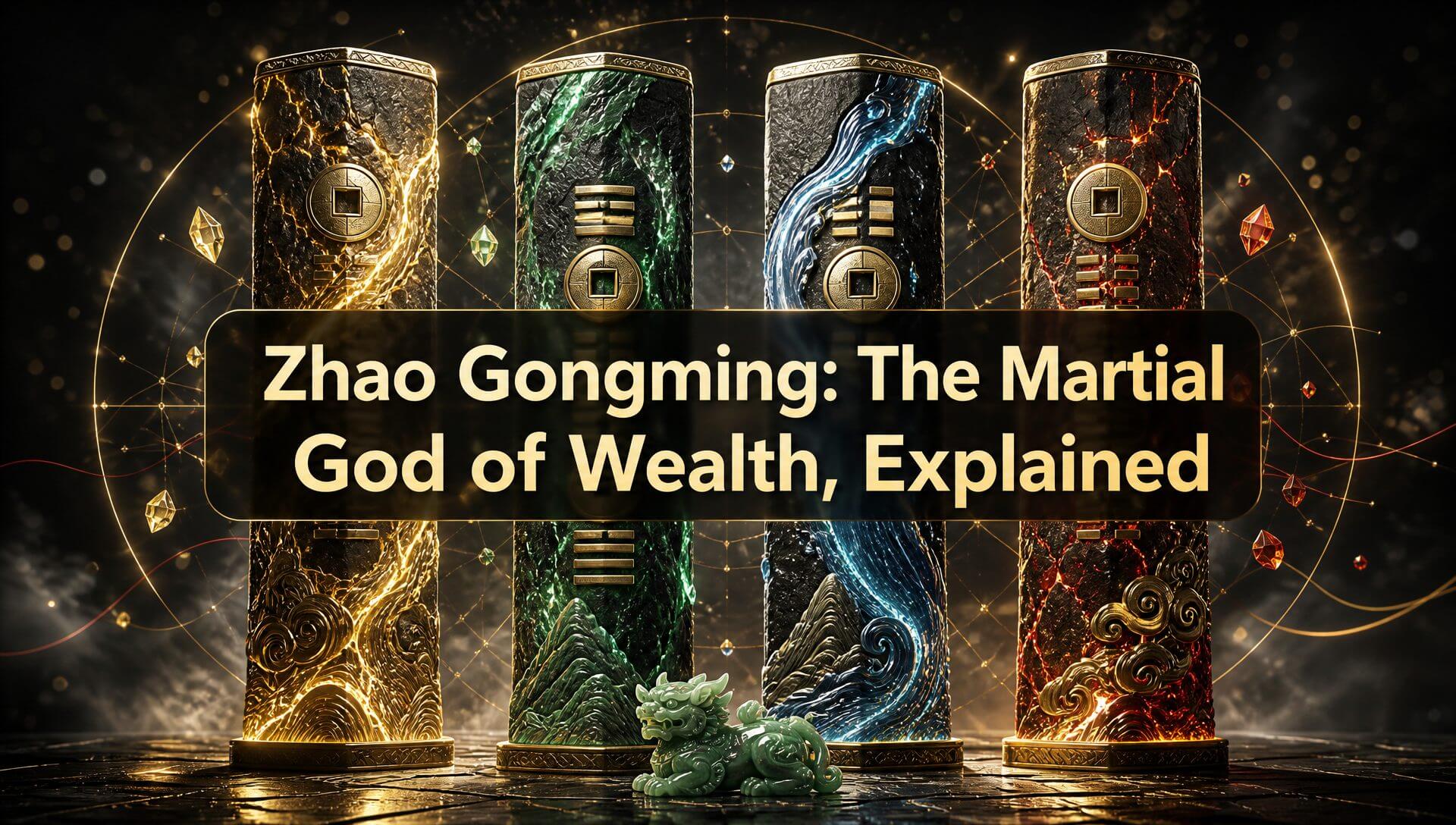
Meet Zhao Gongming, the Martial God of Wealth: Three Roles That Divide Up Money in Chinese Folk Religion
If Chinese folk religion is brand new to you, here’s the first surprise: there’s no single god of wealth. There’s a whole cast of wealth figures with carefully divided job descriptions, the same way Norse mythology never handed the weather to just one god. Zhao Gongming, the martial god of wealth, is the most famous of the bunch — black-faced, riding a black tiger, an iron whip in his hand. But to understand him, you first have to understand the org chart he sits in.
Caishen Is a Job Title, Not a Person
In Chinese folk religion, Caishen, the Chinese god of wealth, works more like a position than the name of one specific deity. Who receives the offerings shifts by region, by trade, and by era. Business owners often turn to Guan Yu, who stands for loyalty and keeping your word. A scholarly household might favor a civil god of wealth such as Bigan or Fan Li. Merchants along the coast have their own customary figures. That crowd of overlapping deities trips up newcomers, but it comes from a genuinely practical premise — wealth has a lot of faces, and earning it, holding onto it, distributing it, collecting on debts, and negotiating a deal all call for different qualities. So the tradition simply assigned different gods to different jobs.
It also means this system was never exclusive to begin with. You won’t find people arguing over which god of wealth is the real one. What you hear instead is “in our line of work, this is the one our family has always honored.” It’s less a unified doctrine than layers of local custom and trade tradition stacked on top of each other. Once that clicks, a lot of the odd-looking details ahead suddenly make sense.
Civil and Martial: One Handles Distribution, the Other Handles Protection
Tradition sorts the wealth gods roughly into civil and martial types, and the split carries a clear logic. The civil god of wealth represents how wealth arrives and how it gets divided. These figures are usually depicted as civil officials holding a gold ingot or a ledger — symbols of rational planning, fair distribution, and patient accumulation. In the legends, civil gods of wealth were known in life for integrity, generosity, or a real talent for running an enterprise.
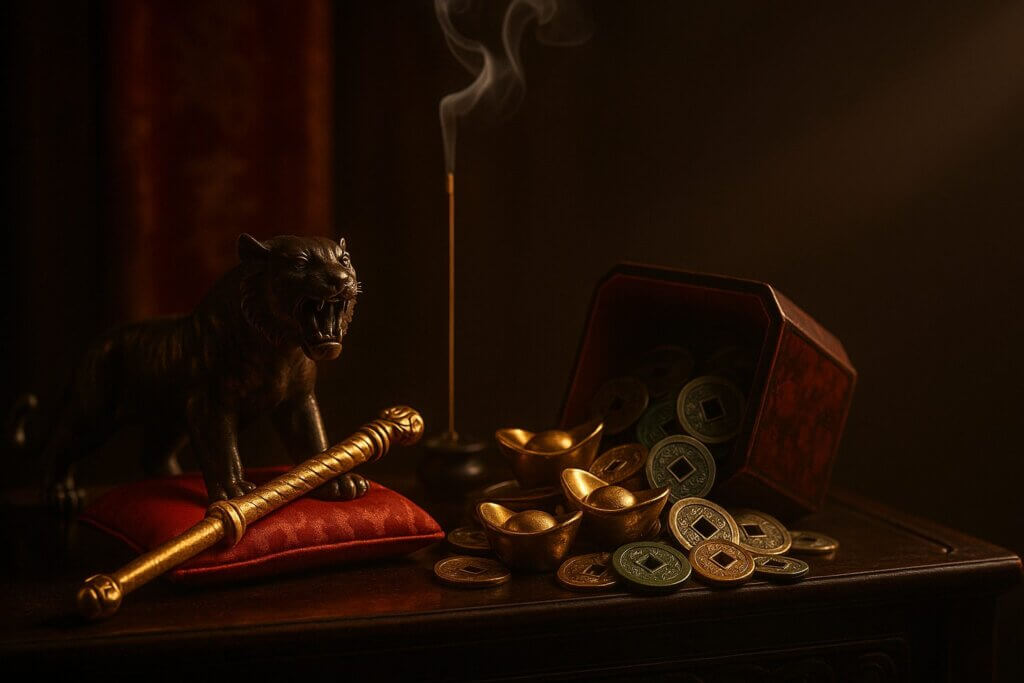
The martial god of wealth is a different proposition entirely. Zhao Gongming is depicted as a general: black face, iron whip, a tiger for a mount. He represents not how you earn but how you keep and how you recover. In traditional society, the thing that sank a business was rarely a shortage of opportunity — it was unpaid accounts, theft, fraud, and rivals competing in bad faith. A god holding a weapon stands for the defense of property, the enforcement of contracts, and a deterrent against money made dishonestly. That’s why, in the thinking of a lot of old merchant families, the martial god of wealth governs order, not just income.
Put the two roles side by side and you get a surprisingly three-dimensional picture of wealth: it has to be created, and it has to be protected; it calls for generosity, and it calls for boundaries. This isn’t superstitious wishing for riches. It’s a way of taking the real problems of commercial life and giving them a face.
The Black Face, the Iron Whip, the Black Tiger: What the Imagery Is Telling You
Zhao Gongming is one of the most instantly recognizable figures in Chinese folk art. In the visual vocabulary of traditional opera and religious statuary, a black face signals someone upright, impartial, and not easy to talk around — the famously incorruptible judge Bao Zheng is painted black-faced too. The message the color sends is unambiguous: this god is not here to be charmed. He deals in principles.
The iron whip stands for enforcement and punishment. Folk stories credit him with driving out plague and cruelty, and also with chasing down debts and disciplining people who break their word. The black tiger he rides is tamed ferocity — a tiger is a threat until it’s mastered, at which point it becomes power. Taken together, the three elements say one thing: wealth is inherently aggressive. It can do enormous good and it can do real damage, and which way it goes depends on whether anything holds it to rules.
That’s why tradition holds that the martial god of wealth grants wealth and punishes too. He isn’t a wishing machine. He’s closer to a demanding investor — one who’ll put resources in your hands and then watch what you do with them.
From Mountain Ascetic to Master of Wealth: Three Turning Points That Made Zhao Gongming the Martial God of Wealth
No folk deity shows up overnight. Zhao Gongming, the martial god of wealth, got to that title the long way around — first as a recluse practicing the Dao in the mountains, then as a figure inside the system of plague deities, and only after the Ming and Qing dynasties as a god of wealth known across the country. That’s a stretch of more than a thousand years. The story of how it happened is worth telling on its own, and it explains something you notice right away in his imagery: a mix of severity and generosity that looks, at first glance, like a contradiction.
The Earliest Version: A Mountain Ascetic Who Governed Disease
In the earliest texts, Zhao Gongming has almost nothing to do with money. He’s described as a figure practicing the Dao on Mount Zhongnan who, having attained the Way, was granted divine office — and the office he got was authority over illness and plague. In the popular imagination of the Han and Tang periods, he belonged to a category of god you approached carefully. He could send an epidemic, and he could call one off.
That sounds like a long way from a god of wealth. Inside the logic of the period, it wasn’t. Plague, disaster, and ruin all sat in the same bucket in a world of farming and small trade: each one was a force that could wipe out a household’s entire savings without warning. A god who could hold back catastrophe was naturally expected to hold back the things that empty your pockets, too. That’s the first hint of where he’d eventually end up.
Worth noting: at this stage he reads as formidable rather than kindly. The popular attitude toward him was awe, not affection. That undertone never fully went away. Even after he became a god of wealth, people talking about Zhao Gongming as the martial god of wealth still carry a note of caution in how they say it.
The Boost from Investiture of the Gods: How a Novel Rewrote a Deity’s Job Description
What actually made him a household name was a Ming dynasty novel, Investiture of the Gods. In that popular work, Zhao Gongming is a Daoist of formidable powers who gets pulled into a sprawling war, dies in battle, and is then enfeoffed in the postwar ceremony of investiture as Zhengyi Xuantan Zhenjun, the True Lord of the Dark Altar. Four subordinates were placed under his command, and together they were charged with ushering in blessings and good fortune, and with pursuing what has fled or been lost.
There’s a genuinely interesting cultural phenomenon buried in that: a work of fiction changed a deity’s actual duties within a living tradition of belief. As the novel circulated widely, ordinary people gradually took its version as the real one. The Dark Altar identity and the association with wealth hardened into place, and the older coloring as a plague god slowly faded out. That tells you something about Chinese folk religion — it grows. It isn’t a closed canon so much as a living tradition, continually rewritten by storytellers, opera troupes, merchants, and families all at once.
For an American reader, the closest feel might be an ancient god getting repositioned because of a bestselling novel. It’s a useful reminder that the content of folk religion is usually a blend of religion, literature, and mass entertainment, all working on each other at the same time.
What the Four Subordinates Stand For: A Complete Picture of How Wealth Moves
The four subordinates under the True Lord of the Dark Altar have refreshingly blunt names: Summoning Treasure, Gathering Valuables, Attracting Wealth, and Profit in the Market. One reading takes them as the four stages of how wealth actually works — spotting the opportunity, bringing resources in, putting money into motion, and finally realizing a profit in the exchange. Read that way, they form a single chain rather than four versions of the same blessing.
The arrangement lines up neatly with the way people talk about business processes now: find the demand, raise the capital, put it to work in operations, close the deal. Traditional folk culture recorded the same sequence by personifying it, which meant a merchant who couldn’t read still had a way to hold onto the idea that money doesn’t materialize out of nowhere — it has to travel the whole route.
So when people say the martial god of wealth commands the wealth of the four directions, the claim isn’t that he tips money out of the sky. It’s that what he presides over is the whole order of operations. Read it as an old-fashioned reminder: if you want the result, you first have to get the process running.
What People Traditionally Do: Three Customs and the Thinking Behind Them
This next stretch covers customs, but read it as anthropology rather than a how-to. These practices have circulated in Chinese communities for centuries, and some of them are still common today. Here’s the thing, though: the gestures aren’t the interesting part. Each one carries an idea about money, and that idea holds up just fine even if you never take part in a single ritual.
Welcoming the God of Wealth at the Start of the Year: A Collective Reboot
In traditional practice, the lunar new year period includes days set aside for welcoming the god of wealth. The exact timing varies from region to region, though the fifth day of the new year is one of the more common choices. On that day, some families and shop owners get up early, open their doors, and set off firecrackers — a way of inviting Caishen, the Chinese god of wealth, across the threshold, and a way of marking the year’s business as officially open. Markets reopen, the books start fresh, and a city that’s been quiet for a few days starts moving again.
What makes this custom worth thinking about is that it turns “beginning” into something public and ceremonial. You’re not quietly deciding on your own that this is the year you finally get serious. You’re opening the year at a moment when everyone around you is doing the same thing. Psychologists call this the fresh start effect — people are measurably more likely to change their behavior at a marked point in time. Traditional societies didn’t have the term. They clearly had the phenomenon.
For a modern reader, the piece worth borrowing is the form, not the belief: give your financial restart a specific date and a little ceremony, and it’ll do far more for you than a vague intention to “get better with money.”
Offerings, Moon Blocks, and Wishes: Saying the Vague Thing Out Loud
Traditionally, people set out offerings at the home altar, light incense, and speak their wishes aloud. Some use moon blocks (jiao bei, a pair of crescent-shaped wooden pieces dropped on the floor and read by how they land) to ask whether the answer is yes. And the wishes are rarely just “please make me rich.” They tend to be concrete: collect the money the shop is owed this year, cover a kid’s tuition, get a new business through its first twelve months.
There’s a very practical mechanism hiding in there. When a serious occasion requires you to say a wish out loud, and say it specifically, you’re being forced to define your own goal. Most money anxiety is fuzzy — “I don’t feel like I have enough” — and fuzzy anxiety can’t be solved. The ritual makes you turn it into a sentence you can actually check.
As for the offerings, the folk explanation is reciprocity: you put something out before you ask for anything. That ordering is itself a value judgment — relationships don’t start with a request. And the moon blocks stand for admitting you don’t control the outcome. You make your case, and you accept that the answer might be no. That posture — do everything you can, then let the rest go — turns out to be a pretty healthy stance toward investing and risk.
Circulation Over Hoarding: Why Folk Belief Says Money Energy Can’t Be Locked Up
If you take only one idea away from this whole tradition, a lot of people would pick this one. In traditional accounts, what Caishen hands you is money energy, and money energy is by nature something that moves — not a pile of metal locked in a safe. It comes to you because someone trusts you to put it to good use. If it stops with you and goes nowhere, that trust has been wasted.
Here’s the part that gets misread: “sharing” doesn’t mean giving away ninety dollars out of every hundred you earn. The traditional idea is much broader than that. Passing along an idea, a method, or something you learned the hard way is sharing. Volunteering your time is sharing. Giving someone an honest piece of advice when they’re just starting out is sharing. What matters is whether the energy leaves you and reaches someone else, not the dollar figure attached to it.
And the form of sharing considered most valuable is passing the ideas that improved your own life on to the people close to you, so their lives improve too. In that exchange you’re not handing over a resource once — you’re building a loop that keeps turning on its own. The people you helped do better, and some fraction of that comes back to you in one form or another. Traditionally, this is exactly what Caishen is said to be watching for: anyone can get themselves rich, but the person who brings others up along the way is the one worth backing further. In modern terms, the first is a one-time payout and the second is compound interest.
None of this logic requires a religious premise. Relationships, reputation, and knowledge networks are assets that gain value the more they’re used, and nearly every form of wealth other than cash is created in motion. That also explains why the martial god of wealth, Zhao Gongming, is imagined as generous and stern at the same time — a figure who hands out resources, then watches what you do with them. In this system, credit has always outranked luck.
5 Common Questions About Zhao Gongming, the Martial God of Wealth
Here’s what people ask most when they run into this subject for the first time. The answers below lay out what the tradition says and the cultural context around it — none of it means you have to believe or practice any of it. Treat it as a door into how another culture thinks, and you’ll get a lot more out of it than treating it as a rulebook.
1. Was Zhao Gongming a real person?
There’s no clean answer, and that’s the interesting part. In the earliest texts, Zhao Gongming shows up in heavily mythological form, and no reliable historical source ties him to a specific real person. A much later novel, Investiture of the Gods (Fengshen Yanyi), handed him a full dramatic biography — but that’s fiction. Chinese folk religion is full of figures who sit somewhere between history and legend. Guan Yu has a solid historical basis. Zhao Gongming is closer to an image built up in layers, out of belief, literature, and local storytelling.
A better question than “was he real” is “why did people need him.” The gods a society invents tend to mirror what it cares about most and controls least. In traditional societies, money came and went unpredictably, and people wanted a figure to hold that anxiety — plus a story that explained what kind of person deserves wealth in the first place. Seen that way, the reality of this deity isn’t a matter of historical verification. What’s real is that the values attached to him genuinely shaped how people did business for centuries.
2. How does the martial god of wealth differ from Guan Yu and the civil god of wealth? Can you hold all three in mind at once?
You can, and keeping them separate actually makes each one clearer. The civil god of wealth represents the planning and distribution side of money. He’s depicted as a civil official, and what he stands for is reason, fairness, and building something over the long haul. Zhao Gongming, the martial god of wealth, represents protection and enforcement. He’s depicted as a general, and he stands for holding on to what you’ve earned, collecting what you’re owed, and deterring people who don’t play straight. Guan Yu is his own case entirely. He’s counted among the martial gods of wealth, but the core of what he symbolizes is loyalty and honor — keeping your word, being someone whose promises hold — which is exactly why merchants took to him.
Think of the three as three answers to the same question: how wealth grows (the civil god of wealth), how it’s protected (Zhao Gongming), and what keeps it standing over time (Guan Yu’s code of trust). Traditionally, different trades and different regions leaned toward different figures. They aren’t competing with each other so much as emphasizing different faces of commercial life. Catching that division of labor is more interesting than memorizing which name goes with which role.
3. Does the folk tradition claim that making offerings will make you rich?
In the more widely shared versions of the tradition, no — and the traditional attitude here is stricter than most people expect. The martial god of wealth’s very appearance carries a note of discipline: the dark face, the iron whip, standing for principle and order. A common folk formulation holds that the god of wealth grants wealth and tests you with it. He hands you resources and then watches what you do with them, and if you handle them badly, they leave.
What gets emphasized far more is character and credit. Older generations talking business often said that wealth comes from virtue, meaning the foundation of money is being reliable and treating people decently. The ritual is a way of expressing that intention, not a shortcut around the work. And honestly, if a belief system really did promise that offerings produce riches, it wouldn’t have lasted more than a couple of generations in a merchant community — the results are far too easy to check. It survived this long precisely because what it kept talking about was who you have to become, not what you can get for free.
4. I’m not religious. Is there anything here for me?
This article was written for that question. Set the deities aside and at least three ideas in this tradition require no belief whatsoever. First, wealth should circulate rather than sit in a pile — knowledge, relationships, and reputation are assets that appreciate the more you put them to work. Second, turning vague financial anxiety into a concrete goal you can say out loud is the step that actually moves anything. Third, credit and long-term relationships are worth more than a one-off opportunity.
There’s a subtler payoff too. Watching another culture imagine wealth makes you notice that your own assumptions are culturally made as well. Treating money as the pure output of individual effort, and wealth as proof of personal achievement, is itself one particular cultural story — not the only answer on the table. This tradition understands wealth as something held in trust, carrying obligations to give back. You don’t have to adopt that. But setting it next to your own view as a comparison tends to surface assumptions you didn’t know you were carrying.
5. Do people still do any of this? On what occasions?
They do, and more routinely than outsiders assume. Across Chinese communities in Taiwan, mainland China, Hong Kong, Singapore, and Malaysia, welcoming the god of wealth during Lunar New Year remains widespread, especially among shopkeepers and in traditional markets. Related customs also show up when a new store opens, when a business changes direction, and around the close of the fiscal year.
The mindset of the participants varies enormously, though. For some it’s sincere belief. For others it’s a habit handed down through the family. Plenty of younger people treat it as holiday atmosphere and a marker of cultural identity — a lot like what people do around holidays generally, which doesn’t always map onto strict religious conviction. The same gesture can mean devotion to one person, nostalgia to another, family connection to a third, and plain fun to a fourth, and those meanings usually coexist in the same room.
That flexibility may be part of why it has lasted. It doesn’t ask you to believe something before you can take part, and it doesn’t shut you out for showing up because you find it interesting.
In the end, the most compelling thing about Zhao Gongming as a figure isn’t whether he can deliver wealth. It’s that for centuries people have used him to keep working through the same set of questions: who wealth should belong to, what kind of person deserves it, and what you owe the world once you have it. A culture that imagines its god of wealth as a stern overseer is reminding itself that money was never a purely private matter, and a tradition that holds money energy has to keep moving has effectively written sharing into the definition of getting rich. You can believe in no gods at all and the question still deserves an answer from each of us: of what you’re holding right now, how much of it is sitting still, and how much is flowing toward someone else?