Meet Them First: What the Eight Paths Gods of Wealth Are in Chinese Folk Religion
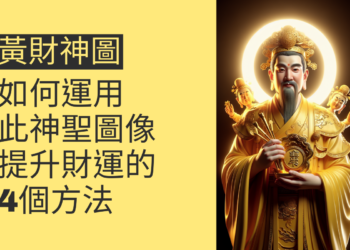
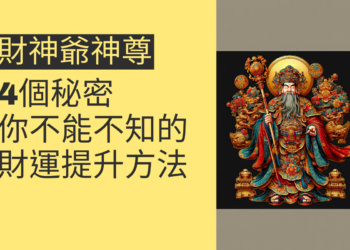
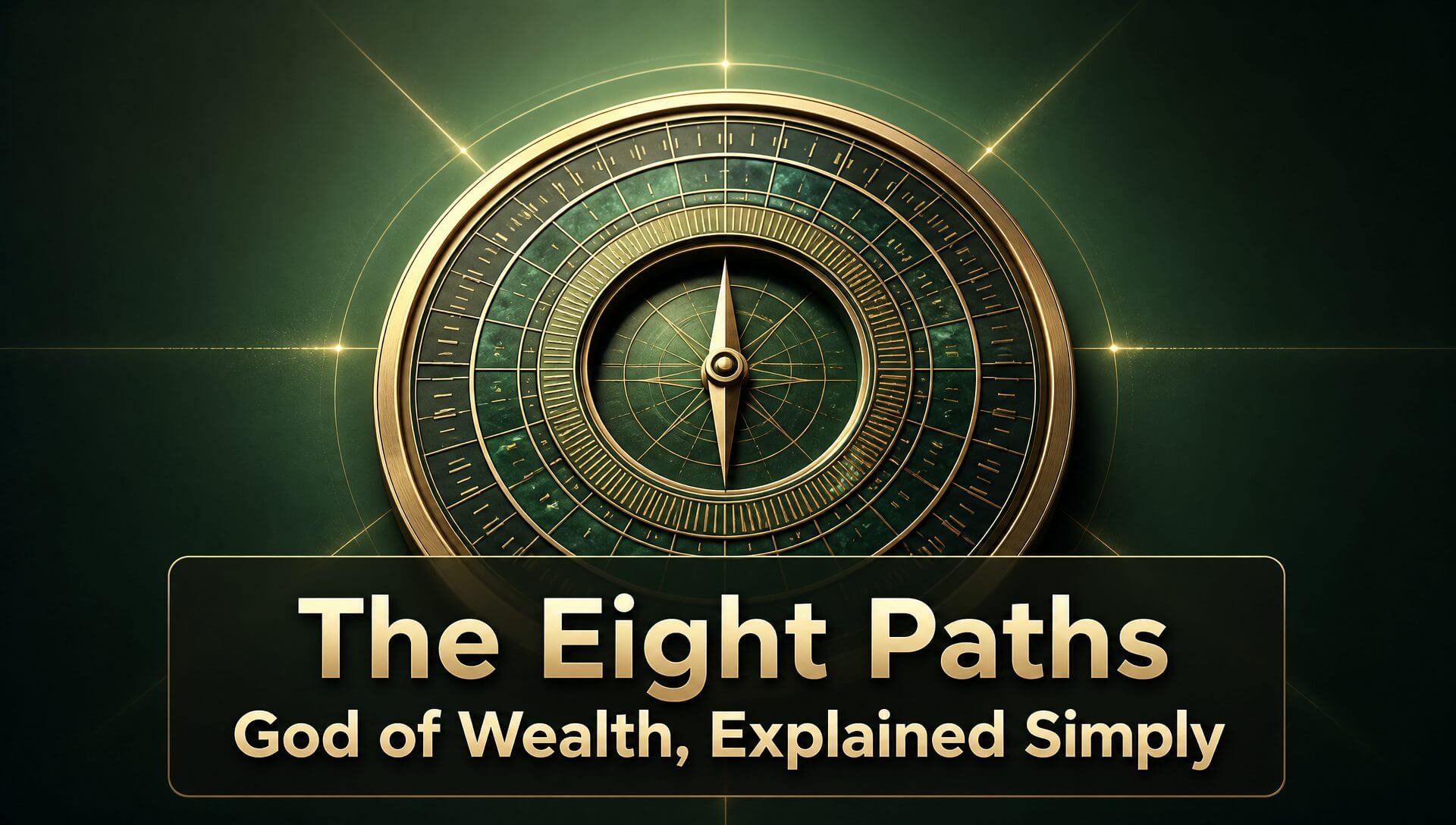
If this is the first time you’ve run into the word “Caishen,” here’s the shortcut: picture Caishen, the Chinese god of wealth, as folk religion’s answer to the question of who’s minding the money. He works nothing like the Greek and Norse gods you already know, though. Caishen doesn’t sit in a temple cutting deals with mortals. He’s closer to an older relative who keeps the books — he watches how you earn, how you spend, and how you treat the people around you. And the eight paths gods of wealth (ba lu cai shen) are one of the more interesting design choices in the whole tradition. There isn’t one god of wealth. There’s a whole crew of them, each stationed at one of eight compass directions, each responsible for a different channel through which money arrives.
1. Why “Eight Paths”: Direction, Income, and the Imagination of a Division of Labor
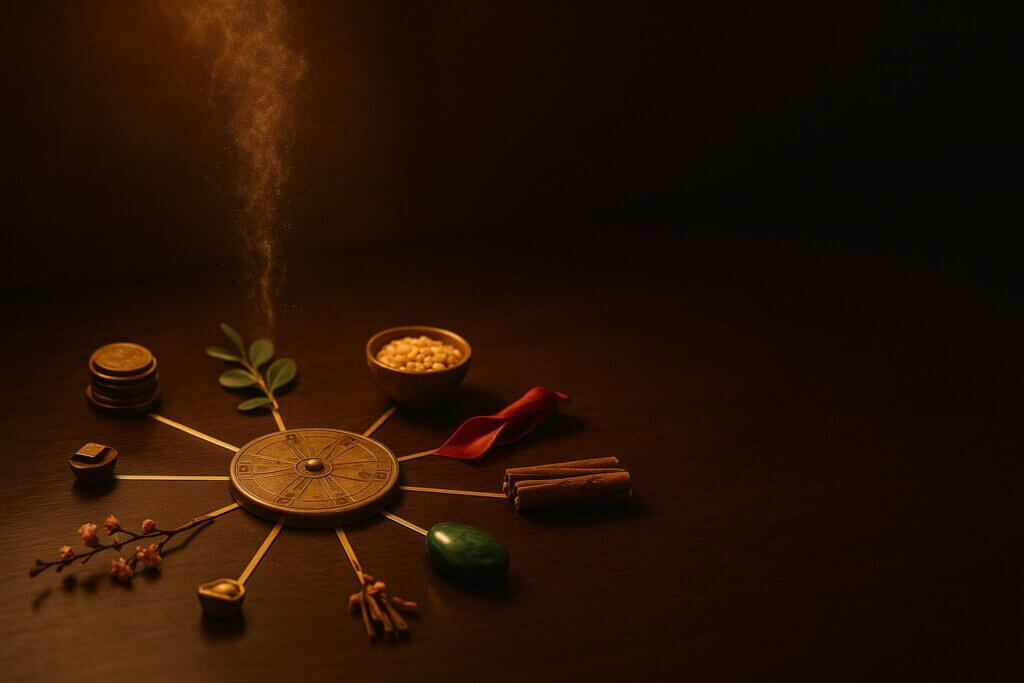
Chinese tradition has long carved up space into eight directions — north, south, east, west, and the four corners in between. That eight-direction framework shows up in architecture, in the calendar, in feng shui, and it shows up here too. The eight paths gods of wealth take the sources of wealth and imagine them as water flowing in along eight separate channels: one carries trade, another carries skilled work, another carries the introduction a well-placed person makes on your behalf, another carries the windfall you never saw coming.
There’s a genuinely clear-eyed idea buried in that design: money comes from more than one place, and never from a single road. Traditionally, people made offerings to all eight not because they wanted eight times the potency, but because the framing itself admits something true — you don’t know which direction the money will come from. You can pour everything you have into the road heading east and then find that the thing that actually turned your life around was a person to the west you once helped without thinking twice about it. Having eight directions in play amounts to a standing reminder not to keep your eyes locked on one spot.
The second layer is specialization. The eight aren’t one deity copy-pasted eight times. Each has his own temperament, his own backstory, his own territory. Some lean civil, some lean martial; some govern regular income, some govern the unexpected kind. That division reflects a practical observation about how money actually behaves: someone who earns a living with words and someone who earns a living with their back run into completely different problems, so the kind of help each one needs is different too.
2. The Civil and the Martial God of Wealth: Two Entirely Different Pictures of Getting Rich
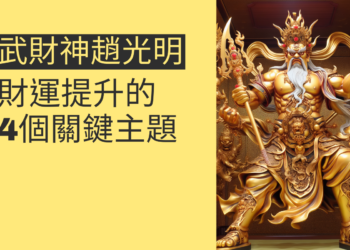
Within this group, the easiest distinction to grasp is civil versus martial. The civil god of wealth maps onto planning, credit, calculation, and steady management — think of it as the accountant’s version of wealth. The martial god of wealth maps onto expansion, protection, negotiation, and the ability to take a hit and keep going — the founder’s version. Traditionally, business families kept both on the home altar, because they understood the trap waiting on either side: all calculation and no nerve means the opportunity shows up and you can’t grab it, while all nerve and no calculation means whatever you make runs straight back out the door.
The contrast is more useful than it looks. It splits “making money” into two genuinely separate skills instead of lumping everything under a vague wish to get rich. When someone feels like they work relentlessly and still have nothing to show for it, the problem usually isn’t effort. It’s that only one of those two skills is actually running. Folk religion made the point concrete by putting two statues side by side, and that sticks in the mind far better than any theory of it would.
3. Caishen Is Not a Wish-Granting Machine: The Conditions Built Into the Tradition
The thing readers without this cultural background misread most often is the transaction itself — the assumption that making offerings to Caishen means making a wish, and that the wish coming true is the proof it worked. Inside the logic of the tradition, what Caishen gives comes with conditions attached. The traditional formulation is that he isn’t only weighing whether you want it. He’s weighing whether it fits you: whether you keep your word, whether you’ve taken advantage of anyone, whether you put money where money ought to go.
That’s why so many folk stories about Caishen turn on someone asking and receiving nothing, or receiving something and then losing it. Those stories function as moral instruction. They frame wealth as a conditional trust rather than an unconditional reward. Once you see that layer, the heavy emphasis on character running through the eight paths tradition starts to make sense — it isn’t moral packaging bolted onto the outside. It was the core rule of the system all along.
From Men to Gods: 3 Stories That Shaped the Wealth Deities
Here’s something that sets Chinese folk religion apart from most Western traditions: its gods usually started out as people. Nobody was born supernatural. They lived, they did something worth remembering — showed a certain kind of character, or pulled off a certain kind of achievement — and later generations remembered them, honored them, and eventually raised them to the status of gods. Caishen, the Chinese god of wealth, came about the same way. So if you want to understand why the Eight Paths gods of wealth keep circling back to credit, sharing, and circulation, the smartest move is to look at who these figures were while they were alive. The reason each one got deified is sitting right there in the story.
1. What Got Remembered Wasn’t His Money — It Was His Word
The most central figure in the whole wealth-deity system is said to have been a general during the Shang dynasty, killed in battle and afterward appointed to oversee the sources of wealth. But his military record isn’t what gave him staying power with ordinary people. What did was a set of traits that gathered around him over time: he was fair, he played no favorites, and when he said a thing, that was the thing. Merchants made offerings to him because they pictured him as a being who would never, under any circumstances, stiff you on a debt.
Another wealth deity with enormous popular reach was, in life, a military commander from the Three Kingdoms period, famous for loyalty and for keeping his promises. The reason merchants adopted Guan Yu as a god of wealth is about as plain as it gets. Ancient commerce had no real legal machinery behind it. If you fronted someone a shipment on credit, whether you ever saw that money again came down entirely to what kind of person they were. So the merchant class collectively picked the embodiment of trustworthiness as their patron. That choice tells you something on its own: in their eyes, the foundation of wealth wasn’t capital. It was being someone others could count on.
2. The Ones Who Gave It Away Are the Ones Remembered as Wealth Gods
A second category of wealth deity comes at the whole thing from the opposite direction. Fan Li, by tradition a strategist of the Spring and Autumn period, is said to have helped his ruler to victory and then walked away from court life to become a merchant. Three times he built an enormous fortune. Three times he broke it up and handed it out among his neighbors, his village, his friends and relatives — and then started over from nothing. Later generations honored him as a god of wealth not because he was good at making money, but because he made it, released it, and made it again.
That story has been retold for more than two thousand years, and the point of it has never been the size of the fortune. The point is the releasing. There’s a Chinese folk idea worth knowing here — not as a financial rule, but as a cultural lens on wealth: money is imagined as water, and water that sits too long goes stagnant. It only stays alive when it moves. Fan Li became one of the templates for the wealth deity precisely because he spent an entire life demonstrating that cycle. Giving it away isn’t a loss; it’s clearing the channel so the water can run. That near-obsessive emphasis on circulation running through the Eight Paths tradition traces straight back to stories like his.
3. Why Group Them at All: Folk Religion’s Habit of Stacking
Nobody sat down one afternoon and designed the Eight Paths gods of wealth. The set piled up over several centuries. Different eras and different regions each elevated their own wealth figures — some drawn from history, some pulled from the Daoist pantheon, some straight out of purely local legend. As people migrated and trade routes tied distant places together, these separate, self-contained traditions ran into each other, and over time they got folded into a single eight-direction framework.
That non-exclusive way of combining things is characteristic of Chinese folk religion generally. It isn’t especially worried about whether the doctrine hangs together; it’s worried about whether the whole arrangement is usable in practice and makes sense when you explain it to someone. Which means the Eight Paths gods of wealth are less a tight theological system than a running list of ideas about money, revised over centuries by collective experience. Behind each figure in the set sits one attitude toward how to conduct yourself and how to do business — an attitude that generations of people tested and kept.
The 3 Ideas Behind the Traditions: Circulation, Credit, and Sharing
What follows is a tour of customs, but the customs aren’t really the point — the thinking underneath them is. Tradition wraps Caishen in a thick set of rules: what to do and when, what not to say out loud, how money ought to be handled. To a modern American reader, a lot of that can land as foreign, maybe even a little occult. Peel off the ceremonial shell, though, and what’s usually sitting inside is a fairly practical principle for living. Here are the three that best explain the logic driving Eight Paths god of wealth culture.
1. Why Tradition Cares So Much About Money Moving
Some families deliberately spend part of their income at certain points in the year — hosting a meal, giving gifts, helping out relatives — instead of banking all of it. From the outside that reads like waste. Inside this culture, it’s called keeping the money energy in motion. The traditional idea is that what Caishen hands you isn’t a sum, it’s a current, something carrying momentum. Block it and it stalls. Guide it and it travels further.
Here’s the interesting part: how broadly “sharing” gets defined. Nobody’s saying you earn a hundred bucks and give away ninety. The idea is that the energy needs somewhere to go. Passing along something useful you know to a friend counts. Spending an afternoon helping with something nobody’s ever going to pay you for counts. The amount isn’t the measure — whether anything is heading outward is. There’s a folk saying that nails it: Caishen is willing to share money energy with you because he needs someone to carry the benefit out to more people. You’re the distribution channel, and a channel gets judged on throughput, not inventory.
Take the deity out of it and you’re left with an intuitive read on network effects. Someone who’s constantly giving things away ends up, over the years, surrounded by more information, more opportunities, more goodwill. Someone who only pulls in looks safe in the short run and quietly falls off other people’s lists in the long run. Tradition describes that as money energy rolling forward; it’s the same phenomenon, different vocabulary.
2. Why Keeping Your Word Is Treated as Nearly Sacred
Among the customs tied to Caishen, one category of taboo is unusually strict: skipping out on a debt, breaking an agreement, or saying one thing and doing another is believed to damage your luck with money directly. Traditionally, some merchants would eat a loss rather than fail to deliver on something they’d promised — not purely out of moral fastidiousness, but because they genuinely believed that once your credit breaks, your path to money closes right along with it.
It isn’t hard to see where that belief came from. In an era with no credit bureaus and no real mechanism for enforcing a contract, a person’s reputation was the only asset they had. Break your word once and the whole market knows by dinnertime; after that, nobody extends you goods on account, goes into business with you, or sends a customer your way. The money path wasn’t taken away by a god — it was taken away by people. The belief just translates a brutal social mechanism into a line that’s easy to remember.
3. Why Making Others Rich Ranks Higher Than Being Rich
There’s an idea in Eight Paths god of wealth culture that sounds strange the first time you hear it: being rich yourself is nothing special, and the person who can make other people rich is the impressive one. The traditional explanation is that before Caishen became a god, the people he dealt with were already wealthy, so wealth on its own doesn’t get his attention. What he’s said to invest more in is the kind of person who spreads a benefit outward.
Put in more contemporary terms, this is the difference between an end consumer and a node. If someone only earns for themselves, their value stops with them. If someone makes everyone around them better off, they become an amplifier, and every unit of resource passing through them comes out larger than it went in. In investment terms, the first returns a dollar on a dollar and the second might return ten — so resources naturally pool around the second.
And the loop comes back around. When other people are doing better because of something you shared, some slice of that benefit eventually finds its way back to you — as an opportunity, as a connection, or just as someone willing to put in a word for you at the moment it counts. Tradition calls that money energy flowing back; a modern reader might call it the dividend on a network. Both are describing the same thing: what you send out doesn’t vanish, it just takes a different road home.
5 Common Questions About the Eight Paths Gods of Wealth
If you’ve made it this far with no background in the culture, a few questions have probably surfaced on their own. Is this a religion? Can it mean anything to someone who doesn’t believe? Is there any real basis for it? These five come up most often from readers outside the tradition. The answers below aren’t trying to talk you into anything — they lay out the internal logic of the tradition so you can decide which parts are useful to you.
1. Are the Eight Paths gods of wealth a religion, or closer to folklore?
Both, and neither, exactly. Chinese folk religion sits at a real distance from what “religion” usually means in the US: there’s no unified scripture, no church organization, no ceremony that signs you up as a member, and no demand for an exclusive statement of faith. A person can show respect to Caishen, to their ancestors, and to a Buddhist bodhisattva all at once, and nobody in the tradition finds that contradictory.
Here’s a closer way to think about it — a kind of cultural operating system. A set of assumptions about how the world works, plus a matching set of behavioral suggestions. Within that system, the Eight Paths gods of wealth handle the money module: where wealth comes from, how you hold on to it, and what behavior drives it away. The authority behind it doesn’t come from revelation. It comes from centuries of accumulated practical experience, handed down one generation at a time. Which is why the actual content turns out to be so remarkably worldly — it’s all about how you treat people, keeping your word, sharing, and putting in the work.
2. I don’t believe deities exist at all. Is any of this still meaningful to me?
Yes, and probably more than you’d expect. The genuinely valuable part of this tradition is the metaphor it picked for wealth. It doesn’t picture wealth as a pile of things you can stockpile; it pictures it as money energy — something that has to keep moving. That metaphor alone changes how a person behaves. If you believe money is something you stack up, you lean toward guarding it. If you believe money is something that flows through, you lean toward putting it in motion.
You don’t need to believe someone is watching from above to accept that people who keep giving outward tend to accumulate more opportunities over the long run. That’s an observation about how social life actually works, and the Eight Paths tradition simply packaged it in a form that’s easier to remember, easier to practice, and easier to hand down. The deities, read this way, function less as an explanation and more as an interface — a way of making an abstract principle feel approachable.
3. Is asking Caishen for wealth the same thing as praying for good luck?
On the surface it looks similar. The underlying logic is different. The prayer most American readers know is a person making a request of a god, with the outcome resting on the god’s will. In the traditional understanding of the wealth deities, it works more like a two-way agreement: what the god provides is money energy — opportunity and momentum — but you have to convert that into actual wealth through your own actions, and then pass the benefit along to others.
So the traditional framing was never “ask and you’ll receive.” Folk tradition is full of stories about people who got exactly what they asked for and then couldn’t hold on to it, and every one of them lands on the same point: what you received was entrusted to you, not given to you. That’s also why so many of the associated customs come with requirements about conduct. In this logic, how you behave decides directly whether that trust gets renewed.
4. There are eight gods of wealth — does making more offerings work better?
This question lands squarely on a common misunderstanding. The “eight” here stands for completeness of direction and aspect, not for additive quantity. Using eight directions to describe sources of wealth is a way of saying wealth might arrive from anywhere — not that eight rounds of offerings are eight times as effective as one.
Folk tradition actually takes a pretty pragmatic view of this. What gets emphasized is never how elaborate the form is, but whether intention and behavior line up. A large body of traditional sayings makes the same point over and over: however grand the ceremony, if you turn around and take advantage of people or go back on your word, none of the form counts for anything. From a cultural-studies angle, that preference for substance over ritual form is one of the more striking features of Chinese folk religion — and one reason ordinary people have kept finding it credible for centuries.
5. What’s the biggest difference between this view of wealth and the American one?
The biggest difference is probably the question of who wealth belongs to. In a framework that emphasizes individualism, wealth tends to be understood as the product of personal effort, belonging to the person who earned it, with its use a matter of personal freedom. In the tradition the Eight Paths gods of wealth represent, wealth is closer to something passing temporarily through your hands — you’re a custodian and a conduit, not fully an owner.
That difference produces very different behavioral tendencies. The first readily produces the attitude that what you earned is yours to keep, all of it. The second has a built-in pressure toward continuous outward distribution, because stopping the flow is understood to damage the source itself. Both views have their logic and both have blind spots — leaning too hard on circulation can overlook the real need to accumulate, while leaning too hard on ownership can undervalue the long-term worth of a network of relationships.
Having read through a body of ideas that’s been circulating for centuries, the most interesting thing about it may not be whether it brings anyone money. It’s that it poses a question modern culture rarely asks. It doesn’t ask “how do I earn more?” It asks “of the resources that passed through my hands, how many people ended up better off?” You don’t need any belief at all to answer that one, and how you answer it goes a long way toward determining what your relationship with money looks like.