Who Is the Heavenly Official Martial God of Wealth? Three Identities That Make the Statue Make Sense
If Chinese folk religion is new to you, here’s the assumption to drop first: that “the god of wealth” means one specific guy — a single recognizable face, the way everybody pictures the same Santa Claus. That’s not how it works. The Chinese wealth-deity tradition runs more like a department, staffed by several figures who each handle a different kind of business. Caishen, the Chinese god of wealth, is the umbrella name for that whole idea. The statue known as the Heavenly Official Martial God of Wealth (tian guan wu cai shen) is the most common and most representative of the bunch, so his identity is the place to start.
1. There Isn’t One God of Wealth — There’s a Whole Division of Labor
In Chinese folk religion, wealth has never been treated as one flat thing. One person is hoping for a steady paycheck. Another wants an opening in business. A third just wants to collect on money somebody already owes them. Traditionally, those different needs got assigned to different figures, and that’s how the split between the civil god of wealth and the martial god of wealth came about.
Broadly speaking, the civil god of wealth covers management and accumulation. He’s shown in the robes of a civil official and is associated with salary, steady earned income, and holding on to what you have. The martial god of wealth covers expansion and protection. He appears as a general in armor and is associated with commerce, windfall income, and guarding what you’ve already earned. Business owners, salespeople, and shopkeepers have traditionally gravitated toward the martial god of wealth, because their income doesn’t land on the first and fifteenth like clockwork — it has to be won.
That division tells you something worth noticing: in this culture, money isn’t an abstract number. It gets sorted by how it arrived. Different sources of income call for different attitudes toward the money itself. The idea holds up on its own, whatever you make of the gods.
2. Taking the Name Apart: “Heavenly Official” and “Martial God of Wealth”
“Heavenly Official” (tian guan) is one of the Three Officials of Daoism — the Heavenly Official, the Earthly Official, and the Water Official. A saying still in wide circulation, “the Heavenly Official bestows blessings” (tian guan ci fu), sums up the job description: he’s the one who grants good fortune. So the first half of the name carries the sense of giving, of favor conferred from above. It’s describing rank and function.
“Martial god of wealth” describes appearance and portfolio: dressed as a general, in charge of wealth. Put the two halves together and the statue represents a figure who both holds the authority to bestow blessings and shows up in the form of a warrior. Think of it as a compound title — the first part says what he can give, the second says what he looks like and what falls under his jurisdiction.
One caveat is worth saying plainly. Folk religion doesn’t come with the standardized official definitions that institutional religions have. Different regions and different lineages use these titles somewhat differently, and in some places the roles of several deities get layered together into one. That fuzziness isn’t a mistake waiting to be corrected. It’s what folk religion actually looks like — it grew out of daily life, not out of a textbook.
3. The Statue Is Its Own Instruction Manual
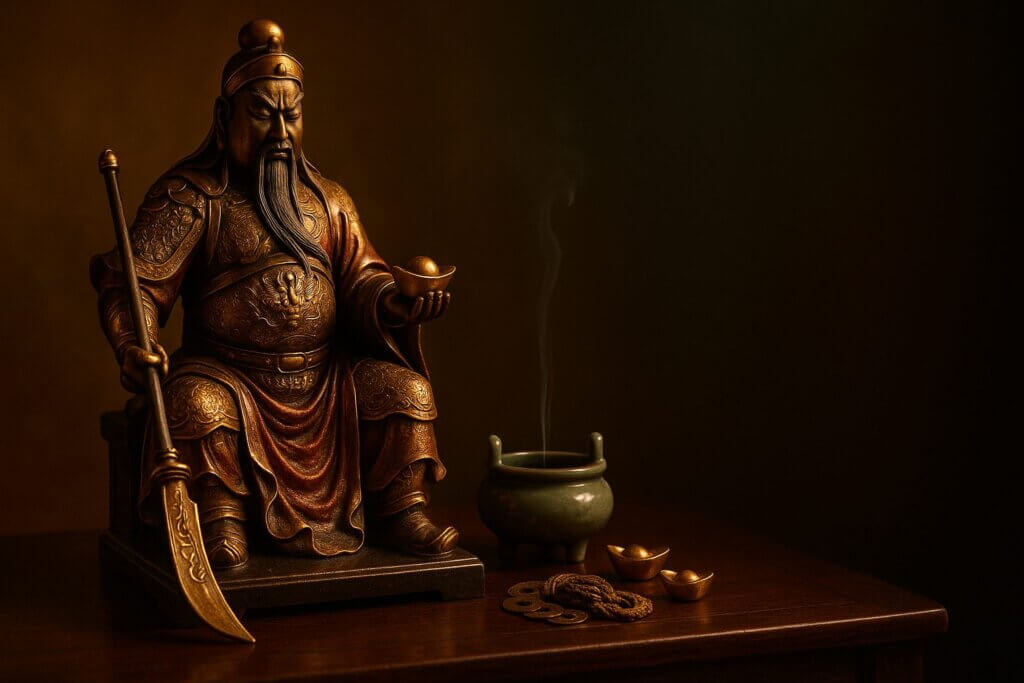
Chinese religious statuary is rarely decorative. Nearly every element on the figure is telling you something. The most common form of the Heavenly Official Martial God of Wealth shows a dark face and heavy beard, an iron crown, battle armor, a whip in one hand and a gold ingot (yuan bao) cradled in the other. Some versions put a black tiger beneath him as his mount.
Each element carries a reading. The whip stands for discipline and correction — the idea that wealth comes with rules, and that anything obtained dishonestly won’t be protected. The ingot stands for the source of income, the tangible return. The black tiger stands for ferocity and guardianship, the part that keeps what shouldn’t be lost from slipping away. Read together, the statue lays out a complete picture of wealth: you have to be able to earn it, you have to be able to keep it, and you have to come by it honestly. All three, none optional.
Put another way, you don’t have to believe the deity exists to read what the statue is saying. It takes an abstract set of values and renders them as something you can stand in front of and look at.
From Warrior to God of Wealth: Zhao Gongming’s Three Transformations
Just about every folk deity comes with a story attached, and here’s the thing — those stories usually tell you more about what a culture values than the deity ever could. The martial god of wealth is most often identified as Zhao Gongming, and his backstory takes some strange turns. At the outset he had nothing to do with money at all. What he was associated with landed a lot closer to bad news than good fortune. How he got from there to here says a lot about how Chinese culture understands where money actually comes from.
1. A Character Who Walked Out of a Fantasy Novel
The version of Zhao Gongming most people know comes from a Ming dynasty novel of gods and demons called Investiture of the Gods (Fengshen Yanyi). In that story he’s a Daoist adept of formidable power who rides a black tiger and fights with a steel whip. Out of loyalty to a friend he comes down from his mountain to join the fight, loses his life in a long run of magical duels, and is elevated to godhood only after his death.
That origin is worth sitting with. He wasn’t born divine. He was a man with a body, with choices, and with the capacity to get things wrong. Chinese folk religion is full of gods like this — Guan Yu was a general, Mazu was a fisherman’s daughter, and city gods were usually local people known for their integrity. The underlying assumption is that divinity isn’t something you’re issued at birth. It’s something a person accumulates by what they do.
Set that against the Greek gods, who are already living on Mount Olympus when their stories start, and you get a genuinely different picture of the universe. What this one is saying is that the road was walked by human beings, which means human beings can walk it.
2. From Plague to Prosperity
In earlier texts, Zhao Gongming turns up in connection with sickness and epidemics — the kind of figure you treated with wary respect and would rather not provoke. Getting from that to a god everyone’s glad to see took several hundred years.
The hinge was a particular job he was given: settling disputes and collecting what was owed. In the legends he can arbitrate right and wrong and pursue unpaid debts, making sure that what should be returned is returned and what should be paid is paid. In the world of business, that function is more or less indistinguishable from wealth itself. What keeps merchants up at night is rarely the fear of not earning — it’s the fear of not collecting, of being stiffed, of getting cheated. A god who enforces fair dealing is exactly the god a merchant needs.
So Zhao Gongming became a god of wealth not because he conjures money out of thin air, but because he stands for the order that makes transactions work. It’s a strikingly practical turn, and it points straight at what Chinese commercial culture has always treated as the heart of the matter.
3. Why a Warrior Is the One Minding the Money
You might reasonably wonder why the money job went to a man carrying a whip. Wouldn’t some genial, prosperity-radiating figure make more sense?
That’s exactly what makes this tradition interesting. The traditional view is that the biggest risk to wealth isn’t failing to earn it — it’s failing to hold on to it. You get defrauded, a client defaults, or your own greed does the job for you. So the god who oversees wealth needs authority and judgment far more than he needs warmth. The whip in his hand is less a weapon aimed at other people than a way of setting the terms: he protects those who keep their word, and he offers no cover to those who cut corners.
The whole arrangement amounts to a single proposition — wealth is an order that has to be defended, not a bet you win by getting lucky. Which is also why the martial god of wealth is especially popular among merchants. That proposition describes their working day.
What People Traditionally Do, and the 3 Ideas Behind It
Now for the customs. One thing to be clear about up front: what follows describes what people have traditionally done and how they’ve thought about it — not a set of instructions for you to follow. The specifics of Chinese folk religion vary enormously, and no two families do it quite the same way. What’s actually worth your attention is the reasoning underneath the practices, and that part holds up whether or not you believe in any deity at all.
1. The 3 Most Common Traditional Practices
The first is welcoming the god of wealth on the fifth day of the first lunar month. Traditionally, people believe Caishen makes his rounds that day, so businesses pick it to open for the year and firecrackers go off up and down the street. The practical function is to hit the start button on the new year in a formal way — a public ritual announcing, to everyone within earshot, that you’re back to work.
The second is everyday cleaning and arrangement. Some families make a habit of wiping down the home altar, changing the water, keeping the space in order, and they treat that as the baseline of respect. The practical effect here is about as direct as it gets: a space you keep clean over the long run changes the state of mind you bring to the work you do in it.
The third is returning to give thanks. Traditionally, when someone asks for something and it comes through, they go back to say so and express gratitude. That act of returning carries a lot of weight in folk religion. Asking is easy. Remembering to come back and repay is hard, and it’s the second half that gets counted.
2. Why the Tradition Keeps Coming Back to Circulation
If you had to pick the single most central idea in this whole belief system, circulation would be it.
There’s a Chinese folk idea worth knowing here — not as a financial rule, but as a cultural lens on wealth: giving someone money energy is itself an act of trust, and what the giver wants in return is that you use it well and pass some of it along. That “passing along” often gets misread as an instruction to donate most of what you earn, but that isn’t what the tradition is describing. Sharing can mean telling a friend about something you figured out that would be useful to them. It can mean putting your time into something your community needs. It can mean giving someone a hand when they’re just getting started. The question is whether the energy keeps moving outward, not how big the number attached to it is.
There’s a clever extension of this idea, too: getting rich by yourself isn’t considered especially impressive, but making the people around you richer is what marks you as worth investing in further. Put a dollar into most people and you might get fifty cents back; put a dollar into someone like that and it can come back tenfold. You don’t have to believe there’s an actual deity running investment evaluations to notice that the description holds up in ordinary life — someone who consistently makes the people around them better off really does see opportunities flow back their way.
3. Putting These Ideas Into Your Own Thinking About Money
Set the deities aside, and this several-centuries-old body of culture leaves you with three reminders that land as strikingly modern.
First, wealth is a product of relationships, not a solo achievement. In the stories about the martial god of wealth, money is bound up with fairness, credit and orderly dealing — not with cleverness or luck. What you earn in a market over the long haul mostly comes down to whether other people are willing to do business with you a second time.
Second, holding onto money is harder than making it, and it takes more discipline. That’s exactly what the whip is there to point at: rules aren’t a limit on how much you can earn, they’re what lets what you’ve earned stay put.
Third, letting benefit circulate accumulates more than hoarding does. Sounds like a greeting card, sure, but there’s a concrete mechanism behind it — when your knowledge, your resources and your connections keep flowing outward, you become the person everyone thinks of when something comes up, and that’s usually how opportunity finds its way to your door.
You can take all three of these on board without lighting a stick of incense or setting out a single statue. That’s probably where culture earns its keep: the rituals shift as the times do, but the judgment sitting underneath them lasts a very long while.
5 Common Questions About Tian Guan Martial God of Wealth Statues
If this is your first time anywhere near this subject, a handful of questions tend to pop up fast. Is this a religion? Can you engage with it if you’re not Chinese? Does making offerings actually bring money in? Here are the five that come up most, answered from a cultural angle, so you can see the full shape of the tradition instead of just one corner of it.
Question 1: How is a Tian Guan martial god of wealth statue different from “Caishen” in general?
In Chinese culture, “Caishen” — the Chinese god of wealth — works as an umbrella term. Underneath it sit several different figures with different origin stories and different jobs, much the way “deity of wealth” in English names a category rather than one specific being. The Tian Guan martial god of wealth is one very particular figure inside that category: a warrior in form, usually linked to Zhao Gongming, associated more with business and windfall money than with salary, and carrying the extra meaning of blessings bestowed by the Heavenly Official (tian guan ci fu).
The bigger difference is one of emphasis. The civil god of wealth line leans toward salary, preservation and steady accumulation, and is depicted as a scholar-official. The martial god of wealth line leans toward expansion, competition and protection, and is depicted as a general. Traditionally, someone drawing a fixed paycheck and someone running their own shop would gravitate toward different figures. That said, local traditions vary enormously from region to region — these categories are a map that helps you find your way around, not a rulebook.
Question 2: Is this a religion? Can I explore it if I’m not religious?
Absolutely. Chinese folk religion is built very differently from monotheistic faiths. There’s no book of doctrine, no conversion process, no exclusivity clause, and no requirement that you drop whatever you already believe. It works much more like a body of living culture layered up over a long stretch of time, blending Daoist elements, local legend, novels and commercial custom.
Here’s the thing: plenty of Chinese people wouldn’t call this “being religious” either. For many, it reads more like an inherited family habit, or a nod to a particular set of values — keep your word, play by the rules, remember to give back. You can approach it the same way you’d approach Norse mythology or Japanese lucky cats: understand what the culture is thinking first, then decide whether any of it is useful to you. That’s the stance this article takes too.
Question 3: How did Zhao Gongming become a god of wealth in the legends?
Short version: he had nothing to do with money at the start. In earlier records, Zhao Gongming shows up as a figure presiding over illness and misfortune — someone to be held in awe rather than approached for favors. By the time of the Ming-dynasty fantasy novel Investiture of the Gods (Feng Shen Yan Yi), he’d become a Daoist adept riding a black tiger and swinging a steel whip, pulled into a war out of loyalty to a friend and killed in it, then granted a divine title after his death.
What really turned him toward wealth was a specific job the legends handed him: settling disputes fairly and collecting on debts that were genuinely owed. In a traditional commercial society, that function was close to identical with keeping your wealth — a merchant’s biggest risk was never failing to earn, it was getting stiffed or swindled. A god who could enforce fair dealing on your behalf was naturally elevated by merchants into the role of a wealth deity. So the heart of that transformation wasn’t “conjuring money” but “maintaining order in transactions,” and that’s a detail worth sitting with.
Question 4: If people make offerings to the martial god of wealth, do they really get rich?
The honest cultural answer is that this tradition never made that promise in the first place. If anything, it does the opposite — it keeps attaching conditions. Keep your word. Take the legitimate route. Know how to give back. The whip carries an unmistakable message: anything obtained by improper means falls outside the scope of what gets protected.
In the popular telling, what a wealth deity provides is money energy — the idea that wealth behaves like a current rather than a pile — not cash. And for money energy to turn into actual money, a person’s own judgment, effort and choices have to do the work in between. More to the point, the tradition holds that money energy only grows while it keeps flowing outward; for someone who only wants to take in and never give out, the circuit stops.
So rather than calling this a technique for acquiring wealth, it’s more accurate to call it a value system about how wealth ought to be regarded — one that happens to come packaged in a figure you can see and touch. That kind of packaging shows up in folk traditions all over the world.
Question 5: If I’m not Chinese, what should I keep in mind when engaging with this?
The big one: approach it as culture to be understood, not as a decorative symbol or a lucky prop to be used. For many families a statue is a meaningful object, and casually setting one out as decor comes across, culturally, as somewhat disrespectful.
If you get the chance to visit a place connected with this tradition, the ground rules are the same as for any religious space: stay quiet, don’t block the way, check whether photography is allowed before you start taking pictures, and don’t touch anything on the offering table. Most Chinese communities are genuinely welcoming to outside visitors and happy to explain things, as long as what you’re bringing is curiosity rather than a taste for the exotic.
One more small suggestion: don’t rush to file this under a framework you already own. It doesn’t map cleanly onto the Western idea of a “god,” and it isn’t simply superstition either. It’s a philosophy of living that grew slowly out of a long commercial history. Go in with that frame of mind and you’ll come away with a whole lot more.