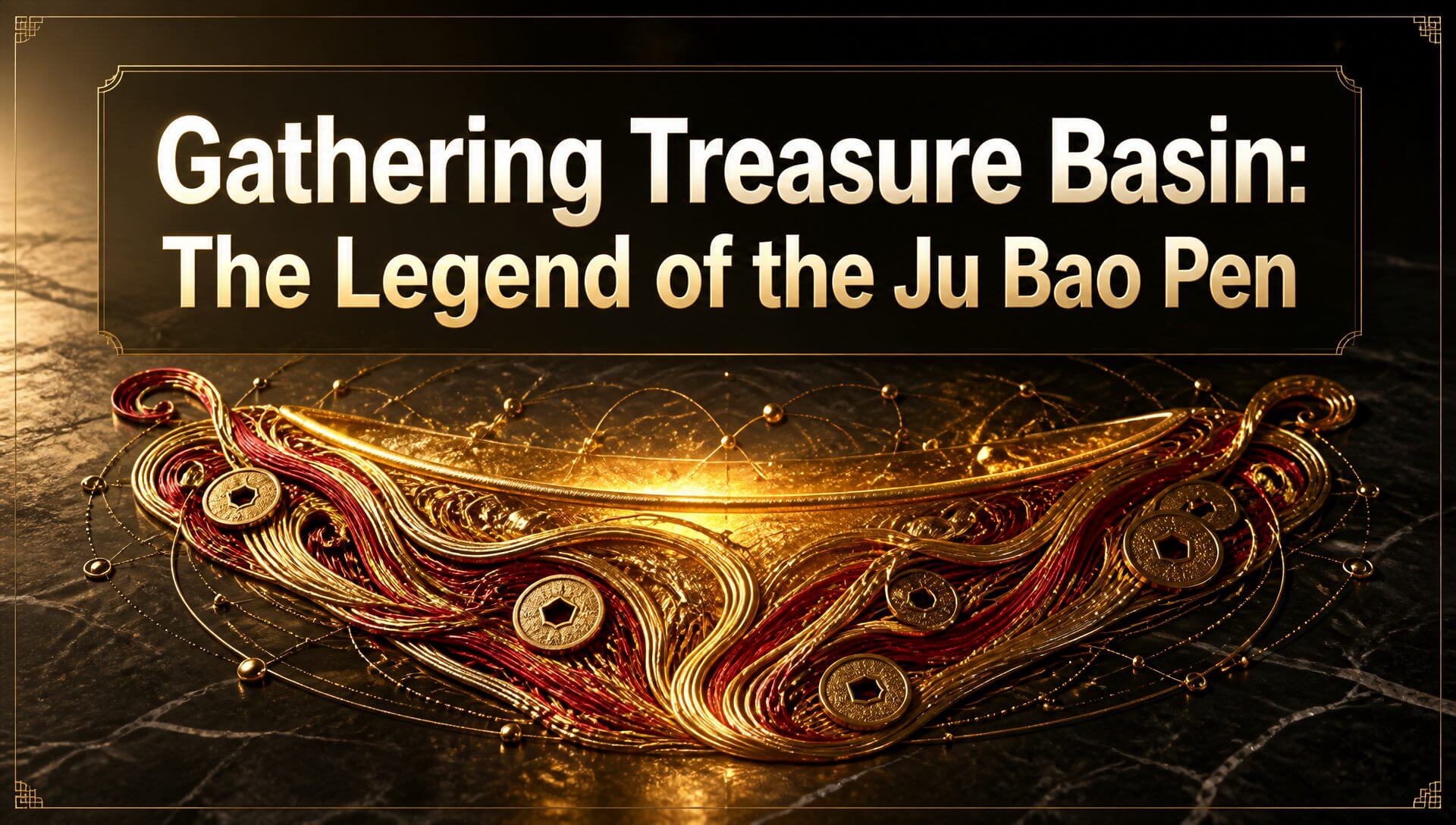
What Is a Ju Bao Pen? Two Ways In for Complete Beginners
Ever seen a Japanese lucky cat waving from a shop counter? Heard the Irish legend about the pot of gold at the end of the rainbow? Then you’re already halfway to understanding the ju bao pen (a treasure bowl said to multiply whatever is placed inside it). Nearly every culture has some magical object that answers the question “where does wealth come from?” In Chinese folk tradition, that object is a bowl. It looks perfectly ordinary. Still, its story has been told for hundreds of years, and it keeps showing up on Lunar New Year decorations today.
A Bowl That Makes More of Whatever You Put In It
The Chinese name is about as literal as names get: “ju” means to gather, “bao” means treasure, and “pen” means bowl or basin. The power it has in the legend is just as simple. Whatever goes in, the bowl fills itself to the brim with more of the same. Drop in one copper coin, and the next morning you’ve got a bowlful of copper coins. Drop in a single silver ingot, and the next morning you’ve got a bowlful of silver.
Here’s the thing a lot of people miss the first time they hear the story: the ju bao pen never makes something out of nothing. An empty bowl is still an empty bowl the next morning. The bowl amplifies. It doesn’t create. We’ll come back to this point later, because it’s very nearly the heart of the whole story.
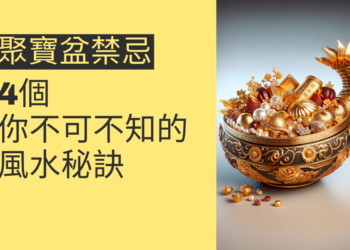
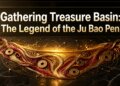
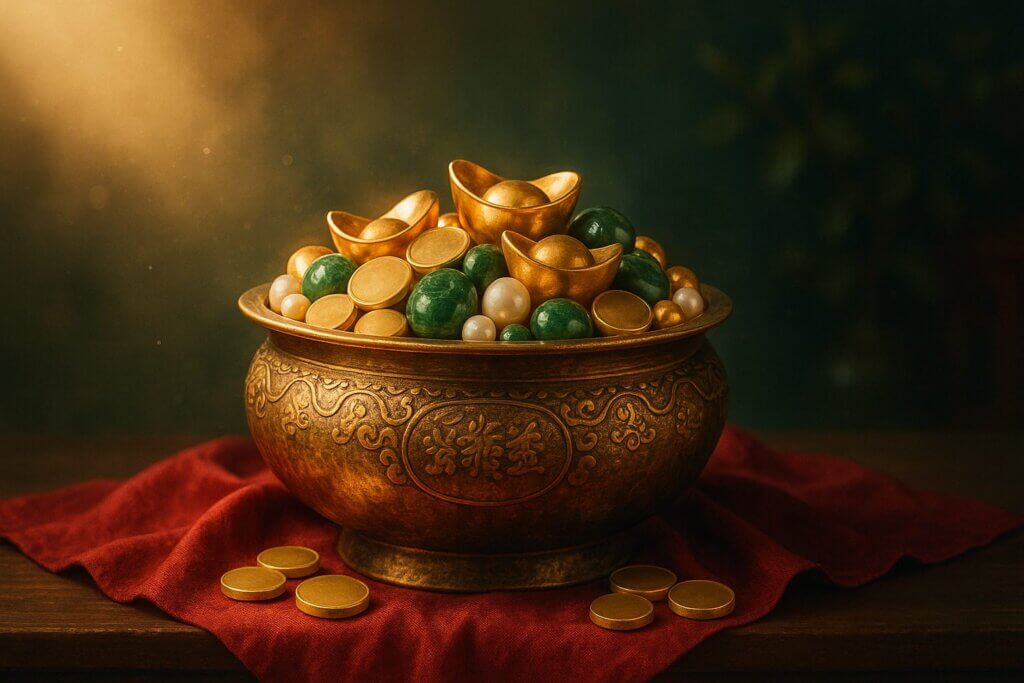
In pictures, the ju bao pen is usually drawn as a wide-mouthed bowl or basin heaped with gold ingots, copper coins, coral and pearls, sometimes with rays of light streaming out of it. If you’ve ever walked through a Chinese neighborhood around Lunar New Year, there’s a decent chance you’ve seen it already, on a red New Year print or a paper cutout, and had no idea what you were looking at.
Where It Fits Among the Gods of Wealth
Before the ju bao pen makes sense, you need to meet Caishen, the Chinese god of wealth. Chinese folk religion doesn’t revolve around a single deity. Think of it as a sprawling bureaucracy, with one office for rainfall, another for exams, another for marriage, and, naturally, one for money. The deities in charge of money are known collectively as Caishen, and there’s more than one of them. Some started out as generals, some as court officials, some as merchants, and each comes with a story of his own.
So is the ju bao pen a god? No. It’s part of Caishen’s gear. In traditional portraits, some versions of Caishen have a ju bao pen sitting at their feet, or an attendant standing beside them holding one. Its role is a little like Thor’s hammer in Norse mythology: the object is famous in its own right and has its own stories, but its meaning is tied to the god who carries it.
Now for the interesting part. People tend to picture a god of wealth as someone who tosses money around at random, and that’s a long way from how folk tradition sees Caishen. In the traditional telling, he’s closer to a sharp-eyed investor, and cash isn’t what he hands out. What he gives is something called money energy — the idea that wealth behaves like a current rather than a pile, which you can think of as opportunity, luck and the conditions for making money. And Caishen has standards for deciding who receives it. The story of the ju bao pen happens to be a story about exactly those standards.
Where the Ju Bao Pen Comes From: The Legend of Shen Wansan in Three Acts
Pull on almost any story about the ju bao pen and you’ll find the same man at the other end: Shen Wansan. He was a real person. He lived in the Jiangnan region of southern China in the fourteenth century, right as the Yuan dynasty was giving way to the Ming, and he ranked among the wealthiest merchants of his day. His fortune was so hard to wrap your head around that later generations reached for a legend to explain it, and some strands of folk belief eventually went a step further and counted him among the gods of wealth. The legend plays out in three acts.
The Poor Man Who Saved a Pond’s Worth of Frogs
When the story opens, Shen Wansan is no tycoon. He’s a young man scraping by like everybody else. One day on the road he runs into a fisherman who has caught more than a hundred frogs and is about to butcher and sell them. Shen can’t stand to watch. He empties his pockets, buys every last frog, carries them to the edge of a pond, and lets them go.
That night the croaking from the pond is loud enough to shake the sky, and he barely gets a wink of sleep. At daybreak he walks over to see what on earth is going on and finds the frogs gathered around an old clay basin, calling nonstop. Puzzled, he picks the basin up, takes it home, and puts it to work as a plain old washbasin.
Here’s the thing to notice in this opening: the order of events. In the story, the giving comes first and the treasure comes second. When Shen bought those frogs, he had no idea anything would ever come back to him; he simply did something that offered him no advantage at all. Folk tales love this setup. The treasure never lands in the hands of someone who’s only thinking about what they can get.
A Silver Hairpin Falls Into the Basin
The turning point shows up in a thoroughly ordinary moment. One day Shen Wansan’s wife is washing her hands at the basin when the silver hairpin in her hair slips loose and drops in. She reaches down to fish it out and finds the basin brimming with silver hairpins, more than she could ever scoop out. Startled, and more than a little suspicious, the couple decide it’s worth a shot to toss in a single copper coin. Before long, the basin is heaped with copper coins.
That’s how the ju bao pen’s power comes to light. From then on Shen has capital, and he goes into business. Yet every version of the legend agrees on one detail: he doesn’t sit at home letting the basin mint money for him. He takes that capital and puts it into trade. The historical Shen Wansan was in fact famous for his overseas trading ventures, with goods shipped out from Jiangnan in every direction and silver flowing constantly in and out.
Put another way, even the legend doesn’t buy the idea that owning a magic basin is enough. The basin supplies a starting point. The fortune that follows still gets built the old-fashioned way, through circulation and the daily grind of running a business.
The Ending Beneath the City Gate
The story closes on a bittersweet note. After the Ming dynasty was founded, the emperor Zhu Yuanzhang set out to build the city walls of Nanjing, and Shen Wansan paid for a very large share of the project. According to the legend, one of the city gates collapsed no matter how many times it was rebuilt, and someone declared that only the ju bao pen, buried under the foundation, could hold it steady. So the emperor took the basin and had it buried beneath the gate, which came to be known among ordinary people as Jubao Gate, the “Gate of Gathered Treasure.”
And Shen Wansan himself? The legend says his enormous wealth, and the very public way he showed it off, stirred the emperor’s suspicion, and in the end he was exiled to the far southwestern frontier.
People have been chewing on that ending ever since. Think about where the basin winds up: in nobody’s house at all, but in the ground beneath a city’s foundations, where it became something that belonged to everyone. Some read this as a warning: wealth concentrated too heavily in one person can’t be held onto forever. Others read it as a homecoming: the greatest fortunes were always meant to return, eventually, to the many. Whichever reading you lean toward, it ties back to the same idea, that money has to keep moving.
How People Have Traditionally Treated the Ju Bao Pen: 3 Customs and the Thinking Behind Them
Legends that stick around long enough turn into customs. Over several centuries, Chinese communities built up a handful of practices tied to the ju bao pen. Some show up on shop counters. Others turn up in Lunar New Year decorations. Here’s a look at what people have traditionally done and, more to the point, what they were thinking when they did it. Even if you never plan to follow a single one of these customs, the ideas behind them are worth a look.
The Bowl Is Never Left Empty: Something Has to Go In First
Traditionally, some families and shopkeepers keep a symbolic ju bao pen at home or on the counter, and by habit they don’t leave it empty. There’s usually something sitting inside: a few coins, a little rice or grain. The folk saying doesn’t mince words. An empty bowl gathers no wealth.
That habit comes straight from one detail in the legend. The bowl multiplies what’s put into it. It never creates anything. Translate that into modern terms and you get a plain piece of financial common sense: without principal, compound interest has nothing to compound. You have to save the first dollar, learn the first skill, and build the first relationship of trust. Only then does “more” have anything to work on.
People tend to picture wealth as a bowl that spits out money from thin air. For hundreds of years, this custom has been quietly making the opposite case: what you put in decides what you can take out.
Wealth Has to Move: Why Sharing Gets So Much Emphasis
One idea sits at the center of the folk understanding of Caishen. When he extends money energy to a person, it’s an act of trust. He expects that person to use it well and then let it flow onward. In the traditional telling, the more you share of what you receive, the more money energy comes your way. And for someone who only takes in and never lets anything out? The flow stalls.
People often misread this as a rule that if you earn $100, you have to give away $90. The folk version is a lot more relaxed than that. What matters is keeping the energy moving, and there’s more than one way to move it. Volunteering your time counts as sharing. So does passing along to friends and family the good ideas you’ve picked up about how to think about money and manage it. That second kind is often considered the best of all, because it leaves the other person able to build abundance on their own. A one-time gift can’t do that.
The traditional image for this process is a snowball. You share something, someone else’s life improves, part of that benefit finds its way back to you, and the loop grows with every turn. Set the belief aside and you’re looking at what people today call networks, reputation, and reciprocity. Over the long haul, people who are willing to teach others and give them a hand up do tend to have more opportunities around them.
How Caishen Sees It: Getting Rich Yourself Is Nothing Special
Folk legend offers one more angle that’s fun to chew on. Before they became gods, many of the wealth deities were rich merchants themselves, or officials in charge of money and grain, and their circles were full of wealthy people. From where they stand, one person having a lot of money is nothing to write home about.
So what does catch Caishen’s attention? The kind of person who helps other people prosper too. Think of it as an investment. Money energy handed to an ordinary person might earn fifty cents on the dollar. Handed to someone who spreads the benefit around, the same dollar might bring back ten. By that logic, Caishen naturally doubles down on the second kind of person.
This way of thinking also ties the Shen Wansan story together. He received the ju bao pen because he first gave something up for a group of frogs that had nothing to do with him. His fortune grew because he kept goods and silver circulating. And the bowl’s final resting place was the foundation of a city wall. From start to finish, the wealth in this story never sits still. If you take one idea away from the ju bao pen tradition, it’s probably this one. In this cultural view, a person’s wealth is measured by how much they’ve held on to, and also by how much has flowed outward through them.
5 Common Questions About the Ju Bao Pen
Meet the ju bao pen for the first time and you’ll probably land on the same handful of questions everyone else does. Is it real, or just a legend? How is it any different from the wealth-attracting objects other cultures have? And if you don’t believe in gods, what’s in it for you? Here are the five questions that come up most often, each one answered in full.
Q1: Did the ju bao pen ever actually exist?
The bowl itself belongs to legend, and no archaeologist is ever going to dig one up. The man attached to it, though? Completely real. Shen Wansan was a hugely wealthy merchant in the Jiangnan region, the lower Yangtze, during the transition from the Yuan dynasty to the Ming. Historical sources record both his family and his fortune. Nanjing also had a city gate historically known as Jubao Gate, the “Gathering Treasure Gate.” Scholars generally trace that name to nearby Jubao Hill, and it was the legend that later stitched the two together.
Real person plus magical object is a pattern that turns up in folklore all over the world. When someone’s success goes beyond what ordinary people can account for, a story grows up to explain it. Historical explanations of how Shen Wansan got rich include reclaiming and farming land, inheriting another man’s estate, and running overseas trade. But for ordinary people a few hundred years ago, “he had a magic bowl” was plainly the version that was easier to remember and a whole lot better to tell. As the story was handed down, each generation folded its own views about wealth into it, layer upon layer. That’s the real reason it’s still worth reading today.
Q2: How is the ju bao pen different from Japan’s lucky cat or the Western cornucopia?
The three do get lumped together a lot. The lucky cat (maneki-neko) is defined by its gesture. It beckons, with one paw raised to wave customers and good fortune through the door, so its point is attraction. The cornucopia of Greek and Roman myth, the horn of plenty you’ve seen on every Thanksgiving table runner, pours out food, fruit and flowers without end. Its point is unconditional abundance, and it never asks you to put anything in first.
The ju bao pen runs on a different logic from either one, and its keyword is “multiply.” An empty bowl does nothing at all, so something has to go in first. That gives the story a layer of meaning the other two lack, because what comes out depends on what you put in. The legend also opens with an act of mercy, the release of captured animals, and ends with the bowl buried under the city’s foundations. Taken whole, it traces a full cycle of giving, multiplying, and returning to the community, which makes it a good deal more than a good-luck mascot. Want the distinction in a single sentence? The cornucopia is about a gift, the lucky cat is about attraction, and the ju bao pen is about circulation.
Q3: Where do people traditionally come across the ju bao pen?
The most common setting is Lunar New Year. On the holiday’s woodblock prints, paper cuttings, red envelopes and decorations of every kind, you’ll often see a bowl heaped with gold ingots. Sometimes it sits beside an image of Caishen, or alongside a lucky phrase such as zhao cai jin bao (roughly, “may wealth and treasure come in”). For most Chinese families this is closer to seasonal decoration, a lot like hanging stockings at Christmas. It carries a wish for good things and doesn’t necessarily signal a serious religious act.
The other familiar setting is shops and restaurants. Some owners keep a symbolic ju bao pen on the counter or near the entrance, with a few coins inside. The thinking behind it was covered earlier: a bowl with something in it stands for a business that has capital to work with and money moving both in and out. Beyond that, the bowl and the Shen Wansan story are stock material in the brick and wood carvings of traditional buildings, and in folk opera and the repertoire of professional storytellers. Think of it as a cultural symbol woven into everyday life, one that was never confined to religious settings.
Q4: I don’t believe in gods. What does this story have to offer me?
No problem. You’re entirely free to read it as a fable about money, the same way reading Aesop doesn’t require believing that a tortoise really raced a hare. Strip away the mythological trappings, and the ju bao pen story leaves behind several surprisingly practical observations.
First, wealth needs a seed. Whether it’s savings, a skill or your credit and good name, you have to put something in before time and compounding have anything to work on. Second, wealth that stands still is fragile. Shen Wansan’s ending is a reminder that a fortune that’s heavily concentrated and has stopped moving tends not to last. Wealth in circulation has more life in it, whether it’s put into a business, used in partnerships, or shared with other people. Third, helping other people do better is no loss to you. The story’s claim that what you share rolls back around to you translates, in modern terms, to long-term trust and reciprocity opening up more opportunity. None of these ideas requires any belief as a starting point. They only ask that you be willing to look at money on a longer time scale.
Q5: What exactly is “money energy”? Is it the same thing as money?
Not quite, and this is where a lot of newcomers get tangled up. In the folk understanding, money energy and money are two separate things. Money energy is closer to the set of conditions that give money a chance to show up, meaning luck, opportunity, a helpful person and the right timing. The traditional way of putting it is that what Caishen hands out is money energy, and that it becomes actual wealth only through a person’s own effort. So having money energy doesn’t mean having money right away. The ju bao pen gave Shen Wansan his starting capital, but he still had to go out and run the business himself.
There’s real wisdom in the distinction, because it steers clear of two extremes at once. One is “it’s all luck, so effort is pointless,” and the other is “it’s all you, and luck doesn’t exist.” The idea of money energy grants that part of opportunity lies outside your control. It also insists that catching the opportunity, and deciding where to put it to use, is on you. Folk tradition adds one more line, and it’s an important one: whether or not the money energy has turned into actual wealth yet, whoever receives it is expected to keep it flowing onward. In this cultural view, wealth is never a destination. It’s a river that passes through you, and while it does, you get to decide whose fields it waters next.