What Is a Pixiu? 3 Things to Know About China’s Wealth-Guarding Mythical Beast
Maybe you’ve spotted one next to the register at a Chinese restaurant, on a shelf in a Chinese-owned shop, or in the living room of an Asian friend’s place: a small statue that’s part lion, part dragon, with its mouth hanging wide open. That’s a pixiu (say it roughly “pee-shyoh”). Here’s the first thing to know: it’s a mythical beast, and nobody treats it as a god. Within Chinese traditions around wealth, it’s about as recognizable as the lucky cat is in Japan. This section covers what it looks like, what its job is, and where it sits in the larger belief system.
1. What It Looks Like: A Mythical Beast Assembled from Parts
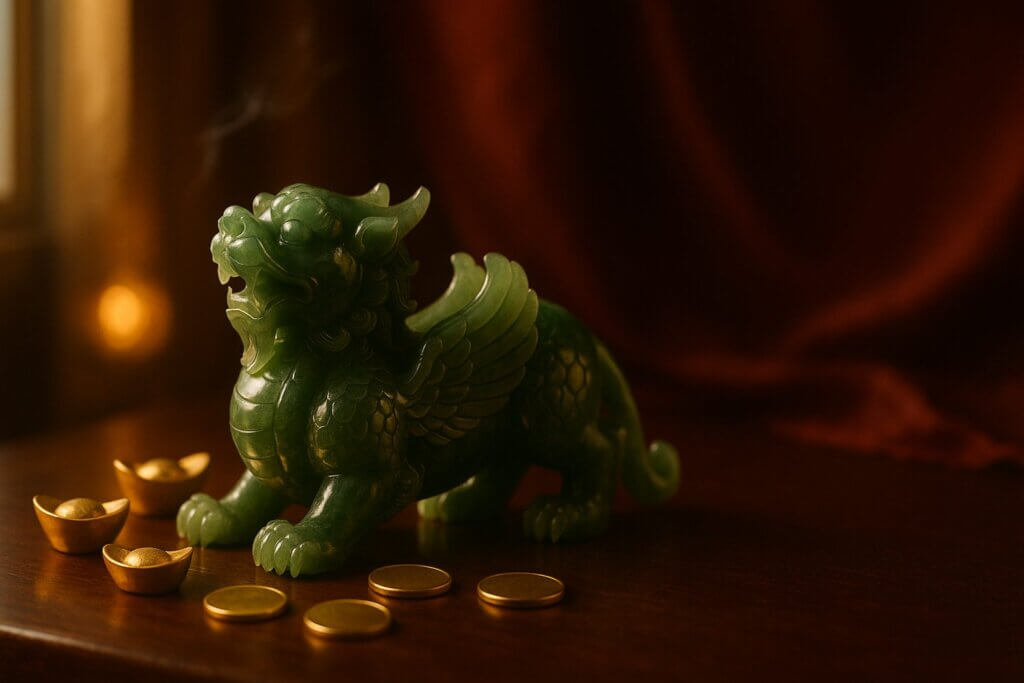
The pixiu is an imaginary animal, a cousin of sorts to the griffin or the unicorn in the West. The usual description gives it a dragon’s head, a body as powerfully built as a lion’s or a bear’s, a pair of wings on its back, and horns on its head. Old texts get even more specific: the one-horned version was called tianlu (“heavenly fortune”) and the two-horned version bixie (“warder-off of evil”). Over time, ordinary people dropped the distinction and just called them all pixiu. Two features of the design never change. One is a gaping mouth. The other is a round, full belly and hindquarters. And no, that wasn’t some craftsman’s artistic whim. Those features illustrate the legend — a mouth big enough to swallow wealth from every direction, and a belly round enough to hold it all. Chinese auspicious imagery often works this way. The shape itself is a sentence.
2. What It Does: It Draws Wealth In, but Above All It Guards It
Chinese wealth traditions have a big cast of characters, and they don’t all do the same job. Take Caishen, the Chinese god of wealth. In his various forms, he’s more like the one who hands out opportunities — people traditionally credit him with bringing good fortune, business, and helpful connections. The pixiu plays a different part. Its job is to bite wealth, drag it home, and then stand watch so none of it slips away. The key is its most famous legend: the pixiu eats but never excretes, so every bit of gold, silver, and treasure it swallows stays in its belly. So what does it stand for in the folk imagination? Holding on to what you’ve earned, more than earning a lot in the first place. That distinction is worth a second look. A culture went to the trouble of creating a dedicated symbol just for keeping money, which tells you people figured out very early that making it and keeping it are two different skills.
3. Where It Fits in Folk Belief: A Guardian, Not a Deity
People don’t make offerings to a pixiu. Traditionally, no one lights incense or prays to one, and it has no home altar of its own. Its standing is much closer to that of stone lions and door gods — the guardian category. Placed somewhere, it signals defense and watchfulness. In fact, its original main function was warding off evil, meaning it kept bad things out, and many of the stone beasts stationed in front of ancient tombs and city gates are its ancestors. The wealth association got layered on later. Once you know that, the fierce expression every pixiu wears makes a lot more sense. It was a sentry from day one. The only thing that changed is what it guards — city gates then, wallets now.
From the Battlefield to the Cash Box: 3 Legends That Turned the Pixiu Into a Symbol of Wealth
Nobody sat down and wrote the pixiu’s story in one go. It piled up in layers over a few thousand years. The pixiu started out as a fierce beast of the battlefield. Later, it got promoted to guardian of the imperial house. Later still, folk storytellers tacked on an episode about a punishment handed down in the heavenly court, and only then did it become the money-drawing creature people recognize today. Here’s the thing: the three legends don’t really add up to one plot. Set them side by side, though, and you can watch a culture slowly translate “ferocity” into “fortune.”
1. The Ancient War Beast: A Fierce Animal in the Yellow Emperor’s Army
The pixiu first shows up in written history more than two thousand years ago. In the Records of the Grand Historian, Sima Qian writes about the Yellow Emperor, the legendary common ancestor of the Chinese people. While at war with his rival the Yan Emperor, he’s said to have trained six kinds of fierce animals for battle: black bears, brown bears, pi, xiu, chu (another big predator) and tigers. Notice that the pi and the xiu are still two separate animals at this point. They most likely refer to some real predator, though some scholars think the names belonged to tribes that took those beasts as their totems. Either reading gets you to the same place. In its original context, “pixiu” was simply another word for ferocity, and ancient writers even used it as a name for elite troops. Money? Nowhere in the picture yet.
2. The Dragon’s Ninth Son: The Child Born With a Taste for Gold and Silver
Later folklore gave the pixiu a pretty impressive family tree. A Chinese saying holds that “the dragon has nine sons, and no two are alike.” Each son has his own looks, his own temperament and his own passion. One loves music, so he’s carved onto the heads of stringed instruments. Another loves carrying heavy loads, so he bears stone tablets on his back. In some versions of the list, the pixiu is the ninth son, and his passion is eating gold, silver and jewels. Step back, and the whole scheme is a charming piece of folk explanation. People saw all sorts of animal-shaped ornaments on buildings and objects, with origins nobody could quite account for. So they wrote them into a single family, and each child’s “passion” neatly explains why he turns up where he does. A pixiu who loves eating treasure? Naturally, he got assigned to stay wherever the money is.
3. The Jade Emperor’s Punishment: Where “Everything In, Nothing Out” Comes From
Of the three, this is the one that gets told the most. As the story goes, the pixiu was a pampered favorite in the heavenly court and ate far too much. One day it relieved itself right on the palace floor. That enraged the Jade Emperor, the supreme ruler of the heavens. He brought his hand down and landed a smack squarely on the creature’s backside, and the blow sealed its anus shut. From then on, all the gold, silver and treasure the pixiu swallowed went in and never came out, and its belly grew rounder and rounder. The tale has the earthy humor that folk legends specialize in, but it also pulls off an elegant reversal: a punishment becomes a gift. It’s also the episode that officially turned the pixiu from a “fierce guardian” into a “keeper of wealth.” And here’s a detail that’s easy to miss: the story actually begins as a warning about gluttony and losing control. Hold that thought, because we’ll come back to it a little later.
How Do People Traditionally Treat a Pixiu? 3 Customs and the View of Money Behind Them
So that’s where the Pixiu comes from. How does it actually show up in everyday life? Chinese communities have built up a fair number of unwritten conventions around this creature, and at first glance they read like a checklist of superstitions. Here’s the thing, though: ask “why?” of each one and you’ll find a plain, practical lesson about money tucked inside. You don’t have to believe a Pixiu really heads out and hauls money home in its jaws to get something out of this. Taken together, the three customs below add up to a surprisingly complete philosophy of money.
1. Head Facing Out, Never Facing a Mirror: Keep Your Attention Where Opportunity Comes From
Traditionally, people place a Pixiu with its head pointed toward the front door or out a window. The idea is that it “goes out” and carries the wealth outside back in its jaws. By the same convention, it’s never set directly facing a mirror or a bathroom. Shopkeepers often keep one near the cash register, facing the direction customers walk in from. Translate the symbolism into plain English and you get a very practical statement. Wealth comes from the world outside: customers, markets, your dealings with other people. Shutting the door and staring at yourself won’t produce any. A merchant who sees that little beast facing the entrance every morning gets the same nudge every morning, which is to keep an eye on the door. And when an ornament gets handed down through generation after generation of merchants, odds are it’s because it really does work as a reminder.
2. Not Letting Just Anyone Touch It: Your Finances Need Boundaries
Another common convention holds that a Pixiu recognizes its owner and doesn’t like being handled by outsiders, especially around the mouth and eyes. Some people add that the owner traditionally pets it often, building a bond with it the way you would with a pet. The intuition behind this one is actually pretty modern: your money needs boundaries. In traditional Chinese society, lending between relatives and friends was extremely common, and so was going into business together or cosigning someone’s loan. The social pressure to say yes was heavy. “Nobody touches my Pixiu” gave people a way to say, without torching the relationship, “My finances are mine to manage and mine to decide.” The part about the owner staying close to it covers the other half of the job. You have to keep checking in on your own finances rather than leaving them to gather dust on a shelf. The first step in holding on to money has always been knowing how much you have and where it’s going.
3. The Other Side of “Only In, Never Out”: Holding On and Letting Flow Have to Coexist
This is the point I think is most worth talking about. If the Chinese view of wealth boiled down to “only in, never out,” it would be nothing more than a philosophy of stinginess. But within the very same belief system, the lore around Caishen, the Chinese god of wealth, points in exactly the opposite direction. There’s a folk idea worth knowing here, not as a financial rule but as a cultural lens on wealth. When Caishen hands someone a share of money energy (the idea that wealth behaves like a current rather than a pile), it’s an act of trust. He expects that person to use it well and pass it along. In terms you already own, that’s reciprocity. Givers gain, and the more you share, the more the cycle grows, like a snowball picking up size as it rolls downhill. Sharing doesn’t have to mean writing a check, either. Teaching friends and family something useful counts as keeping things in circulation, and so does giving your time as a volunteer. The traditional view goes further still. Getting rich yourself is nothing special. The person truly worth “investing” in is the one who can help other people prosper too.
Set the Pixiu and Caishen side by side, and that’s when the full picture of this culture comes into view. The Pixiu is in charge of “no leaks.” It keeps money from draining away pointlessly through carelessness, impulse, or a lack of boundaries. Caishen is in charge of “wealth has to move.” You deliberately send resources, knowledge, and time out into the world so they come back carrying more with them. Do the two contradict each other? They don’t. What separates them is whether the money leaked out or you sent it out. Now think back to that slap from the Jade Emperor. The Pixiu’s story begins with gluttony that had no limit, and a beast that can only swallow was originally a figure of punishment. It became a symbol of good fortune only once it was given the duty of standing guard. “Only in, never out” was never meant to be the whole ideal. It needs its other half for balance.
5 Common Questions About the Pixiu
People meeting the pixiu for the first time tend to ask the same things. How is it different from a stone lion or a lucky cat? Why is there a male and a female? Can you display one if you don’t buy into any of this? Here are the five questions that come up most often. In each answer, I’ll try to keep two things apart: what the tradition says, and what the tradition is trying to get at. That way you can decide for yourself which parts mean something to you.
Q1: How is a pixiu different from a stone lion or a qilin?
All three are guardian creatures you’ll see all over Chinese culture, and newcomers mix them up constantly. The easiest way to tell them apart is to look at their job descriptions. Stone lions usually stand in pairs on either side of a building’s main entrance, the male with a paw resting on an embroidered ball and the female with a cub under hers. Their task is to guard the threshold. They stand for authority and protection, and they have very little to do with money. The qilin has scales on its body, a horn on its head and hooves for feet. It’s a gentle creature, so gentle that legend says it can’t bear to step on a blade of grass. It stands for kindness, good omens and gifted descendants, which is where the folk saying “the qilin delivers children” (qilin song zi) comes from. The pixiu has wings, a wide mouth, a round belly and a fierce expression, and its specialties are warding off harm and guarding wealth. In short: the stone lion guards the door, the qilin brings blessings and talented children, and the pixiu keeps an eye on the money. That careful division of labor is interesting in its own right. Chinese folk belief doesn’t put much faith in one all-purpose symbol. It takes the different hopes of everyday life and hands each one to a specialist.
Q2: Why do pixiu usually come in pairs? Is there really a male and a female?
There really is a folk saying that the male pixiu brings wealth in and the female pixiu keeps it there. That’s why many people display them as a pair: one to go out hunting, one to stay home and stand guard. Some people tell male from female by whether the figure has one horn or two, or by which foot is stepping forward. But the explanations vary from region to region, and if you ask ten people you may well get several different answers. That’s typical of folk belief. There’s no central authority handing down official interpretations here, just a set of customs that grew slowly, passed along by word of mouth from one place to the next. So which system is “correct”? Honestly, I think that’s the less interesting question. Look at the structure of the saying itself. It treats making money and keeping money as two distinct jobs, each needing its own dedicated role. Plenty of people earn a good income and still can’t save, and the trouble is often that they’ve got the one that goes out hunting and nobody at home standing guard.
Q3: I’m not Chinese and I don’t share this belief. Is it disrespectful to display a pixiu?
Generally speaking, no. The pixiu is not a deity, and there is no ritual of making offerings to it. Within Chinese communities it has always sat closer to auspicious decoration and cultural symbol than to sacred religious object. Many Chinese people who keep a pixiu simply see it as a nice touch of good luck, and they don’t think of themselves as doing anything religious. It’s a lot like the lucky cat: you don’t need to be Japanese to put one in your store. Whether you’re allowed to display one was never really the issue. Respect comes down to whether you know what it is. If you know its story, understand that it stands for protection and for holding on to wealth, and enjoy it as a cultural object with a real history behind it, you’re in good shape. What sits less well is treating it as a pure gag prop, or claiming it has some magical power that guarantees riches. That second one, as it happens, is something many Chinese elders wouldn’t say either.
Q4: Can a pixiu actually bring wealth?
Here’s my honest take: there is no evidence that a statue can change your bank balance. But I think the question is worth asking a different way. Does a symbolic object sitting in a room do anything for a person? That one gets a yes. Humans are very good at using objects to remind themselves of what matters. Think of a wedding ring, a family photo on the desk, or the finisher’s medal a marathon runner hangs on the wall. For many Chinese shopkeepers, the pixiu is that kind of object. Seeing it face the front door every morning at opening time is a nudge to pay attention to customers, to watch expenses and to think twice before lending money out. If that reminder makes someone pause three extra seconds before spending, it really does add up over the long run. The habit is doing the work there, and the beast is just the cue. I suspect that’s why customs like this one have lasted for a thousand years and more. They hold advice that actually works, and the legend is the wrapping that makes the advice easier to remember.
Q5: “Only takes in, never lets out” sounds greedy. Is that what Chinese culture encourages?
That’s a fair challenge, and the answer is no. If you look only at the pixiu, it’s easy to come away thinking Chinese culture prizes hoarding, but the pixiu is just one corner of a larger picture. In the same world of belief, the lore around Caishen says money should move and be shared. Folk tradition holds that money energy is entrusted rather than owned. Whoever receives it is expected to pass it along, whether as money or as knowledge and time, and the people Caishen is said to favor most are the ones who help others prosper too. Chinese tradition has never been short on mockery of misers, either. The penny-pincher who won’t part with a single coin has always been a punchline in opera and folktales. So the more accurate reading is that the pixiu stands for “don’t leak,” not “don’t give.” Losing money to carelessness, to impulse, or to being too embarrassed to say no is one thing. Giving generously and on purpose is another. This culture values plugging the first and practicing the second, both at the same time.
Step back, and this small beast turns out to carry a surprisingly mature observation. Earning wealth is only half the job. Keeping it is the other half, and the reason to keep it is so you have the power to choose where it goes and to send it somewhere worthy. Here is a culture that posts a ferocious mythical creature to guard the cash box and then calls on a whole company of generous wealth gods to remind people to share. The tension between the two may be the most practical lesson about money that Chinese tradition has left us: watch the way in, and think carefully about the way out.