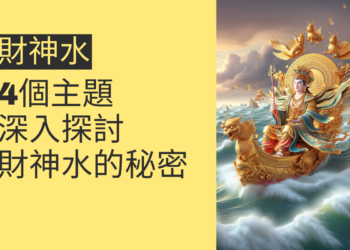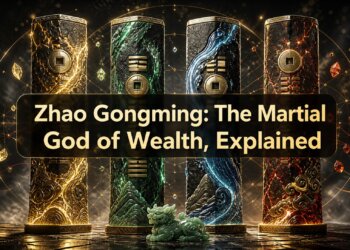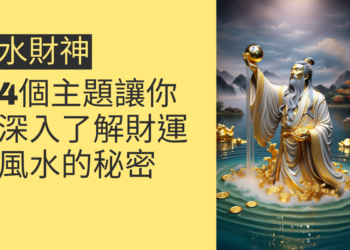
Who Is the Central Path God of Wealth? Three Things to Know About One of Chinese Folk Religion’s Key Figures
If everything you know about Chinese culture comes from kung fu movies and Lunar New Year parades, Caishen, the Chinese god of wealth, is probably a new name to you. Here’s the short version: he’s the deity in Chinese folk religion whose whole portfolio is money — though “portfolio” covers a lot more ground than you’d expect. There are many gods of wealth, and one of them sits at the center of the entire arrangement. He’s known as the Central Path god of wealth (zhong lu cai shen). Understanding him comes down to three facts: he isn’t the only god of wealth, he’s the martial god of wealth rather than the civil one, and what he presides over isn’t only money.
1. There’s More Than One God of Wealth: The Five Paths and the One in the Middle
Chinese folk religion isn’t monotheistic. It looks a lot more like Greek or Norse mythology — a whole society of gods with assigned duties, a bureaucracy in the sky mirroring the one on the ground. Wealth, naturally, gets its own department. And it isn’t a one-man operation: tradition recognizes the Five Paths gods of wealth (wu lu cai shen), corresponding to east, south, west, north and center. The logic behind “five paths” is worth sitting with. It assumes wealth arrives from every direction at once — a merchant heading east finds eastern money, a merchant heading south finds southern money, and no direction gets written off as a dead end.
The Central Path god of wealth is the one standing in the middle, presiding over the other four. His name is Zhao Gongming, and he’s also called Xuantan Zhenjun (the True Lord of the Dark Altar). “Central path” carries two meanings: central in position, and central in rank. The other four are each responsible for one piece of the business — summoning treasure, gathering valuables, drawing in wealth, and profiting from trade. Think of them as four distinct links in the chain of making money: finding resources, holding on to value, bringing in cash, and closing the deal. The Central Path god of wealth is the one who ties the whole system together. That’s why, in a Chinese temple, when you see five statues lined up side by side, the one in the middle is usually him.
2. Why “Martial”: The Black Tiger, the Steel Whip, and That Gold Ingot
Chinese gods of wealth come in two varieties, civil and martial. The civil god of wealth is typically depicted in the robes of a scholar-official, and what he represents is salary, steady employment, wealth earned inside an established system. The Central Path god of wealth is the martial god of wealth, and he’s depicted riding a black tiger, a steel whip in one hand and a gold ingot in the other — the boat-shaped bars of gold and silver that served as currency in imperial China.
That image deserves a second look. Why would a deity in charge of wealth need a weapon and a big cat? Because in the traditional understanding, money has two sides: getting it, and keeping it. Commerce is full of con artists, deadbeats and counterparties who suddenly can’t remember what the contract said, so the god who handles money needs some muscle to keep that behavior in check. The steel whip isn’t there to hit you with. It’s there to back up the people who play fair. That’s exactly why merchants held him in such high regard — not because he conjures money out of thin air, but because he was understood to keep order in the marketplace.
3. He Doesn’t Just Handle Money: Fairness, Credit, and the Order of the Deal
Traditional texts assign the Central Path god of wealth one duty that tells you almost everything: “buying and selling, seeking wealth, fair dealing.” In plain English, he isn’t concerned with who earns the most. He’s concerned with who earns it honestly. Cooked books, junk goods sold as premium, payment taken for work never delivered — in the folk understanding, all of it goes down in his ledger.
That makes him a different kind of figure from the wealth gods you’ll find in most other traditions. He isn’t a pure good-luck symbol. He’s closer to a business partner who comes with a morals clause attached. Traditionally, people believed that whether he was willing to give had everything to do with how clean your hands were around money. So in a Chinese context, making offerings to a god of wealth was never a simple “let me win the lottery” wish — it was submitting yourself to an audit of your own credibility. And you don’t have to believe this deity exists to see the point of the design: it welds “making money” to “being a decent person” so the two can’t be graded separately.

From Mortal to Deity: 3 Turning Points in the Story of the Central Path God of Wealth
Most Chinese deities had a life before godhood. They were historical figures or legendary ones, elevated after death because of some quality they stood for. Caishen, the Chinese god of wealth, is no exception — and here’s the thing, his story is a lousy motivational poster. He didn’t get the job by making a fortune, and he ended up on the losing side of a war. How that turn happened is a lot more interesting than where it landed.
1. The Man Cultivating in the Mountains: Where the Story Starts
Zhao Gongming’s earliest appearances are scattered across old Daoist texts, and his role in them is murky — sometimes a god presiding over plague, sometimes a commander in the underworld, with no connection to money at all. He took his familiar form through a single Ming dynasty novel, Investiture of the Gods. Think of that book as the Chinese Iliad crossed with American Gods: it swept a mass of loose folk legend into one coherent universe, and in the process settled who was who.
In the novel, Zhao Gongming is a Daoist who has spent years cultivating in the mountains — formidable in power, blunt and unbending in character. He wanted nothing to do with worldly affairs. He came down from the mountain and into a dynasty-ending war for exactly one reason: an old friend showed up asking for help. He chose the Shang side, which is to say the side that lost. That detail matters more than it looks. He didn’t enter the war for gain, he entered it out of loyalty. Chinese has a phrase for that quality, roughly “a person of feeling and honor” (you qing you yi), and in his case it’s where the whole story begins.
2. He Lost the War and Was Made a God Anyway
The war did not go well for Zhao Gongming. For a stretch he beat the other side so badly they had no answer for him, and in the end he was brought down not in open combat but by something close to a curse — a hidden, underhanded technique. In the logic of traditional storytelling, that manner of death carries weight: when someone dies for holding a position, and dies in a way that was never settled fairly, his qi doesn’t disperse.
When the gods were invested after the war, the victorious side’s chief strategist didn’t disqualify him for backing the wrong army. He was named Marshal of the Mysterious Altar (xuan tan zhen jun) instead, given command of four subordinates — Attracting Treasure, Gathering Riches, Bringing in Wealth, and Profit in the Market — and installed as the central path god of wealth among the Five Paths gods of wealth (wu lu cai shen). That arrangement carries a message inside Chinese culture: you judge a person by their character, not by which team they were on or whether they won. A man who kept faith to the point of death was handed custody of the one thing in human life most likely to make people break faith — money. Call it a coincidence if you want. It fits a little too neatly for that.
3. From Novel Character to Popular Belief: How a Story Grows into Daily Life
Over the centuries that followed, this character walked off the page. Merchants started keeping him in their shops as the backer of the business. A day for welcoming the god of wealth showed up on the Lunar New Year calendar. His image got printed on New Year prints and pasted on the doors and walls of millions of homes. Today even Chinese people who’ve never set foot in a temple can more or less describe what the god of wealth looks like — riding a tiger, holding a whip, beaming as he cradles a gold ingot.
The process itself is worth noticing. Which figure a culture picks for its god of wealth says a lot about how that culture imagines money is supposed to arrive. They didn’t pick the richest hoarder. They didn’t pick the shrewdest merchant. They picked a general who kept his word, held his position, and was killed by a dirty trick. Read that as a collective statement of values: wealth is legitimate because of the character of the person holding it.
Flow, Credit, and Sharing: The Money Ideas Behind Three Traditional Customs
Here’s a look at how people have traditionally treated the civil god of wealth. One thing to get straight up front: this is a description of what the customs look like and why people do them — not a set of instructions for you. The ritual isn’t really the interesting part. What’s interesting is that every one of these practices has a particular view of money baked into it, and that view might be worth something to you even if you don’t believe in any deity at all.
1. Welcoming the god of wealth on the fifth day: a sense of timing built around starting over
During the Lunar New Year, Chinese communities mark a specific day called the fifth. Traditionally the days before it are for resting and visiting relatives, with no business conducted; on the fifth, shops open their doors again, and that day became known as the day for welcoming the god of wealth. Some people set off firecrackers and open the doors before dawn, a gesture that symbolizes bringing Caishen inside.
Set the deity aside and what’s left is a piece of engineering about rhythm. The custom builds in a stretch of time when everything stops, then uses one clearly marked, ceremonial moment to announce that the new year’s work has begun. A financial fresh start needs a starting line, and people are famously bad at drawing that line for themselves — so the culture drew it for you. Plenty of societies have some version of this; only the form differs. The fiscal year. New Year’s resolutions. The budget spreadsheet you open on the first of the month. What’s distinctive here is that Chinese tradition turned the line into something loud and communal, done by the whole town at once, which makes it very hard to ignore.
2. Offerings, borrowed seed money, and paying it back: credit is a skill you can practice
The offerings traditionally set out before the civil god of wealth tend to be fruit, candy, wine, and similar things, with the quantities and varieties differing from region to region. The logic underneath is where it gets good. In folk understanding, an offering isn’t a bribe — everybody knows perfectly well that a deity has no use for your orange. It works more like a statement of intent: you’re willing to put something in first rather than show up empty-handed and ask.
More telling still is a custom found in some places, in which people borrow a small symbolic sum from the god of wealth to use as seed money, with an agreement to return it with interest within the year. The amount returned is usually a little more than what was taken. None of this is legally binding. Nobody’s coming after you, and it doesn’t show up on a credit report — yet a great many people are said to pay it back, and to remember the debt clearly for a full year.
What makes the design clever is that it turns credit into a small, repeatable exercise. Someone who takes a hundred dollars borrowed from a god seriously enough to return it, and someone who figures nobody’s checking anyway, are usually two different people in real business relationships too. Traditionally, the civil god of wealth is believed to care about exactly this, because he governs fair dealing in the first place: what he’s watching isn’t how much you borrowed, but whether your word holds.
3. Money energy has to move: what this cultural idea offers a modern reader
There’s a term that comes up constantly when Chinese tradition talks about wealth deities — money energy, the idea that wealth behaves like a current rather than a pile. It isn’t the cash already in your hand; it’s something still in motion, still capable of turning into money. And the concept has essentially one rule at its core: money energy has to move, and what doesn’t move disperses.
The traditional framing goes like this. When the god of wealth shares money energy with you, that’s an act of trust — the expectation is that you’ll use it well and pass some of it back out. But “passing it back” gets badly misread as earning a hundred and donating ninety. That’s not it. Sharing here means keeping the current flowing outward. Telling a friend an idea you learned that genuinely helps them is sharing. Volunteering your time is sharing. Saving a beginner three years of wrong turns is sharing too. And when what you pass along actually makes someone else better off, some portion of it finds its way back to you in ways you didn’t plan for, and the snowball starts rolling.
One line in this logic is unusually blunt: to a god of wealth, getting rich by yourself is nothing special. The reasoning behind that is practical enough — these figures spent their pre-divine lives dealing with wealthy people, and they’ve seen plenty of them. The person worth doubling down on is the one who can pull others up along the way, because a dollar invested there doesn’t come back as fifty cents. It comes back as ten.
Strip the deity out entirely and the passage still holds. Connections, knowledge, and opportunities all behave this way by nature: hoard them and they expire, hand them out and they appreciate. Teach someone something and you’ll understand it more deeply yourself. Refer an opportunity along and you’ll find the referrer’s seat is worth more than the participant’s. What Chinese tradition wrapped in the slightly mystical language of money energy is actually a fairly modern observation — in a densely connected world, the asset that holds its value best is how many people are better off because of you. Maybe the story of the civil god of wealth survived precisely because it packaged that idea into an image people could remember.
5 Common Questions About Zhao Gongming
By now you’ve probably got a rough sketch of who this deity is. But if you came in with zero background in the culture, a few things still snag — how he’s different from the other wealth gods, whether making offerings to him is just superstition with better costuming, and how far an outsider can really get with any of this. Here are the five questions that come up most. The answers stay on the cultural side of the line, not the religious one.
1. What actually separates Zhao Gongming from the other wealth gods?
Mostly portfolio and personality. The civil god of wealth covers stable, institutional income — salary, stipend, doing well on exams, moving up a rung — and he’s depicted to match, as a mild-mannered civil official. Zhao Gongming is a martial god of wealth, and his territory is money you go out and take: deals, trade, cracking open a new market. He rides a black tiger and carries a steel whip. So merchants have traditionally been the ones who honored him, while people on a fixed paycheck more often mention the civil god of wealth instead.
The other difference is rank. Among the Five Paths gods of wealth (wu lu cai shen), the other four have narrower briefs — attracting treasure, taking in valuables, drawing wealth, and profitable trade, one link in the chain each. Zhao Gongming commands them, which is why many accounts hold that honoring him covers all five paths at once. That’s the real weight behind the “central path” title: he isn’t one of five, he’s the center that ties the whole system together.
2. Isn’t making offerings to a god of wealth just superstition dressed up as “get rich quick”?
If you only watch the surface gestures, sure, that’s an easy call to make. The cultural content underneath is more complicated. What people traditionally asked Zhao Gongming for was rarely “give me ten million” — it was closer to “let this business run smoothly, let me run it honestly, and let the people I deal with keep their word.” His domain is fair dealing in the first place, and asking a god of fair dealing for something you didn’t earn doesn’t hold together even inside the logic of the belief itself.
A closer comparison might be a recurring financial self-audit. You stand there and account to yourself for how you made your money this year, what you owe anyone, and what you intend to do next. That kind of moment — talking straight to yourself, no flinching — has value in any culture. Whether the deity exists and is listening is a question of personal belief. But the custom does push people to check their own financial character on a schedule, and that function is real regardless.
3. Why does this tradition put so much weight on sharing and circulation?
It comes out of a broader Chinese view of wealth. In that view, wealth is imagined as something that flows rather than a fixed lump of metal. Standing water goes bad, and so does money that sits. It’s an old metaphor, but a pretty accurate one: assets that don’t move stop producing, relationships you don’t maintain go quiet, knowledge you never use fades.
The fuller version of the idea is that money energy comes with an expectation attached: use it well, and keep it moving outward by helping other people. So the sharing that counts most isn’t cutting one big check and calling it done. It’s passing along the ideas, methods, and openings that improved your own situation, so the people around you can build something too. Because they got there partly through you, some part of that circuit comes back around, and the current grows. In modern terms: the people who create positive-sum games earn the highest long-run returns. The Chinese version just says it with a better picture.
4. I’m not Chinese and I’m not religious — what’s in this for me?
Read it the way you’d read Norse mythology or Japanese lucky cats. Every culture takes its collective opinion about some part of life and pins it onto a concrete figure, and those figures are often more honest about what a culture actually believes than any textbook is.
Zhao Gongming tells you several specific things. This culture thinks wealth has to be guarded, so the god carries a weapon. It thinks making money and keeping your word can’t be pulled apart, so the same god also oversees fair dealing. It thinks money shouldn’t sit still, so the emphasis falls on circulation and sharing. And it thinks a person’s worth lies in whether they can bring others up with them, which is why getting rich alone isn’t considered impressive. You don’t have to accept a single supernatural claim to hold those four ideas up against your own attitude toward money and see where they line up and where they don’t. Cultural literacy earns its keep exactly when it shows you that something you assumed was obvious is really just one option among many.
5. What do the details in Zhao Gongming’s image mean?
Nearly every element of the depiction is carrying something. The black tiger is his mount and stands for the power to hold danger in check — in the traditional imagination, wherever money is, trouble tends to be close by, and that calls for something intimidating. The steel whip is a weapon that stands for keeping order and enforcing the rules on behalf of people who follow them, not for striking at anyone who comes asking for wealth. The ingot in his hand is old Chinese gold and silver currency, boat-shaped, and about as direct a symbol of wealth as you’ll find.
His face is usually dark, heavily bearded, and stern, which throws a lot of people the first time they see it — a god in charge of money, and he isn’t smiling at you. But that fits his character exactly: he isn’t there to flatter you, he’s there to size you up. Put it all together and the figure sends one consistent message. Wealth is a serious matter, it needs guarding, it needs rules, and it needs a witness who isn’t easy to fool. That an image like this has circulated in Chinese culture for centuries says plenty on its own about how the society regards money — wanted badly, and watched closely.