Meet the Five Paths Gods of Wealth: The Five Money Managers of Chinese Folk Religion
If your mental image of Chinese culture stops at red envelopes, dragon dances, and New Year firecrackers, here’s a door you probably haven’t opened: Caishen, the Chinese god of wealth. He didn’t create the world. He doesn’t run heaven or the underworld. His portfolio is a lot more concrete than that — money. And it isn’t one figure, it’s five, each posted at a different compass direction. Sounds like a corporate org chart, and honestly? That’s not far off. Let’s start with the basics.
1. These Gods Work More Like Departments
To make sense of the god of wealth, you have to set one assumption aside. In a lot of monotheistic frameworks, God is singular, all-powerful, and in charge of everything. Chinese folk religion doesn’t run that way. It looks more like a sprawling bureaucracy with a very fine division of labor: there’s a god for exams, a god for childbirth, a god for safe passage at sea, a god for the fire in your kitchen stove. The god of wealth heads up the money department.
That specialization has an interesting side effect. The relationship between people and gods reads less like submission and more like an ongoing correspondence. You’ve got a specific need, so you go to the figure whose desk it lands on. Asking for money doesn’t feel like a betrayal of anything, the same way seeing a dentist isn’t disloyal to your primary care doctor. It’s also why one person can make offerings to several gods at once without any of it being in conflict.
More important still: in the traditional imagination, the god of wealth is not a wish-granting machine. He isn’t a vending machine where you drop in a wish and a stack of cash falls out. What people traditionally believed he provides is money energy — the idea that wealth behaves like a current rather than a pile. Think opportunity, favorable timing, conditions under which your effort is more likely to bloom into something. Whether that current ever turns into actual dollars still depends on how you conduct yourself. That distinction is the least religious and most usable part of the whole tradition.
2. “Five Paths” Means East, West, South, North, and Center
The “paths” in the Five Paths gods of wealth (wu lu cai shen) refers, most literally, to direction: the eastern path, the western, the southern, the northern, and the central. The central figure is the commander; the other four hold the four quarters. Tying wealth to direction isn’t strange in Chinese thinking, because in this cosmology direction was never merely geographic. It also carries time, season, the five elements, and the movement of qi (the vital energy or life force believed to circulate through people and places).
But “five paths” has a second, much more down-to-earth meaning: wealth arrives from every side. If you run a business, your customers might come from the east, your inventory might come in from the south, and your payments might get wired from the north. There’s a traditional saying that in all five directions — east, west, south, north, and center — profit can be had, and the point is not to picture your income too narrowly. Someone with a single source of income is, in this framework, fragile. You want many paths, and you want the net cast wide.
So when people go about welcoming the god of wealth on the fifth day of the first lunar month, the gesture is about throwing open doors and windows and tending to every direction at once. Nothing especially mysterious about the custom itself. The message it carries, though, is pretty modern: opportunity doesn’t only arrive from the direction you happen to be facing.
3. Joss Paper for the Five Paths Gods: Why Burn a Stack of Paper?
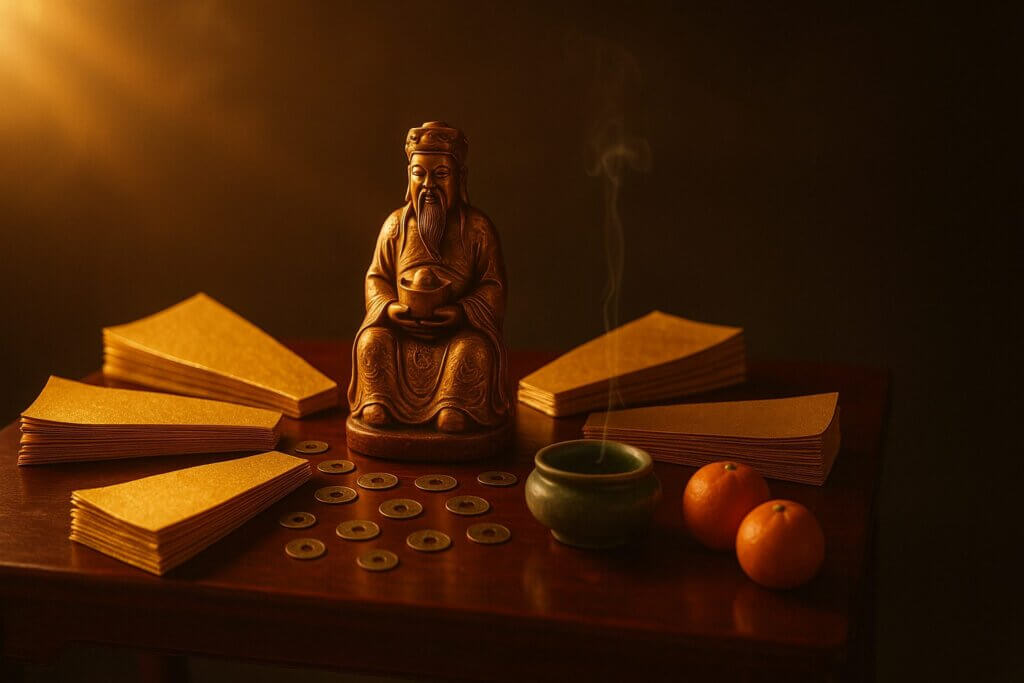
Here’s the part most likely to trip up an American reader. Traditionally, when people make offerings to the god of wealth, they prepare a special kind of paper — joss paper made for the Five Paths gods. It’s usually printed with gold foil or gold-colored designs, carrying images of the gods and auspicious phrases, prepared in neat stacks and burned at the end of the ritual.
From the outside, this looks like setting money on fire. Inside the logic of the culture, what’s being burned is a conversion. The paper has little value in this world, but once it’s sent across through the medium of flame, it’s imagined as a resource that circulates in another one. Think of it as a cultural act of currency exchange: intention on this side of the river, converted into tender that spends on the other.
What’s telling is that this joss paper is typically prepared in fives, or in multiples of five, one portion for each direction, with none left out. That detail gives away what the whole thing is actually about — not quantity, but whether you’ve tended to everything that deserves tending. Traditionally, people didn’t treat it as a bribe either. It sits much closer to the gift in an exchange of gifts: maintenance of a relationship, not the price on a transaction. That sense of proportion is the key to understanding how wealth is asked for in Chinese culture.
From Mortals to Gods: Three Origin Stories Behind the Five Paths Gods of Wealth
Caishen, the Chinese god of wealth, didn’t just materialize one day. Most of these figures come with names, family backgrounds, and biographies that have been retold and rewritten for centuries. The stories shift from dynasty to dynasty and region to region, and the versions often flat-out contradict each other — which is exactly what folk religion looks like up close. This was never a fixed scripture handed down intact. It’s something thousands of people built together over a thousand years, each one adding a piece.
1. Zhao Gongming: A Plague God Who Changed Careers
The commander at the center is generally identified as Zhao Gongming, and here’s the twist in his résumé. In the earliest records, he isn’t a god of wealth at all — he’s a god who spreads disease. In texts from the Wei, Jin, and Northern and Southern Dynasties period, Zhao Gongming leads armies of ghosts and brings sickness with him. He’s someone to fear and drive away, not someone to invite in.
The shift happened slowly. Over the centuries, this terrifying figure was first absorbed into the pantheon as a protector, then handed a specific portfolio: settling disputes fairly, recovering debts, and keeping commerce honest. By the time of the Ming dynasty novel *Investiture of the Gods*, he’d become a formidable general riding a black tiger and carrying an iron whip, canonized after falling in battle and formally put in charge of the wealth department.
That career change tells you something. A force that can bring disaster is also a force that can offer protection; a presence that scares you becomes, once tamed, a presence you can lean on. Chinese wealth traditions have hung onto that wariness. Money was never treated as a straightforwardly good thing — it has power, it has a temperament, and traditionally it’s understood as something to handle with care.
2. Four Deputies, Four Different Faces of Wealth
The four figures at the cardinal directions are traditionally Zhao Gongming’s deputies, and each one has a defined job: the Heavenly Lord Who Summons Treasure (zhao bao tian zun), the Heavenly Lord Who Gathers Riches (na zhen tian zun), the Envoy Who Attracts Wealth (zhao cai shi zhe), and the Immortal Official of Profitable Trade (li shi xian guan). At a glance, those four names sound like synonyms for the same thing. Pull them apart and you find four distinct states of wealth.
“Summoning treasure” and “gathering riches” both point toward acquiring and holding rare and valuable things — the discovery of value and its accumulation. “Attracting wealth” sits closer to cash flow: money coming in, money turning over. And “profitable trade” is the most interesting of the four, because it refers to transactions going smoothly and marketplaces thriving. It isn’t about how much any one person earns; it’s about whether the whole market is alive. Those four, plus Zhao Gongming at the center, make up the complete five paths.
Slicing wealth into these four pieces is a genuinely subtle piece of observation. People centuries ago had already worked out intuitively that owning assets, having cash on hand, being able to spot value, and operating in a lively market are four separate things. You can sit on farmland and still not make payroll. You can be flush with cash and have nothing worth putting it into. The org chart of the Five Paths gods of wealth (wu lu cai shen) takes those distinctions and turns them into a division of divine labor.
3. Why Wealth Needs Five Directions
Looking back, the decision to build this out as five gods instead of one is itself an argument: wealth isn’t a single thing, it’s a system. It needs a source, it needs circulation, it needs accumulation, and it needs a healthy environment to move through. Pull out any one piece and the whole arrangement seizes up.
That’s also why, traditionally, when families prepare joss paper for the Five Paths gods of wealth, the emphasis falls on covering all five directions. The insistence that you can’t make offerings to just one of them carries a plain reminder underneath it: you can’t focus only on earning while ignoring how money moves, and you can’t focus only on saving while sitting in a market that’s gone dead.
Four Ideas About Money Hidden in the Customs — Useful Even If You Don’t Believe
Here’s the part the whole article has been building toward. Maybe you’ll never light a stick of incense or set out a single offering. Doesn’t matter. This body of thinking has held up for a few hundred years, and buried inside it are several judgments about money that reward a close look. Call it common sense, ground down over countless cycles of running a business, going broke, clawing back, and handing something down to the next generation — then packaged as the preferences of a god. Here are the four that matter most.
1. Circulation: Money Energy That Doesn’t Move Stays Put
One word keeps surfacing across the whole Caishen tradition: move. Traditionally, people believed the money energy — the idea that wealth behaves like a current rather than a pile — that a god of wealth hands you is alive. Clutch it and sit still, and it slowly fades. Let it flow out, and it comes back with company. So a lot of the customs are about circulation. At New Year, money comes out of the drawer and goes into red envelopes. When a shop reopens for the year, the point is to get loud and get business moving. Even the joss paper for the Five Paths gods of wealth (wu lu cai shen) is meant to be burned rather than saved, which is its own small metaphor: what you keep doesn’t count, what you send out does.
Pull the deities out and you’re left with a plain theory of capital. Money sitting still is just money; money in motion becomes a tool that produces something. Traditionally, people described this as money energy “rolling,” which is the same argument a modern reader makes about compounding and reinvesting. Different vocabulary, identical logic.
2. Credit: The Gods Are Watching Whether You Pay Back
There’s a step in Chinese wealth customs that outsiders routinely miss: the return visit to make good on a vow. You ask for something, and when it comes through, you go back and deliver on what you promised. In folk practice this is taken extremely seriously — more seriously than the asking. Some people, once things have worked out, will come back with joss paper for the Five Paths gods of wealth to close the loop. The point of that gesture was never the paper. The point is that you said you would, and then you did.
You can read the entire belief system as a credit system. Asking for wealth isn’t a one-way grab; it opens an account. The account gets kept honestly, and what’s owed gets paid. Traditionally, merchants took this more seriously than anyone, because in an era with no credit bureau, a person’s reputation for paying was the whole of their capital.
None of that has expired. How you handle what you promised, the favors you owe, the contracts you signed — that’s what decides whether anyone hands you the next opportunity. Whether a god is watching is one question. The people around you are definitely watching.
3. Sharing: The People Worth Investing In Are the Ones Who Make Others Rich Too
This is the one most worth putting in front of a modern reader. The traditional version goes like this: a god of wealth sharing money energy with you is an act of trust, and what he expects in return is that you use it well and pass some of it along. What you received was never meant to be hoarded. You were handed a portion to look after, with the understanding that you’d help spread it around.
And sharing here doesn’t mean earning a hundred dollars and donating ninety. It takes a lot of forms. Explaining an idea you’ve learned to a friend is sharing. Spending your Saturday volunteering is sharing. Being willing to bring along someone new and hand over what you know is sharing. What matters is whether the energy moves out at all, not the size of the number attached to it.
The reasoning underneath it is the interesting part. The tradition holds that a person being rich on their own isn’t especially remarkable — before they became gods, these figures were already moving in wealthy circles. What’s genuinely rare is someone who lifts the people around them along with him. From an investor’s angle: put a dollar into most people and you get fifty cents back, but put a dollar into that kind of person and you get ten dollars back. So the ones a god of wealth doubles down on are the ones who spread good things outward. Strip out the deity entirely and the claim still holds up just fine in a career or a startup.
4. Proportion: Reverence Without Superstition
The last point is the brake the culture built for itself. You’ll notice the traditional customs almost never promise that making offerings produces wealth. People honored Caishen and still got up early to open the shop, still counted inventory and reordered stock, still smiled at difficult customers. The ritual never stood in for the labor. It added a layer of psychological order on top of the labor — somewhere to set down the anxiety about the part you can’t control.
That sense of proportion is the most pragmatic thing about Chinese folk religion. It grants that luck is real, and grants just as readily that luck isn’t everything. It asks you to hold wealth in some awe without betting your life on a stick of incense.
So if you ask what this tradition hands you, it’s roughly this angle of vision: wealth isn’t a target you chase down and finish with, it’s a relationship that has to be maintained — it needs to circulate, it needs your word kept, it needs to be shared out, and it needs your feet on the ground. You don’t have to believe Zhao Gongming rides a black tiger to agree with those four things. That’s often where the value of a culture sits: it takes some hard-to-articulate common sense and turns it into stories, into holidays, into a stack of paper that gets set on fire, so that it can travel a few hundred years and then, on some ordinary afternoon, be read by someone from an entirely different world.
Five Common Questions About the Five Paths Gods of Wealth
You’ve made it through the introductions, and you probably still have a few concrete questions rattling around — especially the ones that trip people up when they’re looking at this tradition from the outside. Here are five that come up a lot. Each answer is framed around how the culture itself understands the thing, not around what you’re supposed to do about it. The point here is to help you read the tradition, not hand you a checklist.
1. Are the Five Paths gods of wealth basically the same thing as the Japanese lucky cat?
Related, sure. Same level, no. The lucky cat is a charm — a symbol. It has no biography, no story, no office to hold. Nobody makes a vow to a lucky cat and then comes back to make good on it. The Five Paths gods of wealth (wu lu cai shen) are named deities with origin stories, legends about how they came to hold the role they hold, clearly divided responsibilities, and a whole etiquette governing how a person and a god deal with each other.
The closer comparison is probably the gods of Norse mythology. They have personalities, stories, and their own domains, and the relationship between people and them runs both ways. Here’s the difference: for most people today, Norse myth is literary inheritance, while belief in Caishen, the Chinese god of wealth, is still very much alive — on the fifth day of the first lunar month, a great many people are genuinely doing this. It isn’t a museum piece. It’s a tradition that still breathes.
2. Isn’t burning joss paper for the Five Paths gods of wealth wasteful and bad for the environment?
This is an argument Chinese communities are having internally, and having loudly. In recent years plenty of places have pushed to cut the volume, consolidate the burning in one spot, or swap in other ways of expressing the same intention. Some people argue for taking the money that would have gone toward joss paper and just donating it outright, on the grounds that giving is closer to the point of the whole thing anyway.
Culturally, the argument itself is the interesting part: it shows the tradition isn’t frozen, and that it gets renegotiated as conditions change. The heart of the burning was never how much goes up in smoke. It was using a physical act to send something abstract — intention — somewhere it can be received. Once people recognize that the cost of the act is getting passed along to everyone breathing the air, changing the form doesn’t hollow out the belief underneath it. Plenty of traditions have made adjustments like this one. That’s the ordinary metabolism of a living culture.
3. Isn’t this tradition just an endorsement of greed?
On the surface, that’s an easy misreading to land on — this is, after all, a tradition that talks about money openly and without embarrassment. But look at its internal rules and you find limits on wealth almost everywhere you turn: money should circulate rather than pile up, debts should be paid rather than dodged, gains should be shared rather than hoarded, and effort should do the work rather than luck alone.
Put another way, the tradition grants that wanting money is a legitimate desire, then insists you chase it with discipline. That’s a different stance from cultures that treat money as something dirty to be held at arm’s length. This one puts the desire out in the open and writes rules for it. You’re free to disagree with the approach, but it isn’t unqualified praise of wealth. Traditional stories are full of characters who wanted more and more and lost it all.
4. Why five gods of wealth instead of just one?
The most immediate reason is direction — east, west, south, north, and center, all five covered, a way of saying income shouldn’t come from a single source. The deeper reason is that this system treats wealth as something with several faces. Spotting value, building up assets, keeping cash moving, and operating in a lively market are four different capacities, so four different gods hold them, with the central commander coordinating the whole operation.
Splitting one job into several posts like this is extremely common in Chinese folk religion, and it reflects a bureaucratic picture of the cosmos — heaven as an organization, with ranks, offices, and a division of labor, much like the world below it. That may sound faintly comic, but it’s exactly what makes the tradition so concrete in practice: identify what kind of difficulty you’re facing, and you know which part of the system it corresponds to.
5. I’m not Chinese and I don’t believe any of this. What’s in it for me?
The most practical use is as a mirror. Every culture works out its own way of living with money, and that way usually runs so deep that the people inside it can’t see it. The money assumptions you treat as plain common sense were handed to you by a tradition too. Looking at a completely different set of answers is what lets you notice the shape of your own.
And a few of this tradition’s judgments hold up perfectly well once you take the gods out of them: money grows when it moves, your reputation is the cheapest and the most expensive capital you have, the person who makes other people better off gets offered more opportunities, and no ritual is a substitute for work. None of that requires belief to accept. It just shows up wrapped in a shell you’re not used to. Peel it off and what’s inside is common sense, left behind by a few hundred years of people getting it wrong and adjusting.