Who Are the Five Paths Martial Gods of Wealth? Three Key Ideas from Chinese Folk Religion
If Chinese folk religion is brand new to you, a phrase like “the Five Paths martial gods of wealth” probably reads like code. Take it apart, though, and it’s pretty simple. “Five Paths” means five directions. “Martial” means he came up as a military commander. And a god of wealth is exactly what it sounds like — a deity whose job is money. Put the pieces together and you get a warrior deity with four officers under his command, stationed at the compass points, whose assignment is to move wealth from every direction into the human world. Behind that image sits a whole theory of how wealth travels, and it’s worth taking slowly.
Where “the God of Wealth” Fits in Chinese Folk Religion
Here’s the thing that surprises a lot of American readers first: Chinese folk religion isn’t monotheistic, and it isn’t much like Greek mythology either, with its tidy family trees. It works more like a bureaucracy that keeps adding departments. Heaven has offices, and each office has a deity assigned to it. One handles rain. One handles examinations. The one who handles wealth is Caishen, the Chinese god of wealth. You’ve got a problem, you go to the desk that covers it.
There’s a fascinating wrinkle in that structure: most of these deities were promoted rather than born. Many were real historical people who did something virtuous or remarkable, stayed in the popular memory, gradually took on divine status, and eventually got a formal spot on the roster. That’s a long way from how God occupies the center of the Christian tradition. It’s actually closer to the logic of Catholic canonization — only with a lower bar and far more bottom-up. Ordinary people started making offerings first, and official recognition caught up later.
Of all these offices, wealth is the one closest to daily life. Aside from birth, aging, sickness and death, money is what people worry about most, which is why this particular tradition spread so widely — shopkeepers made offerings, so did farmers, so did civil servants. And there isn’t just one god of wealth. The tradition splits them into the civil god of wealth and the martial god of wealth. The civil god of wealth came up through the scholar-official track, and his domain is salary, steady earnings, income you can count on. The martial god of wealth came up through the military, and his domain is the kind of money that takes drive, movement and a tolerance for risk. Merchants, traveling salespeople, anyone whose living depends on making deals — traditionally, those are the people who feel closest to the martial god of wealth.
Why “Five Paths”: A Wealth Map of East, South, West, North and Center
The “five” in Five Paths refers to east, south, west, north and center. In the traditional Chinese way of thinking about space, direction is never just geographic; it carries meaning. Five directions taken together stand for all directions — the whole world, everything, nothing left out.
So the full sense of “the Five Paths martial gods of wealth” is this: a principal deity holding the center, four commanders guarding the four quarters, so that wealth can flow in from any point on the compass. The thinking behind that setup is surprisingly practical. Money never arrives by a single road. Your day job is one road. A side business is another. An opportunity a friend passes along is another. Goodwill you planted years ago and forgot about is another still. Traditionally, what people asked for wasn’t one enormous windfall — it was that every road stay open and none of them get blocked.
Picturing wealth as several channels feeding in at once turns out to be the same instinct behind the modern advice to diversify your income streams. One version states it in the language of myth, the other in a spreadsheet.
What “Martial” Signals: Why a God of Money Carries a Weapon
To a newcomer, it’s a jump — the deity in charge of wealth is a general holding a weapon. But the design makes a lot of sense once you look at it.
The first layer is protection. In a traditional society, the biggest threat to your money wasn’t a bad investment. It was robbery, a customer who never paid, bandits on the road. Caravans covered long distances, guarded shipments went over mountain passes, and doing business in that era was barely distinguishable from taking a risk with your life. What people wanted was not only a god who sends wealth your way, but one who can keep it once it arrives. The image of a military commander answers that need directly.
The second layer says something about the character of wealth itself. The martial god of wealth is usually depicted as imposing, upright, and not in the mood to smile. That’s a message. Wealth isn’t coaxed in with sweet talk; it stays because of discipline, because of honest dealing, because you did the work correctly. As you’ll see later on, this tradition sets a startlingly high bar for personal character — the question isn’t only whether you have money, but whether you’ve earned the right to keep it.
From Battlefield to Ledger: The 3 Turns That Made the Five Paths Martial Gods of Wealth
Almost every Chinese folk deity comes with a story attached, and the story usually tells you more about what the tradition actually values than any ritual does. Here’s the setup. The central figure behind the Five Paths martial gods of wealth came out of ancient mythological warfare — a man who spent his entire life with essentially no connection to money, and who then, after his death, became the deity merchants trusted most. How does a turn like that happen? The steps in between spell out, very clearly, what Chinese culture expects wealth to be.
A General Who Died in Battle
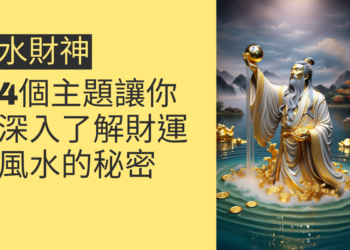
The chief deity among the Five Paths martial gods of wealth is generally held to be Zhao Gongming. His image spread widely through the Ming-dynasty novel Investiture of the Gods (Fengshen Yanyi) — a story of gods and demons fighting through a change of dynasties, occupying a cultural slot somewhere between Paradise Lost and the Arthurian legends: half history, half invention, and deeply formative for how an entire culture pictures its gods.
In the story, Zhao Gongming is a Daoist adept and a formidable military commander who rides a black tiger, carries an iron whip, and picks the side that ultimately loses. He isn’t a villain. He shows up to help a friend out of loyalty, and it gets him killed. The story ends with his elevation to godhood — a very typical move in Chinese mythology, where the loser on the battlefield is handed an office in heaven. And the office he gets put in charge of is wealth.
There’s a detail here worth pausing on. Zhao Gongming isn’t deified because he was good at making money. He’s deified because he was loyal, he kept his word, and he did right by his friends. Put another way: from the very beginning, this tradition handed the management of wealth to a figure known for his credit.
Four Officers, Four Faces of Wealth
Zhao Gongming has four subordinate officers under him, each guarding one direction. What’s interesting is that their titles aren’t “keeper of gold” and “keeper of silver.” They are Summoning Treasure, Gathering Valuables, Attracting Wealth, and Profitable Trade — corresponding, in order, to spotting an opportunity, taking resources in, drawing in sources of income, and closing the deal.
Look at the four together and you’re really looking at the full arc of a piece of business: first you see the opening, then you bring the resources in, then you attract more income streams, and finally the transaction goes through. These aren’t four different kinds of wealth. They’re four stages in wealth going from appearing to actually landing in your hands. Traditionally, people believed all four paths had to be clear — block any segment and the money doesn’t arrive. You see the opportunity but can’t grab it. Or you close the deal but can’t collect payment. Both count as a blockage.
Turning an abstract process into a set of deities like this is a very characteristic move in Chinese folk religion: take something you can’t get a grip on and make it into something you can deal with face to face. You have no direct control over the market. But you can stand in front of a god who represents “the deal goes through,” and psychologically that makes the uncertainty bearable.
From Myth into a Commercial Society
Zhao Gongming’s identity as a god of wealth really took off during the highly commercial late Ming and Qing period. China then had enormous merchant guild networks, with goods moving across provinces on the strength of private banknote houses, verbal promises, and long-standing reputation. In an age with no modern legal system and no modern banking, the entire commercial ecosystem rested on one question: is this person reliable?
In that environment, elevating a general famous for loyalty and for keeping his word into the position of wealth god makes complete sense. What he stands for isn’t only money — it’s the thing money depends on to function at all, which is credit. You could say the whole Five Paths martial gods of wealth tradition is a commercial society taking the value it prized most and putting it on an altar.
Which is also why the martial god of wealth is always depicted as stern. He isn’t a wishing well. He’s more like a partner reviewing whether you qualify.
What People Traditionally Do: Four Customs and the Thinking Behind Them
Now for the customs themselves. One thing to get straight up front: what follows is a description of what people have traditionally done and why it made sense to them — not a set of instructions for you. Here’s the interesting part. Almost every one of these seemingly folkloric practices maps onto a specific idea about wealth. Take the deity out of the picture, and the idea still stands on its own two feet.
Welcoming the God of Wealth: The Opening-the-Doors Ritual on the Fifth Day
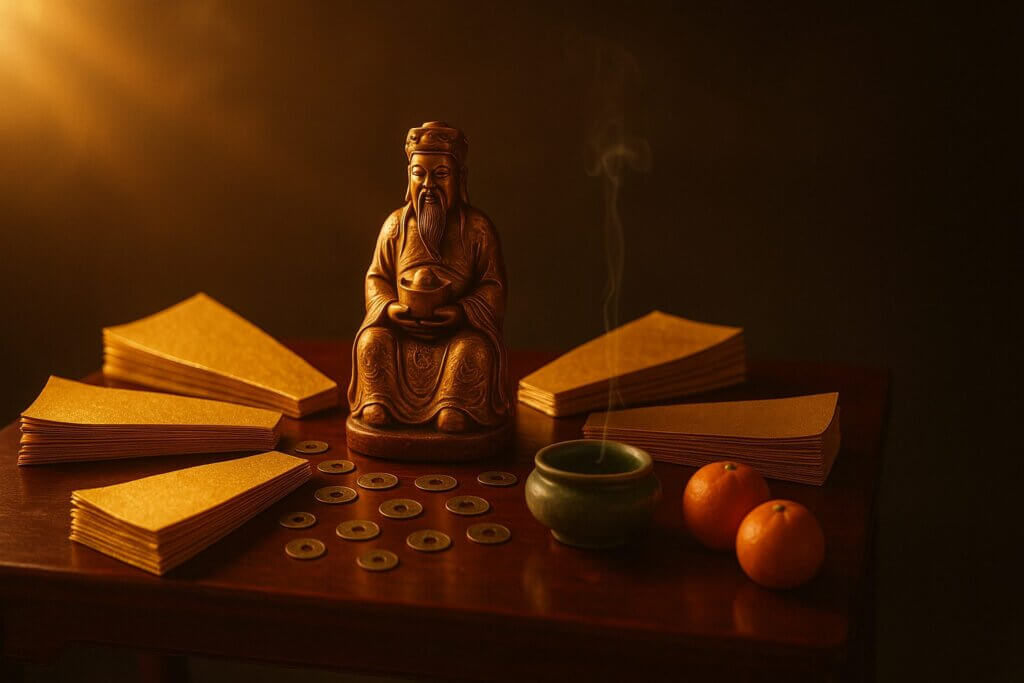
The biggest concentrated moment for Caishen, the Chinese god of wealth, falls on the fifth day of the first lunar month — a day known as “breaking the fifth” or, more commonly, welcoming the god of wealth. Traditionally, people got up before dawn that morning, opened every door and window, and stood at the entrance to receive him. In farming villages and merchant cities alike, the firecrackers that morning went off nonstop, because everyone wanted to be first to welcome him in.
Why that particular day? Because the first four days of the lunar new year come loaded with taboos: no sweeping, no taking out the trash, no needlework, all for fear of sweeping away your good luck. On the fifth day those restrictions lift, ordinary life starts back up, and shops traditionally reopen for business. So welcoming the god of wealth is really a ritual about getting the machinery running again. The holiday’s over. Time to go make money.
The thinking underneath it is refreshingly plain: the attitude you bring to your work at the start of a year has a lot to do with how that year turns out. Opening the doors and windows is symbolic, sure, but the mental state it stages — I’m ready, I’m going back to work — is not. Anyone who’s ever thought “this year I’m getting myself in order” already knows what a ritual like that is doing.
Offerings and Placement: Why the Emphasis Falls on Circulation, Not Accumulation
There are traditional conventions for how offerings to the Five Paths gods of wealth (wu lu cai shen) are arranged, but the details matter less than the principle running through all of them: money energy — the idea that wealth behaves like a current rather than a pile — has to keep moving, or it dies.
You can see the shadow of that idea all over these customs. Offerings are supposed to be fresh, and anything past its prime gets swapped out. Incense is supposed to stay lit, because the qi should be continuous. Doors and windows go open on the fifth day, because nothing closed can be entered. Some practices go further and treat money that’s been sealed away and left completely untouched as something close to a taboo. In this picture, wealth is more like water or air than like stone: it needs to circulate rather than sit in a heap.
Translate the mythic language into modern terms and you get a claim about the nature of capital. Money that sits still is quietly shrinking over the long run. Money that goes out — into investments, into skills, into relationships, into things other people benefit from too — is money that has a shot at coming back larger. Nobody working in this tradition had a mathematical model of inflation or compounding. They said “the qi has to flow,” and they were reaching for the same intuition.
What People Say When They Ask: Why You Give Your Name and Address
Here’s a detail that can strike an outsider as funny: traditionally, when people petitioned the god of wealth, they stated their full name, their address, and their birth date out loud, then explained what they did for a living, what they needed, and how they planned to go about getting it. The whole thing reads less like making a wish and more like filing a formal application.
That takes us back to the celestial bureaucracy described earlier. If heaven is a system with departments and job descriptions, then dealing with a deity ought to work the way dealing with an agency works: say who you are, say what you want, and give your reasons.
But the genuinely powerful thing about this custom is that it forces you to get specific. “I want to be rich” isn’t something you can file. You have to be able to say “I want this shop to survive the year,” or “I want to save this amount for this purpose.” The traditional belief was that a request too vague to put into words is a request no deity will act on — which is, at bottom, the same thing modern people mean when they say goals have to be concrete and measurable. The function of the ritual here is to make you confront what you actually want.
Fulfilling the Vow: Why Keeping Your Word Sits at the Center of This Belief
People petitioning a Chinese deity often make a promise as part of the asking: if this works out, here’s how I’ll repay it. Going back afterward to make good on that promise is called fulfilling the vow, and in the wealth traditions specifically, it carries unusual weight.
The reason goes back to who Zhao Gongming was. He became a god on the strength of loyalty and keeping his word, so in the popular understanding, the one thing he can’t abide is a broken promise. The traditional view holds that making a vow to the god of wealth and never fulfilling it is worse than never having asked at all — because you’ve shown bad faith in front of a deity whose entire standing rests on credit.
That rule shifts the center of gravity of the whole belief from asking to keeping. You may ask, but what matters more is whether you hold to what you said. And the structure still means something if you don’t believe a word of it: someone in the habit of breaking promises to themselves will have a hard time accumulating anything that takes time — money, a career, or other people’s trust. All this tradition did was turn that observation into a ritual you can’t easily dodge.
5 Common Questions About the Five Paths Martial Gods of Wealth
Here’s where most first-timers land. These are the questions people ask when they bump into this tradition and want to know what’s actually going on. The answers below stay on the cultural side, and they don’t assume you buy any of it. The value is in seeing how another culture thinks about money — and that part works whether you believe or not.
Are the Five Paths martial gods of wealth one god or five?
Strictly speaking, it’s one principal deity plus four subordinate generals, treated together as a single unit. The principal figure is usually Zhao Gongming. The four generals hold the east, south, west, and north, with the main deity at the center — five directions, hence “five paths.”
In actual folk practice, though, the line gets fuzzy. Some places treat the five as five deities of equal standing. Others focus on the principal god and treat the four generals as an entourage. Chinese folk religion has no central body of doctrine to rule on who’s right, so regional versions naturally differ — and that difference is considered normal. Nobody’s fighting about orthodoxy here.
That looseness is the key to understanding Chinese folk religion in general. It isn’t a doctrinal system you’re asked to sign onto in full. It works more like a shared cultural vocabulary — everyone understands what the symbols are saying, but each region and each family has a lot of latitude in how they use them. There’s no conversion, and no clear line marking who counts as a believer.
What’s the difference between the martial god of wealth and the civil god of wealth?
The simplest distinction is background: the civil god of wealth is depicted as a scholar-official, the martial god of wealth as a military commander. But it goes deeper than the costume — the two correspond to different kinds of wealth.
The civil god of wealth governs what’s closer to regular income: a fixed salary, an official stipend, predictable and steady earnings. Traditionally, scholars, civil servants, and families living on a set income were the ones drawn to the civil god of wealth, asking for stability and longevity. The martial god of wealth governs windfall money and the kind of money you have to go out and take — trade, deal-making, the sort of income that carries both risk and opportunity. So merchants, people whose work took them out on the road, and those running their own businesses traditionally invoked the martial god of wealth more often.
The classification itself is the interesting part, because it shows the traditional Chinese understanding of wealth had layers. Safe money and risky money are different in kind, they call for different temperaments, and so they call for different gods. In modern terms, it’s a little like separating a salaried paycheck from what you make building your own business — those really do demand different skills.
Does making offerings to the Five Paths martial gods of wealth actually make you rich?
This one gets at the core logic of the whole tradition, and the traditional answer probably isn’t the one you’re expecting: no, not directly — because what the gods of wealth hand out isn’t money. It’s money energy — the idea that wealth behaves like a current rather than a pile.
Think of money energy as opportunities, helpful people, favorable timing — things that can turn into money, but that aren’t money themselves. The traditional framing is that a god of wealth extending money energy to you is an act of trust. He’s investing in you, on the expectation that you’ll put the resource to good use. Whether it converts into actual wealth depends on what you do next.
More important still, this way of thinking holds that money energy can’t only flow in. Once you’ve received it, you’re meant to keep it moving outward — that can mean sharing what you’ve learned, or spending time helping someone, and it doesn’t have to mean giving away money. A common misreading is that you’re supposed to donate the bulk of your income; that’s not what the tradition says. What matters is whether the energy is flowing out at all, not how much of it. Keep it circulating and you get a virtuous cycle — a snowball that grows as it rolls.
Strip the deities out entirely and the logic still holds up: opportunities come from people, and people bring opportunities to you mostly because you gave them something first.
Why does this tradition treat sharing as more important than earning?
This is the most counterintuitive piece of the Five Paths martial gods of wealth tradition, and the most interesting. The traditional claim is blunt: getting rich by yourself is no great feat.
The reasoning is stated plainly. Before these figures became gods, the people they dealt with were already wealthy — so one more individual with money is nothing remarkable to them. What’s worth investing in is the person who can bring others up along with him. Investing in an ordinary person returns fifty cents on the dollar; investing in that kind of person returns ten dollars on the dollar, because he multiplies the resource instead of just pocketing it.
And the best form of sharing, traditionally, is passing along what you’ve learned about money and about running a life to the people around you, so they end up better off too. The payoff is that when they improve because of what you shared, part of that cycle comes back around to you.
Take the deities out of that passage and what’s left is a clear-eyed theory of networks: how much a person accumulates depends heavily on how strong the network around them is, and the most effective way to strengthen a network is to strengthen the people in it. Startup circles and professional communities have borne this out over and over — the people who share knowledge most freely tend to be the ones with the most opportunities coming their way. This centuries-old folk vocabulary is describing the same thing.
I don’t believe any of this. What’s in this article for me?
Plenty of Chinese people don’t especially “believe” it either, and still take part in the customs — for many of them it reads as cultural practice rather than a declaration of faith, roughly the way an American sitting down to Thanksgiving dinner isn’t necessarily a Puritan.
Set the gods aside and this tradition still offers three perspectives worth taking with you. First, wealth is understood as something that flows rather than something you hoard, so the emphasis is always on circulation instead of the number. Second, credit comes before earnings — someone who can’t keep a promise won’t hold onto what they make, and that’s true in any era. Third, a person’s worth is measured not by how rich they are but by how many people are better off because of them.
You don’t have to accept a single supernatural premise to sit with these questions: Are my income sources diverse enough? Am I letting resources move, or just stockpiling them? Of the promises I’ve made to myself, how many have I kept? Are the people around me better off for knowing me?
That’s probably the most practical thing you get from looking at someone else’s culture — you don’t have to accept its answers, but the questions it asks may be exactly the ones you never thought to ask yourself. A commercial society several centuries ago put keeping your word and sharing what you have above wealth itself. That alone is worth sitting with.