Meet the Five Wealth Deities: Five Gods, Five Kinds of Wealth
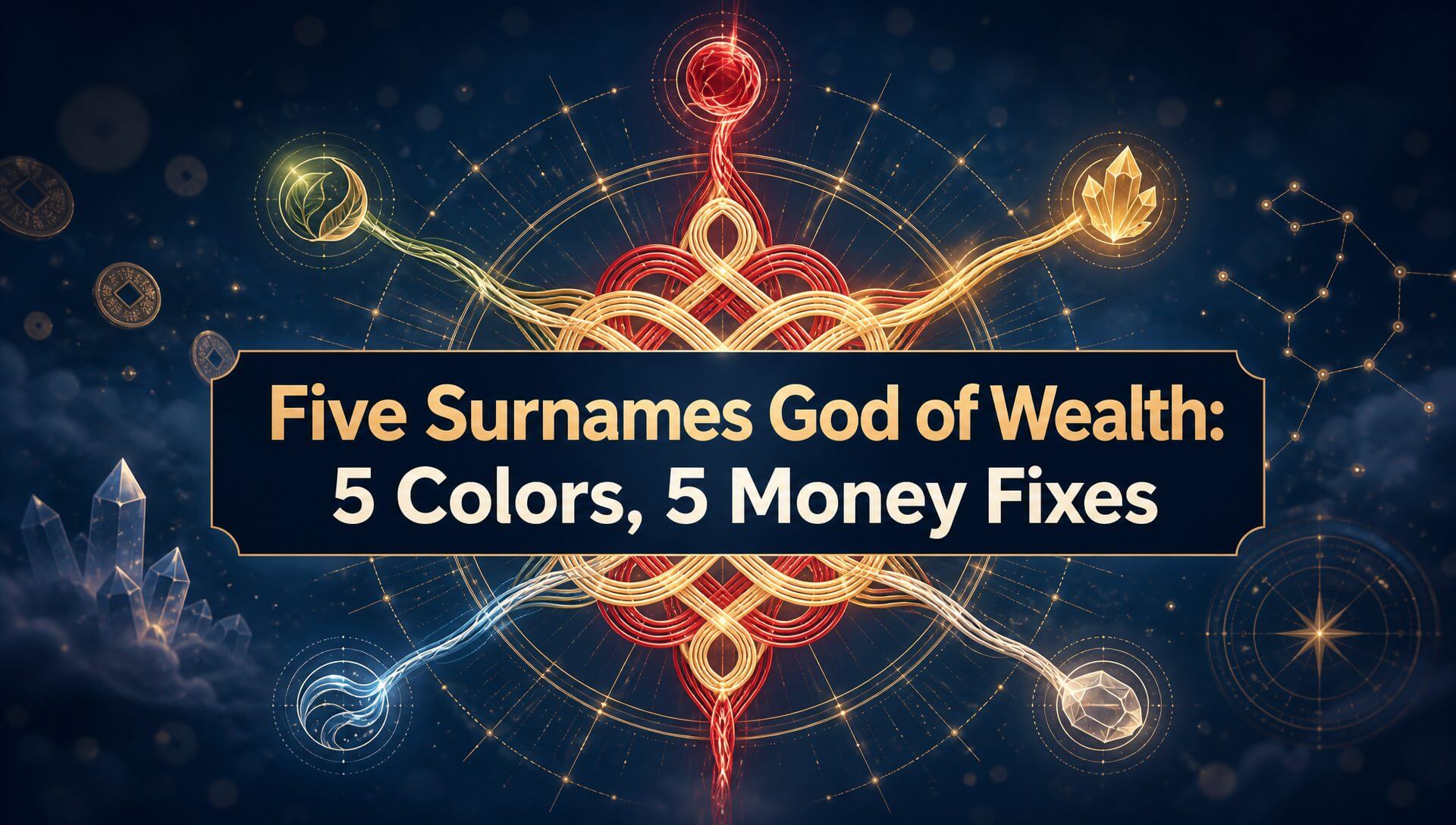
If Chinese folk religion is brand new to you, here’s the place to start: in this culture, heaven isn’t one god handling everything. Think of it more like a large organization with clearly divided departments, where every domain has a god assigned to it. Wealth is one of those domains — and the “five wealth deities” are five gods, each responsible for a different face of it. The easiest way to tell them apart isn’t by name. It’s by color: yellow, white, red, green, and black. Those five colors aren’t decoration. They’re a complete classification system.
What a God of Wealth Means in Chinese Culture
In American culture, money talk usually runs on two tracks: hard work and luck. Chinese tradition adds a third — relationships. The idea is that wealth isn’t only what you earn. It’s what heaven and earth, your ancestors, the gods, and your whole web of human connections conspire to let you have. Which means wealth has to be permitted, and it has to be maintained.
Caishen, the Chinese god of wealth, is that third track turned into a figure. He isn’t a god who hands out cash. He’s closer to an underwriter crossed with an investor: he’s weighing whether you’re the kind of person resources should be entrusted to, and what you do with them once you have them. That setup matters, because it means the entire culture around asking for wealth was never a wishing machine. It’s a two-way relationship with obligations attached. Follow almost any story or custom about Caishen far enough and it circles back to the same question: do you deserve the money you’re asking for?
Chinese tradition has a lot of wealth gods, and they come from very different places. Some are historical people who were elevated to divine status; others are protector deities that arrived with Buddhism. The five wealth deities belong to that second group. They originated in the Tibetan Buddhist tradition, and as cultures mixed they were absorbed into the wider Chinese world of wealth practice, becoming a set of names a whole lot of people know.
Five Colors, Five Different Money Problems
What makes the five wealth deities interesting is how finely they slice “wealth” apart. Traditionally, the division of labor runs roughly like this:
- Yellow Jambhala: the one people mention most. He covers the basics of material provision — food on the table, clothes on your back, nothing running short.
- White Jambhala: associated with poverty and genuine scarcity. In the tradition, he’s said to look after people who have truly run out of options.
- Red Jambhala: the god of wealth that comes through people — relationships, reputation, and the support of others.
- Green Jambhala: leans toward career and action, matching the wealth you build through your own trade and your own effort.
- Black Jambhala: traditionally understood as the one closest to the bottom, helping people who’ve been pushed as low as life goes and are willing to climb back.
You can read these five as five different financial situations. One person needs to cover the basics. Another needs a network. Another needs a breakthrough at work. Another needs to get up off the floor. The classification itself says something pragmatic about how this culture thinks: wealth isn’t one thing, and what a person is missing depends entirely on where they’re standing.
How the Five Differ From Other Gods of Wealth
The best-known Chinese wealth gods are figures like Zhao Gongming and Guan Yu — historical or legendary people who became deities, and who bring strong personalities along with them: loyalty, keeping your word, standing by your people. The five wealth deities work differently. They’re closer to a symbolic system, where five colors map onto five directions and five qualities. The structure carries more weight than the story.
The other difference is emphasis. With the personality-driven gods, character is the whole point — Guan Yu became a god of wealth because he was known for honoring his commitments. The five wealth deities emphasize matching instead: wherever you’re currently stuck, there’s a corresponding figure. That gave them a very fine-grained practicality as they spread through folk practice, and it’s why they read today almost like a personal financial inventory.
Three Origin Stories: How They Became Gods of Wealth
The origin stories of the five Jambhalas are scattered across accounts passed down by word of mouth, and the versions don’t fully line up. Here’s the interesting part: nearly all of them share the same structure. A being who wasn’t compassionate to begin with — or who had nothing to do with wealth at all — makes a choice at some pivotal moment to help people in poverty, and only then gets handed responsibility over wealth. Put another way, in this body of storytelling, the qualification for becoming a god of wealth isn’t having money. It’s being willing to give. These are the three versions that circulate most widely.
Yellow Jambhala: From Protector to God of Wealth
The version told most often about Yellow Jambhala goes something like this. He started out as a fierce-tempered protector deity, and compassion wasn’t what he was known for. During one of the Buddha’s teachings, hostile forces attacked, things turned dangerous, and he stepped forward to defend the assembly — taking injuries in the process. The Buddha, moved by that act of protection and seeing that underneath the fierceness sat a genuine willingness to shield others, gave him an assignment: from that point on, he’d be the one responsible for making sure practitioners and ordinary people no longer had to worry about food and clothing.
The point of the story isn’t supernatural power. It’s an exchange: he gave protection first, and received the authority to distribute wealth second. Traditionally, people picture Yellow Jambhala always holding a treasure-spitting mongoose (tu bao shu), which continuously produces jewels — but those jewels aren’t his private stash. They’re meant to be handed out. That image sits at the center of the whole five-Jambhala tradition: the god of wealth’s hand is open, not clenched.
White Jambhala: It Starts With a Single Tear
White Jambhala’s origin usually ties back to compassion. As the story goes, Guanyin looked out at the world and saw how many people were suffering because of poverty — and worse, how poverty kept people from being good. A hungry person has a hard time thinking about morality; a person with no options left tends to do things they’ll regret. Guanyin wept over this, and that single tear of pity took form as White Jambhala, whose particular job is rescuing those who have hit true bottom.
Buried in that story is a strikingly modern observation: poverty isn’t just a shortage of money. It compresses a person’s range of choices until there’s no room left to do the right thing. So in the traditional understanding, relieving poverty isn’t only about handing over cash — it’s about pushing someone back into a position where choosing is possible again. That’s exactly why White Jambhala is said to pay special attention to people with no connections and no resources who still want to live decently.
Red, Green, and Black: Different Roads to Wealth
The stories about the other three circulate in more fragmented form, but they all point the same direction. Red Jambhala is described as making a person well-liked and well-supported, which corresponds to the kind of money that opens up through relationships and goodwill — in traditional society, whether you could borrow money or close a deal often came down to whether other people were willing to trust you. Green Jambhala gets linked to action and enterprise, emphasizing wealth built steadily and solidly through your actual line of work.
Black Jambhala’s story carries the most tension. He’s said to have been frightening in appearance, yet he’s the one of the five who stands closest to suffering — he goes straight into the ugliest corners to help the people everyone else has written off. The belief is that the lower you’ve fallen, the more readily you connect with Black Jambhala. That setup is a form of consolation in itself: in this tradition, hitting bottom doesn’t mean you’ve been shut out of wealth. It may be the exact moment you’re most clearly seen.
Three Ideas Behind the Traditional Practices
When customs come up, most people jump straight to “okay, what’s the right way to do this so it works?” Here’s the thing, though. Put these practices back in their cultural context and they stop looking like a procedure. They look like ideas made physical — repeated actions that press a particular belief about money into the shape of an ordinary day. The three below are the ones in the Five Surnames tradition with the clearest reasoning behind them. They aren’t a to-do list. They’re three different logics of wealth, and each one is worth sitting with.
Fresh Water and Flow: Why the Tradition Cares So Much About Not Letting Things Sit
Of all the practices tied to the Five Surnames gods of wealth, the most ordinary one is offering water — clean water, changed daily. The usual explanation is that water stands for wealth, and wealth shouldn’t be allowed to go cloudy or go still. Sounds like superstition on the surface. But the idea underneath is plain enough: wealth is fundamentally a current, not a pile.
Chinese culture has long been wary of what it calls dead money. Cash sitting untouched looks safe, sure, but it has quietly stopped doing the one thing that makes it money — being a medium of exchange. Traditionally, people believed Caishen, the Chinese god of wealth, hands you money energy — the idea that wealth behaves like a current rather than a pile — because you’ll put it in motion: invest it, spend it, back someone with it, move resources to where they’re actually needed. The moment circulation stops, the money energy stops right there with it.
So a chore as small as changing the water once a day is really a reminder about rhythm. Is your money doing anything today? Have you locked resources into one place purely out of fear of losing them? Asked in the present tense, that question still earns its keep.
Sharing Money Energy: Why What You Give Away Tends to Come Back Larger
This is the least intuitive piece of the whole god-of-wealth tradition, and it’s also the center of it. The traditional framing goes like this: the god of wealth gives you a share of money energy not so you can sit on it, but so you can act as a relay station. He’s investing in you. The hope is that you’ll pass the energy along — and the more you send outward, the more willing he is to add to your position.
One common misreading is worth clearing up. Sharing does not mean that every hundred dollars you earn obligates you to give ninety away. What the tradition counts as sharing is much broader than money. Telling a friend about an idea that changed how you handle something is sharing. Spending an afternoon volunteering is sharing. Handing an opportunity to the person better suited to it than you are is sharing. The amount isn’t the point. The point is whether good things keep traveling after they pass through you.
Within this logic, the best kind of sharing is teaching the people around you the ideas about money you’ve found genuinely useful, so their lives get a little easier too. When someone else ends up better off because of you, part of that cycle comes back around — you’ve made yourself a node in it. That’s why the tradition says money energy can be rolled: it behaves like a snowball, and what grows it isn’t how tightly you hold it but how far you push it.
Worth Investing In: Putting the Idea to Work in a Modern View of Money
Compress the whole Five Surnames tradition into one line and you get something like this: getting rich yourself isn’t the impressive part — the person worth investing in is the one who can make other people rich too. The traditional version is blunter. Before he became a god, the story goes, the god of wealth spent his days among wealthy people; money alone was nothing remarkable to him. What he was actually looking for was the person who turns one dollar into ten. And the people who multiply resources have never been the best hoarders. They’re the best circulators.
You don’t have to believe anyone is watching for the framework to hold. Translated into modern terms: your financial worth isn’t just your account balance, it’s also how much movement you’ve created inside your own network. How many people have you connected to the right opportunity? How many hard-won judgment calls have you passed along that saved someone a detour? None of that shows up on a balance sheet, but it absolutely shapes what resources come back to you later.
The other thing worth taking with you is the five-way classification of wealth itself. Instead of saying vaguely that you want to be rich, ask which kind you’re actually short on right now: basic security (yellow), the strength to climb back from the bottom (white and black), people willing to back you (red), or a breakthrough in the work you already do (green)? The reason the tradition splits the god of wealth into five figures in the first place is that it understood something early — people who can’t name what they’re missing usually don’t get what they want.
5 Common Questions About the Five Wealth Deities
If this whole subject is brand new to you, a handful of questions tend to surface right away: Is this a religion? Is there anything here for someone who doesn’t believe a word of it? And how do you keep five figures straight? Here are the five questions people ask most. The answers are written as cultural explanation, not religious guidance — the goal is to show you what this tradition is actually thinking about, not to hand you a to-do list.
Are the Five Wealth Deities a religion, or folk culture?
Both, and the line between them was never sharp to begin with. The five figures come out of a Buddhist framework, where they belong to a complete tradition of practice. But once they filtered into everyday Chinese life, what most people ran into was the folk version — no deep doctrine required, closer to a cultural habit and a place to park your hopes.
This pattern — one set of deities living in two modes at once — is extremely common in Chinese society. The same figure can be a serious object of devotion to one person, part of the wallpaper of a holiday to another, and a good story over dinner to a third. All three relationships coexist in the same society without much friction, and none of them gets crowned the “correct” one.
So in getting to know the Five Wealth Deities, you don’t have to settle the belief question first. You can read them purely as a cultural text — the way you’d read Norse or Greek mythology — where the point is understanding how a civilization used stories to handle its anxieties and hopes about money.
If I don’t believe in deities at all, is there anything here for me?
Yes, and probably more than you’d expect. What traditions like this actually carry is rarely a supernatural claim. It’s a value judgment a society built up over centuries — a statement about which kind of person that society thought *ought* to end up wealthy.
Notice that not one of the five stories describes someone getting rich through cleverness, calculation, or taking advantage of others. In every case, the reason a figure became a wealth deity is protection, compassion, or rescue. That reflects a collective consensus: wealth has to be legitimate, or it doesn’t get blessed. That’s a moral position, and it stands whether or not you believe in gods.
The same goes for the ideas built around them — that money energy needs to move, that sharing is what makes it grow, that the people worth backing are the ones who can make others prosperous. Those are social observations you can test directly. Take the deities out and the framework still holds together. You could even call it a fairly sophisticated intuition about how money moves between people.
How do you tell the five apart? Which one applies to me?
The traditional way of distinguishing them is refreshingly concrete: color and posture. Yellow Jambhala stands for basic material sufficiency. The white one corresponds to relief from poverty. The red one connects to social ties and the support of others. The green one leans toward career and action. The black one faces the deepest trouble — the point where someone has to turn a whole situation around.
As for which one applies to you, the traditional answer is usually to look at what you’re shortest on right now. But the more interesting thing is the value of the question itself. It’s asking you to run an honest self-diagnosis: is your current bind actually about income, about not knowing the right people, about being stuck in your own field, or about a whole situation that’s sliding downhill?
When most people talk about money, they’ve got one vague word for it: “not enough.” The advantage of this five-way classification is that it forces you to break “not enough” into parts. You start to notice that what some people lack isn’t money at all — it’s anyone willing to help them. What others lack isn’t opportunity but the patience to take what’s already sitting in front of them and go deeper. Once the diagnosis is clear, the direction gets clear too.
Did people traditionally expect results right away?
Generally not, and the traditional framing goes out of its way to lower that expectation. In this understanding, what a wealth deity gives you usually isn’t described as money. It’s described as money energy — the idea that wealth behaves like a current rather than a pile. Think of it as possibility that hasn’t been cashed in yet: closer to an opening, a well-placed person, a moment of good judgment, or an idea that happens to land at the right time.
Turning money energy into actual wealth requires you to do something in between. You have to catch the opening, tend the relationship, carry the idea all the way through. That’s why you rarely hear anyone in the tradition say that making offerings makes you rich. What you hear far more often is that the road gets easier to walk.
That distinction is honest. It acknowledges that luck exists without claiming luck is everything; it leaves room for effort, and it explains why two people working equally hard end up in different places. For a modern reader, it translates cleanly: opportunity is one kind of resource, and the ability to catch an opportunity is a separate resource you have to build on its own.
What gets misunderstood most about this view of wealth?
The biggest misread is treating it as a transaction — I give the deity this much, so I’m owed that much back. Look closely at the stories, though, and the logic runs the other way around. Each figure took on the role of wealth deity *because* they gave something first, and then handed resources to people who were likewise willing to give. Giving sits at the front of the sequence, not the end.
The second common misread is assuming “sharing” means donating large sums of money, which makes the whole idea sound like a club only rich people can join. But the traditional sense of sharing is much wider than that — time, experience, connections, one piece of advice offered at the right moment. All of it counts. Which means anyone, at any stage of their financial life, can take part in the cycle.
In the end, what the Five Wealth Deities left behind isn’t a technique for acquiring money. It’s a stance toward it: treat money as something that flows, treat yourself as one node along its path, and then ask whether the resources passing through you come out more valuable than they went in. It’s a very old idea, and it’s still a remarkably hard one to argue with.