Who Is the White Wealth Deity? Three Keys to the God Who Rides a Dragon
If the Chinese pantheon is brand new to you, start here: in this tradition, there isn’t one god of wealth. There’s a whole roster of them. Each has his own personality and his own specialty, the way the Norse gods each ran their own department. The White Jambhala is one of the more unusual names on that roster. His color is white, he rides a dragon, and the job assigned to him isn’t making rich people richer — it’s keeping people who have run out of options alive.
The One Dressed in White
In an account that originates in Tibetan Buddhism and later spread widely through Chinese communities, there’s a set of five wealth deities known collectively as the five Jambhalas, sorted by color: yellow, white, red, green, and black. The color isn’t decoration — it’s a filing system, shorthand for the different ways each one handles the problem of money. Yellow Jambhala is the best known, and his domain is the overall fullness of your wealth reservoir. The red one leans toward connections and the pull that brings business together. The black one is understood to have a fierce temperament, and he handles the genuinely urgent cases.
Within that group, the White Jambhala stands for compassion and for getting people out of trouble. Traditionally, he’s said to pay particular attention to those suffering because of poverty — people so short of money they can’t keep going. So in popular understanding, he isn’t the god who makes you rich. He’s the god who keeps money from crushing you. That’s a fascinating role to carve out, because it admits something most wealth talk skips: sometimes the problem with money isn’t desire at all. Sometimes it’s survival.
The Jewel-Spitting Mongoose and the Jade Dragon: Two Details That Look Strange at First
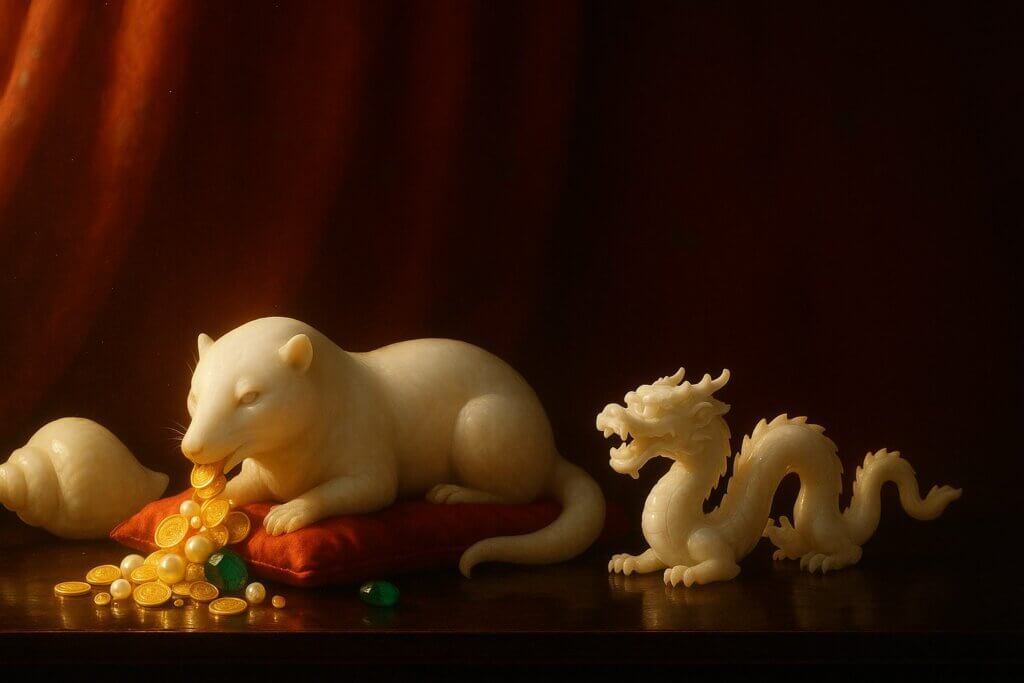
If you’ve seen an image of the White Jambhala, two odd details jump out. The first is the small animal cradled in his hand — it looks like a weasel or a mongoose, and tradition calls it the jewel-spitting mongoose (tu bao shu). Its whole function is to spit out jewels. But here’s the part that matters: it only does so when the deity gives it a gentle squeeze. Which is to say, in this image wealth doesn’t materialize out of nowhere. It gets invited out, coaxed out, guided out.
The second is what he rides: a dragon. In Chinese culture, dragons are bound up with water — they govern rain and rivers. And wealth in Chinese has always been tied to water, too. People talk about a “source of money” the way you’d talk about a spring, about income “flowing in like water,” about not letting good water run off into someone else’s field. A god of wealth mounted on a dragon is making a claim: wealth is fundamentally a thing that moves. Like water, it can arrive and it can leave, and what you can do about it is channel it, not dam it up.
Why He’s Remembered as the God Who Relieves Poverty
The phrase that follows the White Jambhala around is relieving poverty. Traditionally, his brief is understood as dissolving the suffering poverty creates — the concrete binds, like bills you can’t cover, family you can’t support, collectors on your heels. That gives him a particular warmth within the group. What he addresses isn’t the wish behind “I’d like to have more.” It’s the call for help behind “I can’t hold on much longer.”
It also explains why, in the folk retellings, the White Jambhala is so often tied to a sequence: stop the bleeding first, talk about growth later. If someone doesn’t know where next month’s rent is coming from, a conversation about index funds and portfolio strategy means nothing to them. What this tradition does, by splitting the work among different gods, is give that reality a shape — instead of dumping every money-related wish into the same basket.
Where the White God of Wealth Comes From: Two Turns in the Story
Almost every Chinese deity comes with a story attached, and the story usually tells you more about what a culture values than the official title ever will. The White God of Wealth has an unusual origin compared to most figures in this tradition. He isn’t a person who made a fortune in life and got promoted to divine status after death. He’s described instead as a form that a bodhisattva deliberately took on after seeing how much people were suffering. There are two turns in that story, and both are worth slowing down for.
It Starts with a Bodhisattva Seeing Poverty
The most widely told version links the White God of Wealth to Guanyin, the bodhisattva of compassion. In the Chinese world, Guanyin is more or less compassion itself — the figure who shows up the moment someone cries out. In the story, Guanyin looks at the world and sees an enormous number of people suffering from poverty. Not because they were lazy, not because they’d done anything wrong, but because they were born into hard circumstances and pinned there by reality. And compassion that stops at feeling sorry doesn’t help anybody. To actually fix the problem, you need a form that can handle wealth.
So Guanyin manifests as the White God of Wealth: the same compassionate nature underneath, but now holding tools that can hand out actual money. That narrative shape is very typical of Chinese belief — a deity isn’t parked up in the sky waiting to be bowed to, but shifts form in response to a specific kind of suffering. Read as culture, it’s making one point: compassion only counts once it turns into a method. Sympathy doesn’t pay the rent. Help does.
The Road from the Snow Lands into the Chinese World
The White God of Wealth originates in Tibetan Buddhism, and as Buddhism spread through Han Chinese regions, he gradually worked his way into Chinese wealth-seeking culture, circulating alongside the wealth deities already established there — the civil god of wealth, the martial god of wealth, that whole lineup. Nobody got displaced. It was more like a big family picking up a few more relatives. Chinese folk religion has always been flexible that way: if a deity answers a real need, there’s room for him.
Here’s the part worth noticing — how he got absorbed. He’s understood primarily as relief from hardship, not as a shortcut to sudden riches. That reflects a plain, unpretentious ranking of money that ordinary people have always carried around: money that saves your life, money that gets you through the week, and money that lets you build something are three different things. Because of that, the White God of Wealth was rarely cast as a figure who feeds greed. He tends to sit in the “get you through the rough patch” slot instead — which makes this one of the more clear-eyed branches of wealth-deity belief.
What People Traditionally Do: 3 Customs and the Thinking Behind Them
Here’s where we get into what people traditionally do when they turn to White Jambhala. One thing up front: what follows is a description of how people have long behaved and why they think the way they do — not a recommendation that you do the same. There’s a Chinese folk idea worth knowing here, and it’s best read as a cultural lens on wealth rather than a financial rule. What makes it interesting is that if you peel the deity off the outside of these customs, almost every one of them turns out to be a principle about how to handle money. A surprisingly sturdy one, at that.
A Cup of Clean Water: The Cheapest Offering, the Heaviest Meaning
In the tradition of making offerings to White Jambhala, the most common thing set out isn’t gold or treasure. It’s a cup of plain water. That sounds odd the first time you hear it — you ask a god of wealth for money and hand him a cup of water? But that’s exactly where the custom gets beautiful. Water carries several meanings at once here: it’s clean, it moves, and anyone can produce it. Offering water is a way of saying “I’m not paying a price for a favor,” because if a pricier offering bought a bigger return, the whole relationship would collapse into a transaction — and poor people would always be last in line.
Set the deity aside and the custom is really training an attitude: how you carry yourself around wealth shouldn’t be determined by how much money you happen to have right now. Someone who’s scraping by can still be honest, still keep their word, still be generous with other people. None of that requires capital. The tradition says this about as bluntly as it can be said, using a cup of water: the barrier to entry is low enough that anyone can walk through it, and the point was never the offering. The point is who you are when you set that cup down.
Keeping Money Energy Moving: Sharing Is How the Snowball Grows
There’s one idea at the center of this culture that deserves to be pulled out on its own: a god of wealth sharing money energy with you is understood as trust, not as a reward. The traditional thinking is that resources are placed in your hands because you’re expected to use them well and to give something back through how you act. Put plainly, you’re being treated as an agent — someone helping move good things along to more people. So whether a person deserves more isn’t judged by how much they’ve saved. It’s judged by how much they’ve let flow out.
The word that gets misread here is “sharing.” It doesn’t mean that if you earn a hundred dollars you’re on the hook to give ninety away. That’s neither reasonable nor sustainable. Sharing, as the tradition understands it, means letting that energy travel outward. Telling someone about a good idea you picked up is sharing. Spending your time volunteering, or giving a friend a hand, is sharing too. The amount isn’t the measure. Direction is: are you pulling resources inward, or sending them out?
And within this way of thinking, the best kind of sharing is passing what you’ve learned to the people around you so that they end up better off too. Because when their improvement came through you, part of that cycle comes back around to you, and it keeps building on itself, like a snowball. In more modern terms: someone who can help other people make money has a far better return than someone focused only on their own earnings — other people put in a dollar and get fifty cents back, while investing in you might turn a dollar into ten. The tradition puts it even more directly: getting rich yourself isn’t the impressive part. The person worth betting on is the one who brings others up along the way.
Making a Vow and Repaying It: An Old Piece of Credit Engineering
There’s a very consistent rhythm to how Chinese petitions to the gods work: you make a vow first, and once the thing you asked for comes through, you come back and repay it. What repayment looks like varies from place to place, but the common thread is that you have to return, and you have to do the thing you said you would. Some people carry a low-grade unease for years because they forgot to go back — and that nagging feeling is itself proof of how well the mechanism works.
Strip out the theology and this is a piece of self-discipline training: with nobody watching, you promised something to a party that will never come collecting, and then it’s on you to remember it and on you to follow through. The underlying logic of the money world, once you say it out loud, is credit. Getting a loan, closing a partnership, keeping a client — all of it rests on the same thing, that this person does what they say they’ll do. The act of repaying a vow trains credit into something close to instinct, and that runs deeper than any money-management technique.
Put the three together and you’ll see that the view of wealth in White Jambhala belief is actually complete: it starts with sincerity rather than capital, it operates through circulation rather than hoarding, and what holds it together is credit rather than luck. Even if you don’t believe in any deity at all, those three principles on their own are enough to support a fairly healthy relationship with money — one that doesn’t promise you’ll get rich overnight, but does turn you into the kind of person others find easier to trust, and who’s better positioned to catch an opportunity when it shows up. And that’s probably the most concrete thing an old tradition has to offer a modern reader.
5 Common Questions About White Jambhala
By now you’ve probably got a rough outline of who White Jambhala is. But people meeting Chinese folk religion for the first time tend to get stuck in the same few spots — how these deities relate to one another, whether this counts as religion or culture, whether any of it is worth reading if you don’t believe a word of it. The five questions below are the ones that come up most, and answering them fills in background the earlier sections didn’t have room for.
How is White Jambhala different from the other four Jambhalas?
It comes down to what kind of money problem each one is understood to handle. Yellow Jambhala is generally treated as the head of the five, in charge of the wealth reservoir and abundance overall, and he’s the one you’ll hear named most often. Red Jambhala leans toward relationships and gathering people around a deal, which puts him close to business and partnership situations. Green Jambhala gets connected to career momentum and the growth of resources. Black Jambhala has the fiercest character of the group, and tradition hands him the sharper situations — emergencies, being pushed around, being owed money you’re not getting paid.
White Jambhala’s place in the lineup is compassionate relief. He’s understood to deal with the suffering that comes out of poverty itself: illness, debt, a life you can’t keep afloat. So in the popular understanding, he isn’t the figure who makes you rich — he’s the figure who gets you standing again. There’s a lot of lived sense in that division of labor. It admits that people’s relationship with money runs on more than one level, that the money that saves you is not the same as the money that grows you, and that the two call for different states of mind. Expressing all that through a set of five deities gets closer to how things actually work than one all-purpose god of wealth ever could.
Is White Jambhala a Buddhist deity or a folk deity?
He touches both, and that’s part of what makes Chinese religious life so interesting. White Jambhala’s origins are in Tibetan Buddhism, where he sits within the system as a protector and meditational figure with full doctrinal grounding behind him. But once that devotion traveled into Han Chinese popular society, it got absorbed into an already-crowded family of wealth deities, taking its place alongside the civil god of wealth and the martial god of wealth — and the way people understood it became more everyday, less doctrinal.
Here’s a frame that helps if you’re American and new to this: Chinese folk religion isn’t one clearly bounded faith. It’s more like a cultural layer built up over a very long time, with Buddhist, Daoist, local-legend and ancestral elements mixed together, and ordinary people rarely stopping to sort out which tradition a given figure came from. So the same White Jambhala can carry rigorous religious meaning inside a monastic setting while functioning in an ordinary household as something closer to a wish and a reminder about money. Both readings have run side by side in Chinese society for a long time, and they aren’t considered to be in conflict.
What’s in this for someone with no religious belief at all?
Read it as a set of ideas about wealth that happens to come wrapped in a story. The valuable part of a myth usually isn’t the supernatural claim it makes but the collective judgment it preserves — what a culture concluded about something over several hundred years. The judgment preserved in this particular strand runs roughly like this: wealth is meant to move, and it spoils when it’s hoarded; the starting point is sincerity, not capital; credit and reputation matter more than luck; and the person who can bring others up along with them goes further over time.
None of those principles require believing in any deity. You’ll find nearly identical conclusions in modern business writing — they’re just wearing different vocabulary there: network effects, reputational capital, positive-sum games. What the tradition does differently is use images and rituals to make abstract ideas something the body can remember: pouring a cup of water, remembering to close out a vow you made, telling a friend the thing you just learned. For a lot of people, that concreteness turns into a habit far more reliably than reading ten books on the subject.
Why is the offering plain water, and what’s behind that in the tradition?
Plain water carries several layers of meaning at once here. The first is cleanliness — water has no flavor and nothing suspended in it, which stands for an offering made with a clean mind, one that isn’t quietly negotiating for something. The second is movement. Water is a thing whose nature is to flow, and that echoes the central conviction running through this whole tradition: money stays alive by moving, and it goes stagnant the moment it stops. The third layer, and the most practical one, is that anybody can produce a cup of water.
That last point matters more than it looks. If the value of the offering determined the size of the response, the whole tradition would turn into a rich person’s privilege — and White Jambhala, of all figures, is the one positioned to relieve poverty. Making a cup of water the standard offering, something nobody is priced out of, says the thing plainly: this door is open to the poor too. As cultural design goes, that’s elegant. It drops the threshold as low as it can possibly go and puts all of the weight on intention and conduct instead. Some people use the moment of pouring to take stock of where they’ve been lately, and that quiet pause may be what the custom is really doing.
“Sharing makes you richer” sounds like a greeting card — what’s the actual basis in the tradition?
The traditional version is a lot colder-eyed than the greeting card. Its logic goes like this: when a god of wealth extends money energy to you, that’s an investment of trust, and the point of it is to move resources through you and out to more people. So whether what you’re holding actually flows onward is what determines whether that trust gets renewed. Stop at you, and the circuit breaks. Keep it going, and the circuit continues — and gets bigger with each turn. That’s less a piece of moral persuasion than a description of how a distribution system behaves.
The tradition is also pretty specific about what sharing does and doesn’t mean. It isn’t asking you to give away most of what you earn — that’s neither sustainable nor the point. Sharing can mean passing along a good idea, spending time helping someone, or pulling a person through a spot where they’re stuck. The form considered most valuable is teaching what you’ve learned to the people around you so their own situation improves, because that kind of sharing starts a new circuit — and you’re standing at the head of it. Put in practical terms: someone who makes the people around them better off will find that opportunity collects in their direction. The tradition simply describes that phenomenon as the god of wealth raising his stake.