Who Is Caishen? Three Ideas to Get Straight First
In Chinese folk religion, the gods have job descriptions. One handles exams. One handles safe passage at sea. One handles childbirth. And the one who turns up in more homes, across more income brackets, than just about any other is Caishen, the Chinese god of wealth — who, as the name says right out loud, handles money. That sounds blunt, and the bluntness is the whole point: it’s what has kept Caishen one of the most everyday, most reachable figures in the Chinese religious landscape for centuries. Before you get to his story, there are three things worth understanding.
1. He isn’t a mythological character — he’s a daily presence
If your reference point is Norse or Greek mythology, you might expect Caishen to be an epic figure — magnificent, and a little removed from ordinary life. He’s nothing like that. He sits next to the register at a noodle stand, behind the door of a corner grocery, in the corner of somebody’s living room. A shop owner rolling up the security gate in the morning may light a stick of incense before doing anything else. It isn’t a solemn religious rite. It’s closer to saying good morning to a business partner.
Chinese folk religion has that quality built in. It doesn’t operate much like a religion with airtight doctrine, one authoritative scripture, and a procedure for joining. It works more like a long-running set of habits and values handed down through families. Plenty of people who make offerings to Caishen couldn’t lay out a complete theology if you put them on the spot — but they know exactly what the gesture means. It means: my livelihood matters to me, and I’m willing to face it in a way that has some structure to it.
2. There isn’t one god of wealth — there are at least two types
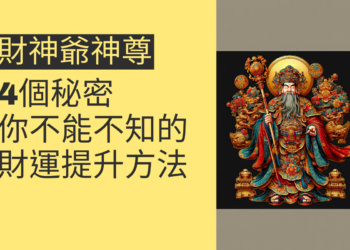
Newcomers usually ask who Caishen actually is, and here’s the surprising part: not one person. Folk tradition sorts wealth gods roughly into two kinds, the civil god of wealth and the martial god of wealth. The civil god of wealth is typically depicted as a mild-featured court official holding a gold ingot or a ledger book — wealth that comes from playing by the rules, dealing fairly, keeping the books clean. The martial god of wealth is usually a stern-faced warrior, often mounted on a black tiger — wealth that can hold a room and keep trouble out.
So why split it in two? Because traditionally, people’s picture of money always had two sides. One side is what you build up slowly through honesty and good management. The other is what you have to defend, so nobody swallows it. Business owners often lean toward the martial god of wealth, because commerce really does call for a certain amount of presence. Trades that live and die by their books and their reputation tend to feel closer to the civil god of wealth. The category split is itself a piece of folk observation about how wealth behaves.
3. Making offerings to Caishen isn’t placing an order — it’s taking a position
This is the part outsiders misread most often. From the outside, offerings to Caishen look like a transaction: I give you incense and food, you give me money. But listen to how people who actually keep the practice describe it, and you’ll hear close to the opposite. They don’t think of themselves as putting in an order with a god. They think of themselves as taking a position.
A position on what? That wealth isn’t entirely their own doing. That they’re willing to earn money within some sense of proportion. That luck exists and they’ll acknowledge it, but they don’t intend to run on luck alone. There’s a saying that gets around: Caishen doesn’t bless the lazy. In other words, the tradition never promised that making offerings produces money. What it promises is closer to this — do the right things, and they get noticed. That distinction shapes how you read every custom that follows.
From Mortals to Gods: Three Origin Stories Behind Caishen
Here’s the most interesting thing about the Chinese gods of wealth: every one of them started out human. Not born divine, not cosmic forces present at the beginning of the universe, but historical or legendary people who lived, did things, and left reputations behind — and got lifted onto the altar by one generation after another. That alone tells you a lot about how Chinese folk religion operates. Respect isn’t handed down through a bloodline. You earn it by what you actually did. The three stories below are the ones you’ll run into most often.
Zhao Gongming: From Demon-Quelling General to the Most Common Martial God of Wealth
Zhao Gongming is the best-known form of the martial god of wealth. In the legends he starts out as a recluse pursuing spiritual cultivation, and is later appointed a divine general commanding the money energy of all four directions — money energy being the idea that wealth behaves like a current rather than a pile. He’s depicted with a dark face and a heavy beard, riding a black tiger, an iron whip in his hand. That fierce, battle-ready statue you’ve spotted in a Chinese-owned shop, the one that looks like it has nothing to do with money? Usually him.
So why put a warrior in charge of the books? This is folk religion being extremely practical. What business owners actually fear is rarely that the money won’t come in. It’s that it comes in and then slips away — a customer who won’t pay, a competitor who sets you up, a sudden disruption that cuts everything off mid-stream. Traditionally, Zhao Gongming’s portfolio includes making trade profitable and fair, meaning transactions that close smoothly and honestly. The whip in his hand stands for keeping bad-faith interference outside the door. The whole image amounts to an argument: wealth requires order, and order requires somebody standing guard over it.
Bigan: Absolutely Impartial, Precisely Because He Has No Heart
Bigan was a loyal minister of the Shang dynasty who, in the traditional account, spoke too honestly to his king and was put to death by having his heart cut out. Later generations enshrined him as a civil god of wealth, and the reasoning is wonderfully imaginative: with no heart, he can’t play favorites.
That’s a fascinating piece of cultural logic. When people go looking for a god to handle money, the thing that worries them most isn’t scarcity — it’s unfairness. Why did he get rich and I didn’t? If even the gods have favorites, then nothing makes sense anymore. So they picked someone who was, in the most literal physical sense, incapable of bias. Bigan’s story lays bare the central anxiety running through the whole tradition of wealth deities: what people are asking for isn’t really money so much as a fair shake. A god of wealth who can guarantee fairness is more trustworthy than one who hands out cash on a whim.
Fan Li: Three Fortunes Made, Three Fortunes Given Away
If you had to name the one figure who best embodies this whole view of wealth, plenty of people would go with Fan Li. He was a real strategist of the Spring and Autumn period who helped King Goujian of Yue restore his kingdom — and then, right at the peak of his achievements, chose to walk away, change his name, and go into business. He became known as Tao Zhu Gong.
The legendary part of his story isn’t that he was good at making money. It’s that he made it and gave it away, then made it again, reportedly three times over. He distributed what he’d accumulated to his neighbors and to people in poverty, started over from nothing, and succeeded every time. When later generations made him a god of wealth, what they clearly valued wasn’t the size of his balance sheet but the thing he’d demonstrated: if your ability to earn is real, losing it once won’t destroy you. And the reverse holds too — anyone who has to clutch the money in their hands just to stay afloat was never really wealthy to begin with. This story is the key to understanding every custom that follows.
What People Traditionally Do: Three Customs and the Thinking Behind Them
Now that you know who Caishen is and where the stories come from, here’s the part outsiders are always most curious about: what does making offerings to the god of wealth actually look like? One thing to get straight first — what follows describes what people traditionally do. It isn’t a set of instructions for you. And honestly, the gestures were never the valuable part. It’s the idea sitting underneath each one, and that part travels just fine even if you don’t believe in a single one of the gods involved.
Welcoming the God of Wealth: Why Everyone Gets Up Before Dawn
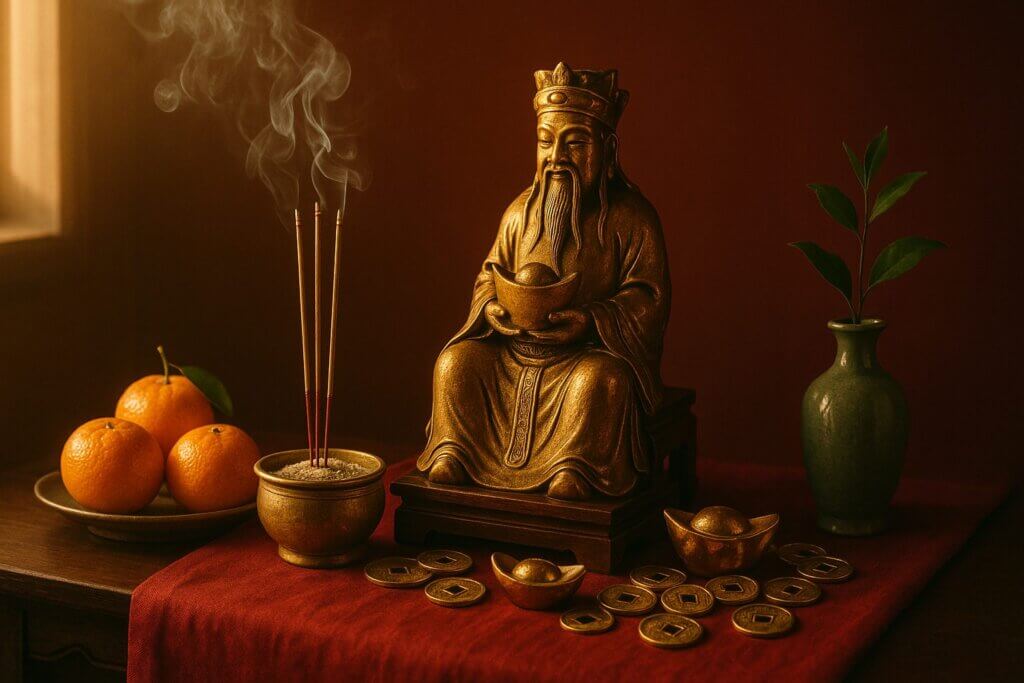
Chinese New Year brings a genuinely festive scene. On the fifth day of the first lunar month, families and shopkeepers get up while it’s still dark, open the doors, set off firecrackers, and lay out offerings. This is called welcoming the god of wealth. Some business owners pick an even earlier hour, competing to be the first to light incense that morning. From the outside, it looks like a mad dash for luck.
Ask the people who actually do this every year, though, and the reason they give is a lot plainer. The fifth day is when the holiday ends and work starts back up. What the ritual really does is hit the start button on the whole year. You get up before dawn, you sweep the shop properly, you get your head straight, and then you say it out loud: this year I’m going to do this well. “Sincerity,” in this context, isn’t some abstract idea about faith moving mountains. It’s concrete — you were willing to get out of bed early for it. That logic holds up in any culture. How you begin something tends to determine how you treat it.
Offerings and Incense: The Point Was Never Giving, It’s Moving
Traditionally, making offerings to the god of wealth means setting out food and lighting incense on a regular schedule. Outsiders tend to assume this is about feeding the deity, but the folk explanation is way more interesting than that. The incense is supposed to be constant; the offerings are supposed to be changed out. The point is that the thing keeps happening and the items keep circulating — not that any single spread is especially lavish. Incense that has gone out reads as a bad sign, and not because a god is offended. It’s because it stands for stagnation.
Buried in that detail is the single most central idea in the whole tradition: money energy — the idea that wealth behaves like a current rather than a pile — is supposed to move. The traditional framing is that when the god of wealth is willing to send money energy your way, that’s an expression of trust. He wants you to use it well and then pass it along. And passing it along doesn’t mean handing over ninety dollars out of every hundred you earn. It means keeping the energy headed outward. You tell a friend about a method that worked for you — that’s sharing. You spend a Saturday volunteering — that counts too. When you’re willing to send something back out after you’ve received, you close a loop, and the loop snowballs.
You can throw out the language of money energy entirely and still find the everyday version hard to argue with: money is like information. Hoarded in place, it loses value. It only produces anything new by moving and being exchanged.
Fulfilling a Vow: A Folk Rehearsal for Credit
The third custom is fulfilling a vow. Traditionally, when people ask for something, they attach a promise to the request — if this works out, I’ll come back and do such-and-such. When it does work out, they’re on the hook to return and make good. Folk tradition treats an unfulfilled vow as an extremely serious matter, serious enough that it can look out of proportion to an outsider.
Why so severe? Because what the practice actually rehearses is credit. In an era with no credit bureaus and no credit scores, whether a person was worth doing business with came down to one thing: whether their word held. If you’d break a promise made in front of a god, what’s your promise worth in a deal? Hence the old saying — people are acting, and heaven is watching. That isn’t purely a threat. It’s closer to a design for turning an abstract virtue into a habit you can actually practice.
String the three customs together and you can see what making offerings to Caishen is really teaching: an attitude toward money. Start in earnest, keep it moving, keep your word. And sitting above that value set is a higher standard still. The traditional line goes that as far as the gods of wealth are concerned, getting rich by yourself isn’t impressive — before they became gods, the people they dealt with were already wealthy anyway. The person actually worth investing in is the one who can bring others up with them. Put a dollar into most people and you might get fifty cents back; put a dollar into someone like that and you get ten. Translate that judgment into today’s terms and it comes out like this: a person’s worth is measured by how many people they’ve made better off, not by how much they’ve stacked up for themselves.
5 Common Questions About Making Offerings to Caishen
When you run into an unfamiliar cultural tradition, the first question usually isn’t “what is this?” It’s “what does this have to do with me?” The five questions below are the ones people outside Chinese folk religion tend to ask most. The answers lean toward cultural understanding rather than religious explanation — think of them as footnotes written for an outside observer.
Does making offerings to Caishen actually make people wealthier?
If you’re asking whether there’s causal evidence, the answer is simple: there isn’t. This can’t be tested, and it shouldn’t be treated as a financial strategy. But if you’re asking why people have kept doing it for hundreds of years, that’s a conversation worth having.
What the custom actually does is turn a handful of easily neglected attitudes into concrete actions. It pushes you to start the year’s work in earnest. It pushes you to check, on a regular schedule, whether you’ve let things stall out. It pushes you to treat the promises you make out loud as real. Traditionally, people understood this perfectly well — there was never a folk belief that making offerings produces money on its own, and the common view ran the other way: Caishen doesn’t look after the lazy. So what this tradition promises isn’t an outcome. It’s a kind of discipline about money. Whether it works depends on whether you actually live by that discipline, not on how many sticks of incense you light.
I don’t believe in deities. Is there still a point in understanding Caishen?
Yes — and you may get more out of it than a believer does, because you won’t get tangled up in the mechanics of ritual and can look straight at the logic underneath.
The Caishen tradition is essentially a very old field report on how wealth behaves. It argues that wealth needs order, which is why a battlefield general was put in charge of it. It argues that wealth has to be fair, which is why the tradition picked a figure incapable of playing favorites. It argues that wealth isn’t real until you can give it away, which is why it honors a merchant who gave away his fortune three times. And it argues that wealth has to move, which is why the incense is never supposed to go out. Strip the word “god” out of those four judgments, drop them into any modern business or personal situation, and they mostly still hold up. That’s the value of reading another culture on its own terms: you’re seeing how someone else thought through a problem, and other people’s thinking has a way of exposing your own blind spots.
How is Caishen different from the Japanese lucky cat or a Western goddess of fortune?
The difference is conditionality. The lucky cat and Lady Luck read as symbols of good fortune — luck shows up when it shows up, and it doesn’t ask many questions about what kind of person you are. That’s a pure and genuinely appealing form of blessing.
Caishen is conditional, and he’s not subtle about it. Behind his image sits an entire moral framework: keep your word, deal fairly, be willing to share, and ideally bring other people up with you. He’s less a figure handing out candy than an investor sizing you up — deciding whether you’re worth putting more capital behind. That’s also why every Caishen archetype is a real or semi-real human being rather than an abstract symbol of luck. Call it a cultural design decision that welds character and wealth together on purpose, with a strong streak of pragmatism running through it.
Why are there several gods of wealth, and what happens if you pick the wrong one?
There are many gods of wealth because no single institution ever defined this tradition. It accumulated over a long stretch of time, with different communities elevating their own figures. Different regions and different trades feel close to different gods of wealth, the same way different cities have different patron saints. That plurality is the signature of folk religion: no central authority, so no official answer.
As for picking the “wrong” one, that’s basically a non-issue in folk understanding, because the point was never the recipient. It’s the attitude you bring and what you actually do. Traditionally, people chose a particular god of wealth based on the nature of their trade or on what the elders in the family had always done — more like picking a figure you feel some resonance with than picking a service window with a different function. From a cultural standpoint, that looseness is itself revealing: this tradition cares about how a person conducts themselves, not about whether the procedure was executed correctly.
What does “sharing your money energy” actually mean? It sounds abstract
It is abstract, but the traditional meaning is more concrete than you’d expect, and it has nothing to do with writing checks.
The folk framing is that what comes to you isn’t supposed to stop with you. Telling a friend in your field about a method you worked out yourself is sharing. Putting your time into volunteer work is sharing. Giving someone a hand when they’re just starting out is sharing. None of that requires handing over ninety percent of your income. And the form considered most valuable is passing along what you’ve learned to the people around you, so that they get better because of it — because in that cycle, they got where they are through you, and some portion of that influence eventually finds its way back.
Take the deity out of it and you’re left with something everyone has watched happen: the people who are genuinely generous with what they know tend to go furthest. Their reputation works on their behalf, and the people they helped turn into opportunities years down the road. That’s probably what several centuries of this way of thinking about wealth leave an outside observer with — it isn’t a theory about how to get rich. It’s a theory about what kind of person deserves to, and those two questions have never really been the same question.