Who Is Yellow Jambhala? Three Basics About This God of Wealth
If the Chinese world of gods and deities is brand new to you, here’s the easiest way in: think of Caishen, the Chinese god of wealth, as a job title rather than one specific guy. In Chinese folk religion, the divine world runs on division of labor. One deity handles imperial exams, another handles medicine, another keeps ships safe at sea — and the god of wealth handles wealth and abundance. That post isn’t filled by a single figure. It’s filled by a whole roster of deities from different origins, each with his own backstory and personality. Yellow Jambhala, a wealth deity who enters Chinese practice by way of Tibetan Buddhism, is the one you’d pick out of a lineup fastest.
1. How to Spot Him: Golden Skin, One Leg Hanging Down, and a Mongoose
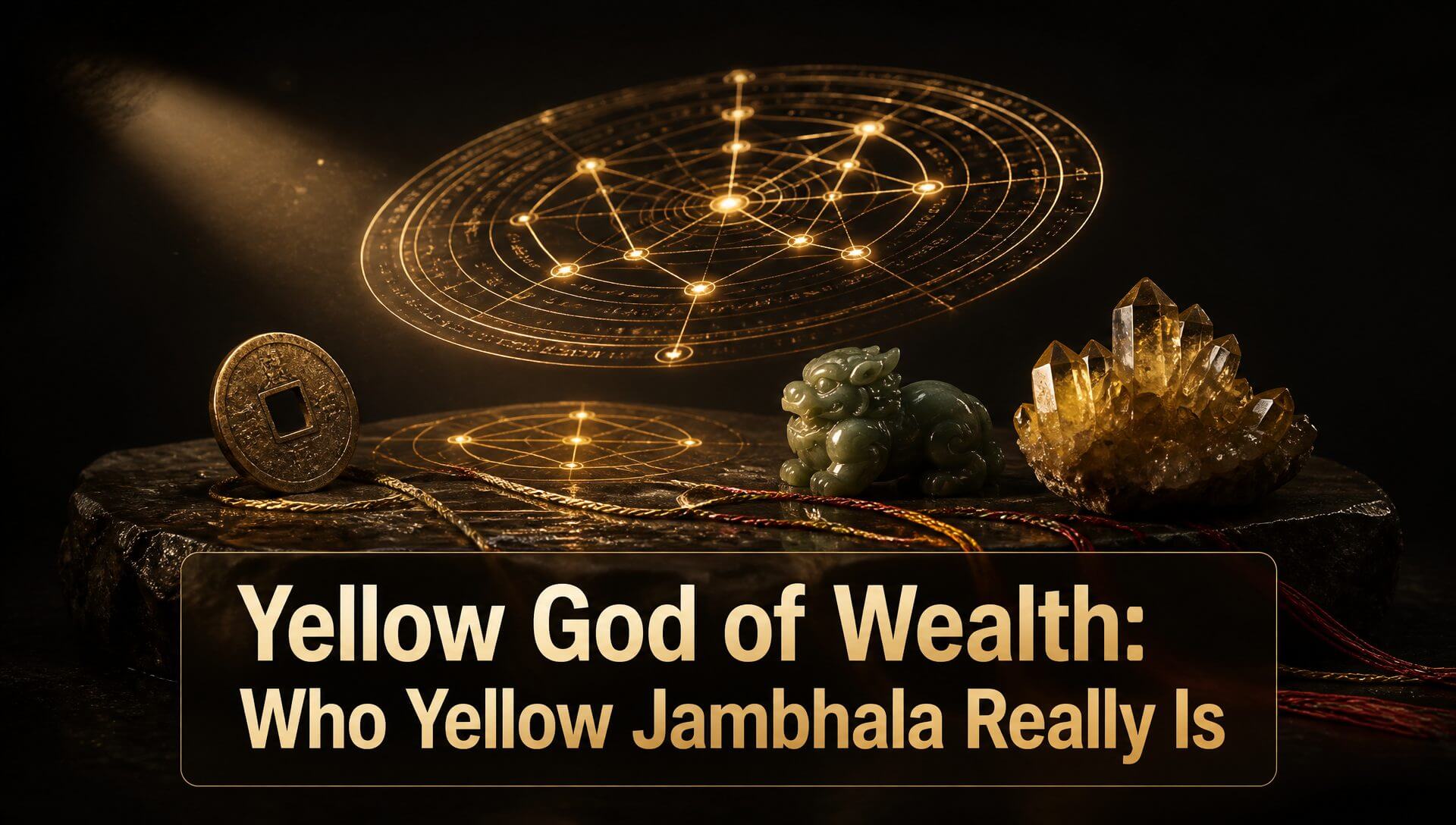
Yellow Jambhala is hard to miss. He’s golden all over, usually bare from the waist up, wearing jewelry and a jeweled crown, and he sits in a posture all his own — not cross-legged and composed, but with his right leg dropped naturally down, resting on a lotus or a small pedestal. Traditionally that pose is read as “ready to stand up at any moment.” If someone genuinely needs help, he isn’t going to take his time about it.
In his right hand he holds a jewel. In his left he grips an animal called a jewel-spitting mongoose (tu bao shu) — a small creature something like a weasel or a mongoose that, when he gives it a gentle squeeze, spits jewels out of its mouth. That mongoose is the most thought-provoking detail in the whole image. Wealth doesn’t simply fall out of the god’s hand; it takes an act of squeezing before anything comes out. Some readings take this as a hint that wealth has to be directed, has to be prompted into motion. It will not land on you out of thin air.
2. Where He Sits in the System: Not the Highest God, but the One Closest to People
In the hierarchy of Chinese deities, Yellow Jambhala isn’t top tier. His role is closer to that of a protector — a figure who guards practitioners and clears obstacles out of the way. That matters, because it shapes how people relate to him. They don’t approach him with the awe and distance reserved for a supreme deity. It’s more like dealing with an older relative who has connections, keeps his word, and also has a temper.
Traditionally, Yellow Jambhala is understood to preside over more than money — his domain is scarcity in the broader sense. Not being able to make rent is scarcity. So is having no network, no opportunities, and nobody willing to give you a hand up. The job assigned to him, then, is to clear whatever is jammed so that the resources that ought to reach you actually can. That’s a more complicated idea than “get rich,” and a more human one.
3. One Thing People Get Wrong: Money Energy Is Not Cash
When Chinese speakers talk about wealth deities, one term keeps surfacing: money energy — the idea that wealth behaves like a current rather than a pile. There’s no clean English equivalent; the closest you’ll get is something like a state of flow or fortune surrounding money. Money energy isn’t the money itself. It’s the set of conditions that makes money more likely to find its way to you.
That distinction matters, because it explains why the tradition never held that making offerings gets you a winning lottery ticket. Between money energy and actual wealth sit your judgment, your actions, and whether you recognize an opening when it shows up. The way the tradition puts it, the god supplies the water source; digging the channel is still your job. Which lands surprisingly close to the modern line about luck favoring the prepared.
Where Yellow Jambhala Came From: Three Turns From Yaksha to Wealth Deity
Almost every wealth deity comes with an origin story, and here’s the thing — those stories usually tell you more than the deity does, because they reveal what a culture believes about who deserves wealth in the first place. Yellow Jambhala took an unusually winding road. He isn’t Chinese at all. He traveled from India through Tibet before he ever reached the Chinese world, and his identity got rewritten more than once along the way. The three turns below trace roughly how he became the figure people recognize today.
1. The Starting Point: A Treasure-Guarding Yaksha Who Was Not Especially Friendly
The prototype for Yellow Jambhala traces back to the guardians of treasure in ancient Indian mythology. In the earliest tellings, beings of this type were classified as yaksha (nature spirits that sit somewhere between gods and demons) — powerful figures who watched over underground ore and hoarded riches, but who weren’t gentle by temperament and carried a real edge of danger.
That starting point is worth sitting with. In a lot of cultures, the first guardians of wealth aren’t kindly faces: in Norse myth it’s a dragon curled on a pile of gold, and in Greek myth the lord of the underworld holds the buried riches right along with the dead. People seem to have figured something out very early — that wealth carries a force that has to be tamed. It can feed you, and it can swallow you.
2. The Turn: A Famine That Changed Him From Guarding Wealth to Giving It
The most widely repeated account goes like this. The Buddha was teaching in one place when hostile opponents attacked and stones rained down from above. A protector of treasure appeared and shielded him with his own body, sparing him from harm. The Buddha then charged this protector with a task: from then on, look after practitioners, so that nobody has to abandon the path toward goodness simply because they lack food and clothing.
Another version turns on famine. A severe drought hit a region, and people were starving to the point where they couldn’t hold their basic lives together, let alone practice anything spiritual. The protector accepted the charge and took on responsibility for keeping beings out of poverty. From that moment his role flipped completely — from a watchman guarding a hoard and keeping people away from it, to a giver actively handing that hoard out.
That flip is the heart of the whole tradition. Yellow Jambhala earned his standing as a wealth deity not because he had money, but because he was willing to give it away. And that standard eventually got extended to people too: in this value system, the person worth respecting isn’t the one who is rich, but the one willing to make others rich alongside him.
3. Landing: Taking Local Form in Tibet and in Chinese Society
As Buddhism spread into Tibet, this protector was absorbed into the Tibetan Buddhist system and became a fairly common figure in ritual practice, and it was at this stage that the name “Yellow Jambhala” settled into its fixed form. Later, through trade routes, migration, and ordinary cultural exchange, he made his way into Chinese folk religion as well.
What happened after he landed is the interesting part. Chinese society already had wealth deities of its own — Zhao Gongming, regarded as the martial god of wealth; Bigan, honored as the civil god of wealth; and later Guan Yu, who came to be revered as a god of wealth because of his reputation for keeping his word. When Yellow Jambhala showed up, he didn’t push anyone out. He was simply slotted into the same “wealth deity system,” which is a very characteristic Chinese move: rather than drawing lines, take everyone in. That’s why you’ll see gods of wealth from completely different origins discussed side by side, coexisting without friction.
What People Traditionally Do: 3 Ideas About Wealth Hidden Inside the Customs
Now for the customs themselves. The goal here isn’t to hand you a to-do list — it’s to pull the practices apart and ask what they’re actually built to protect. Here’s the thing about religious traditions: a lot of what looks like pleasing a deity functions, in practice, as behavioral training aimed squarely at the person doing it. You can believe in no deity at all and still see plainly what habits these customs are trying to build. The three below are the ones that best explain the logic underneath Yellow Jambhala.
1. Why circulation gets the emphasis: money energy compounds by moving, not by sitting still
One idea keeps surfacing in the tradition around Yellow Jambhala: when a deity is willing to send money energy your way, that’s an act of trust, and what he’s said to expect in return is that you use it well and pass some of it along. Put more plainly — the god of wealth shares wealth with you so you can accumulate merit on his behalf. So whether or not that money energy ever converts into actual dollars in your account, the tradition holds that you have to keep it moving outward. That’s what makes it grow.
The part people most often get wrong is what “sharing” means. The traditional claim was never “earn a hundred dollars and give away ninety.” It’s that any outward movement of energy counts. Passing along an idea you’ve learned counts as sharing. Giving your time as a volunteer counts as sharing. The amount isn’t the variable — direction is. Are you pulling things inward, or pushing them outward?
And within this logic, the most effective kind of sharing is teaching the people around you something you’ve learned that genuinely works, so that they end up better off too. Because they got there through you, some portion of that cycle is understood to loop back around. From the deity’s point of view, one person getting rich on their own isn’t much of a story — before these figures became gods, the wealthy were the company they kept anyway. The person worth investing in is the one who brings others up along the way. If most bets return fifty cents on the dollar and this one might return ten, of course the money goes in heavier.
Strip out the religious language and you’re left with a claim any American self-help reader already owns: send value outward, and the returns come back by routes you never would have predicted.
2. Why credit matters so much: your word has to be good
The other thread running through the whole Chinese god-of-wealth tradition is credit. Traditionally, people making a request would also make a promise — if this works out, I’ll come back and settle the vow, or I’ll do some specific good deed. And settling the vow is taken with enormous seriousness, arguably more seriously than the request that kicked it off. There’s a widely repeated version of the rule: making a vow and not settling it is worse than never having made one at all.
That habit has deep practical roots. The Chinese commercial world ran for a very long time on personal credit. A sentence, a nod — that was frequently the whole contract. In that kind of environment, someone who didn’t keep their word wasn’t just morally suspect; they genuinely could not do business, because nobody would deal with them.
So keeping faith with a deity works, in a sense, as practice. You’re rehearsing follow-through inside a relationship where nobody is monitoring you and no law will enforce a thing. Once that habit sets, it carries over into every working relationship you have. It’s also why Guan Yu, a figure known above all for loyalty and keeping his word, got elevated into the ranks of the wealth deities in the first place — that promotion tells you plainly that in this culture, credit is understood as the foundation wealth sits on.
3. Why the offerings are everyday things: money and daily life shouldn’t be kept separate
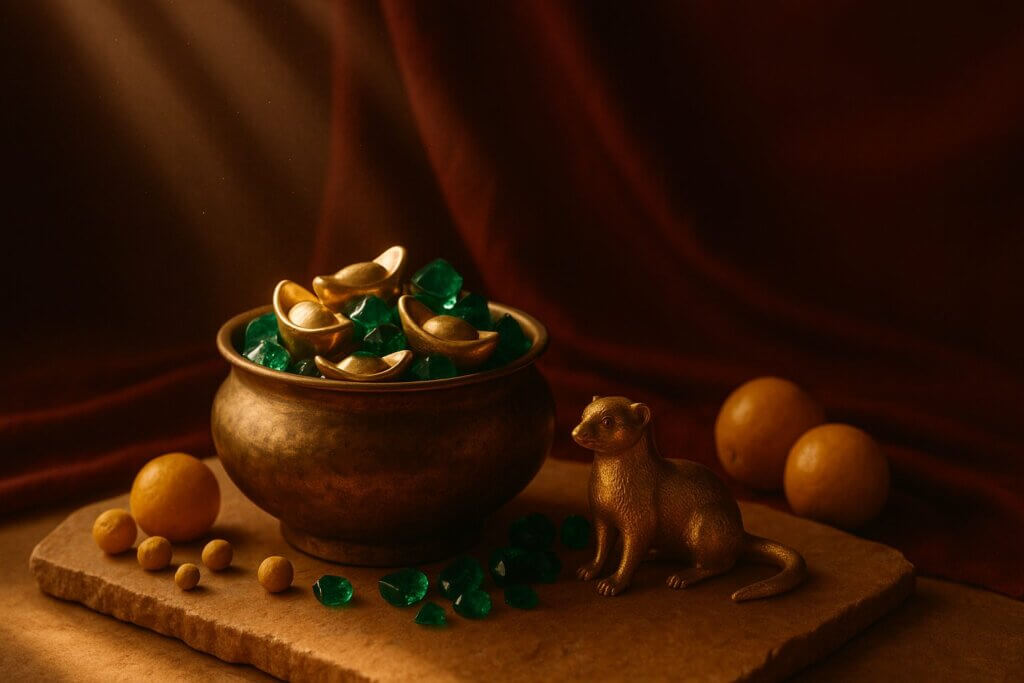
Traditionally, offerings made to Yellow Jambhala are ordinary: water, fresh flowers, fruit, clean rice. Some people wash the statue with clean water. Nothing on that list is unusual or expensive, and the arrangement itself carries a message — this relationship isn’t something you purchase at a price.
What’s more interesting is the insistence on two qualities: clean and fresh. Traditionally the water is changed daily, flowers get taken away once they wilt, and dust isn’t allowed to collect on the home altar. What those rules add up to is a rhythm. Every day you come back to this one thing, spend a few minutes, and put it in order.
In modern terms, that’s a ritualized regular review. It’s not so different from people who check their accounts on the same day every month, or rebalance a portfolio once a quarter. Traditional society had no budgeting apps, so it used incense, water, and a table to keep people in the habit of facing their own finances on a schedule. People believed the god of wealth doesn’t care for cluttered places — and you can read that line a second way too: a chaotic environment and chaotic finances are usually two views of the same thing.
5 Common Questions About Yellow Jambhala
By now you’ve probably got a rough picture of this deity. Still, if this is your first run-in with Chinese wealth-god culture, a few concrete questions tend to surface — whether he counts as Buddhist at all, how he stacks up against the other wealth gods, and what someone who believes none of it is supposed to take away. Here are the five that come up most, answered as much as possible through a cultural lens rather than a religious one.
1. Is Yellow Jambhala a Buddhist figure? Is he the same thing as the Chinese wealth gods?
Strictly speaking, Yellow Jambhala comes out of the Tibetan Buddhist tradition, and the original figure traces back to a guardian of treasure in ancient Indian mythology. He didn’t originate in China. Zhao Gongming, Bigan, and Guan Yu, on the other hand, grew up inside Chinese society itself, each with his own historical figure or mythological backstory behind him.
In actual folk practice, though, that line blurs a lot. Chinese religious habits are inclusive rather than exclusive — the same person might mention a Buddhist deity, a Daoist deity, and a purely local object of devotion in a single breath and see no contradiction in it. So you’ll find Yellow Jambhala slotted comfortably into the broad category of “wealth gods,” standing right alongside the homegrown ones. Rather than rival religious camps, think of them as characters with different origins playing the same role — the way separate mythologies each end up with a sea god and a war god.
2. How does Yellow Jambhala differ from the other wealth gods? Why are there so many of them?
The Chinese wealth gods sort roughly into a handful of personalities. The martial god of wealth usually has a military or warrior background, and is traditionally associated with situations that call for a push — an expansion, a fight for market share. The civil god of wealth tends to carry the image of a court official or a loyal minister, leaning toward steady income and accumulation. And the wealth god known for honor and good faith is about integrity inside a working relationship.
What makes Yellow Jambhala distinctive on that spectrum is his emphasis on relieving scarcity and clearing obstacles. The stories mentioned earlier — the famine, the protection of practitioners so that poverty wouldn’t cut their practice short — all point the same direction: getting a person to the point of surviving and being stable, not making anyone rich overnight.
As for why there are so many of them, that reflects a fairly fine-grained understanding of wealth in Chinese culture. Making money isn’t one single condition. What you need in the early scramble of a new venture has nothing in common with what you need once you’re protecting what you already built. Different wealth gods are, in a sense, different financial circumstances given a face.
3. Traditionally, did people believe that making offerings would make you rich?
Going by what’s been handed down, the answer is no, and the no is firm. What a wealth god gives is money energy — a state in which opportunity comes closer to you more easily — not cash directly. For money energy to turn into actual wealth, it still has to pass through your judgment, your action, and whether you catch the opportunity when it shows up.
Tradition adds another limit on top of that: this money energy is treated as a form of trust, and trust comes with conditions. If the person receiving it just stuffs it in their own pocket and sends nothing back out, the cycle breaks and the money energy stops growing. Put another way, this was never a story about something for nothing. It reads much more like a conditional assignment — resources handed to you because you’re believed to be capable of using them well.
4. I don’t believe in any of this. What’s in it for me?
Plenty of the people drawn to this subject aren’t here for faith at all — they’re curious about how another culture thinks about wealth. Seen that way, the Yellow Jambhala tradition offers at least three ideas that stand on their own, no belief required.
The first is that circulation beats hoarding: value you send outward tends to come back around in ways you didn’t plan for. The second is that credit is the foundation wealth gets built on — practicing doing what you said you’d do inside a relationship where nobody is checking is the habit that eventually determines how many people are willing to work with you. The third is that money shouldn’t be walled off from the rest of your life: look at it regularly, deal with it regularly, because messy finances usually travel with a messy life.
None of those three needs a deity to hold up. They were simply wrapped in myth and ritual and passed along that way for a few hundred years, because in an era before personal finance books, that was the most effective delivery system going.
5. Why is wealth-god devotion so widespread in Chinese society?
A lot of it comes down to historical circumstance. Chinese society went through long stretches of war, displacement, and emigration, and many families left home carrying almost nothing and started over from zero somewhere unfamiliar. In an environment that uncertain, asking for wealth wasn’t greed — it was asking for enough to stay alive and keep a family fed.
The other reason is the Chinese commercial tradition. From the old merchant guilds to the modern networks of overseas Chinese business, deals were often held together by personal trust, and wealth-god devotion happened to supply a shared language and a shared standard of value: keep your word, honor your commitments, give back to your hometown once you’ve made money. It was never only a ritual for asking for money; it carried a whole business ethic along with it.
So when you run across the customs surrounding the wealth gods in Chinese communities, what you’re looking at isn’t just an appetite for money. It’s how an entire generation found somewhere to put its anxiety during upheaval, and how it set a standard for what counts as earning money honorably. Wealth in this culture was never a neutral number. It has always had the same question attached to it: now that you have it, what do you intend to do with it?