Who Is Mahakala, the Wealth Deity? 3 Basics to Get Straight First
If this is the first time you’ve bumped into the name, don’t file him away as “the god who hands out money.” In Chinese folk religion, deities routinely hold more than one job, and Mahakala (da hei tian, literally “the great black one”) may hold the most complicated portfolio of the bunch. He’s a fierce protector. He’s a dharma guardian within Buddhism. And across much of East Asia, he’s a figure associated with abundance. Those three identities don’t contradict each other — they stack, one on top of the next. Get all three straight now, and the stories that follow will land a lot better.
1. He didn’t start out as a wealth deity — he started out as a guardian
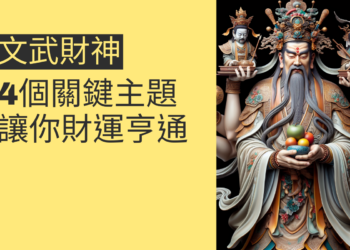
In both Chinese and Tibetan Buddhist contexts, a dharma guardian is a being who protects the teachings and the people practicing them. Figures in this role are rarely depicted as gentle. Honestly, they’re depicted as terrifying: bared fangs, glaring eyes, a body wreathed in flame. The look isn’t meant to scare the faithful. It’s symbolic shorthand. What he’s up against is greed, fear, and deception — genuinely stubborn opponents — so he’s given a face that can hold a room. Think of it as a kind of cultural bodyguard aesthetic: the person actually protecting you doesn’t have a sweet face.
His identity as a wealth deity grows straight out of that guardian role. The traditional logic runs like this: a force that can keep your own greed from swallowing you is a force that also knows how to keep a family’s holdings intact. So in popular understanding, his domain isn’t only money coming in — it’s money staying put. That emphasis is worth noticing, because it treats wealth from the get-go as something that has to be defended, rather than something that falls into your lap if you catch a lucky break.
2. In Chinese folk religion, there isn’t just one god of wealth
Most American readers assume “the god of wealth” points to a single figure. In practice, Caishen, the Chinese god of wealth, works more like a department than a person — several managers, each with a distinct specialty and personality. Some are drawn from real historical merchants and officials, remembered by later generations for their honesty and generosity in life. Others come out of myth and scripture, carrying more abstract symbolic weight. People gravitate toward whichever one fits their trade, their circumstances, or their family’s tradition.
Within that department, Mahakala is an unusual case, because his lineage runs through Buddhism rather than through a homegrown historical figure. That’s part of why the ideas attached to him tend to emphasize character over transaction: the request isn’t “give me money,” it’s closer to “make me someone money can safely belong to.” That distinction is the key to understanding him.
3. The “black” in his name probably doesn’t mean what you think
English speakers tend to read the “black” in “great black one” as a negative color. Within this symbolic system, though, black stands for depth beyond measuring, for the capacity to contain everything, and for the particular power of night — the hours when things rest and gestate. The link to wealth is more intuitive than it first sounds: real wealth isn’t loud or flashy. It’s like a deep pool, quiet and heavy, with no visible bottom.
Black also carries the sense of making no distinctions — not treating you differently because you’re rich or broke, high-status or nobody in particular. That’s precisely why traditional stories so often describe Mahakala as taking special care of the destitute. It’s a striking combination once you catch it: the imagery is ferocious, but the underlying value is thoroughly egalitarian. That’s one reason he’s held onto popular affection for as long as he has.
From India to East Asia: 3 Turns in Yellow Jambhala’s Story
Gods tend to have messier biographies than people do. A god travels with the people who carry him, and every time two traditions bump into each other, he gets reinterpreted. Yellow Jambhala might be the single most successful border-crosser in East Asian religious history. He starts in India, moves through the Buddhist system, and eventually grows into two figures that look nothing alike — one in China, one in Japan. There’s no single authorized version of this trip, but the outline is clear enough, and it’s a story worth hearing.
1. The starting point: an Indian deity presiding over destruction and renewal
The earliest traces go back to ancient India, where he was understood as a force tied to time, to night, and to destruction. Pay attention to what destruction means in an Indian cosmology, though: not a bad thing, but a necessary link in a cycle. The old has to clear out before the new can show up. Nothing gets harvested, nothing gets planted next season. That idea — that breaking down is its own kind of renewal — quietly shaped the personality he’d later bring to his job as a god of wealth.
If you’ve read any Norse mythology, this will feel familiar: the world is reborn after Ragnarök, which rhymes with the Indian sense of cycles. The difference is that the Indian version treats the cycle as an everyday thing, running constantly, rather than a one-time apocalypse. That framing also made a certain lesson easier for later believers to swallow — that the rise and fall of your fortunes is part of the cycle, not a punishment.
2. The turn: entering the Buddhist system as a protective force
As Buddhism developed in India and spread outward, it absorbed a great many deities who’d belonged to other traditions and recast them as protectors of the teaching. This is the stage where Yellow Jambhala completed his first change of identity: from an awe-inspiring god into a guardian posted at the door, keeping trouble away from practitioners.
That shift came with a character trait worth noting. He started to be associated with vows and with keeping one’s word. A protector protects rules, so the tradition holds that he pays particular attention to whether a person keeps promises. The trait survived his later transformation into a god of wealth, and here’s the thing — it turns out to be the most practical piece of the whole tradition: the people who keep their word are the ones who hold onto money.
3. Landing: reimagined across East Asia as a god of abundance
Once the tradition reached Tibet, China, and Japan, people in each place leaned on whatever their own lives needed most. In the Tibetan context, his character as a protector stayed largely intact. In China, merchants and farmers cared more about harvests and business, so “protection” gradually came to mean protection of the family enterprise — and the god-of-wealth identity grew out of that.
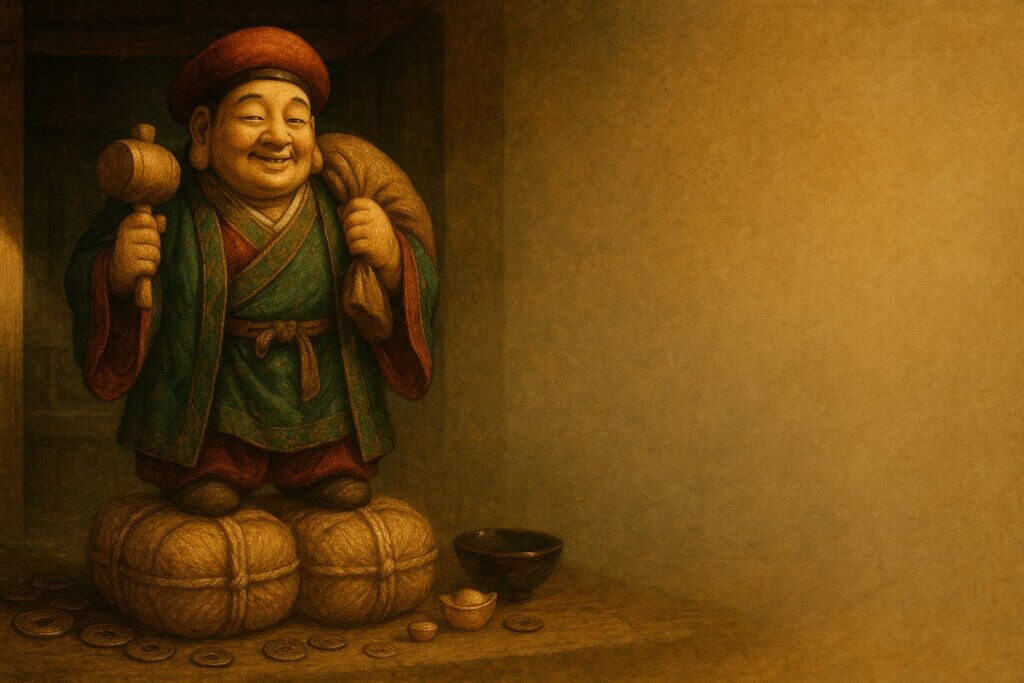
The Japanese version may be the branch the most Americans have seen without ever knowing its name: the smiling figure in a soft cap, a big sack slung over one shoulder, standing on two bales of rice with a small mallet in his hand. Same bloodline. He was folded into the Seven Lucky Gods, his image softened from fearsome to kindly, and one tap of that mallet makes good things fall out. In an agricultural society, rice was wealth in the most literal sense, so the whole design amounts to a picture of abundance anyone could read at a glance. One god, two societies, two completely different faces — that fact alone tells you a lot about how belief actually works.
Three Money Ideas Behind the Old Customs That Still Hold Up Today
What follows isn’t a to-do list. It’s a look at what people have traditionally done, and why they thought about money the way they did. Chinese folk practice around wealth is packed with specific rituals, but the rituals were never the interesting part — the interesting part is the theory of money sitting underneath them. And here’s the surprise: most of those ideas, worked out centuries ago, translate almost cleanly into the language of modern personal finance.
1. Credit Comes First, Wealth Comes Second
In the traditional telling, what a god of wealth hands you isn’t cash — it’s trust. Resources land in your hands because you’re believed to be someone who’ll use them well. That framing does something subtle: it turns asking for money into being entrusted with it. And once trust is the currency, performance matters. Whether you did what you said you’d do counts for far more than how big a wish you made.
That’s why casually promising something and then quietly acting like it never happened has traditionally been treated as a serious misstep. Some families keep that credit intact in very plain ways — setting one small, genuinely achievable goal at the start of the year, then circling back at year’s end to confirm it got done. From the outside it looks like a religious act. Structurally, it’s a self-accountability system: it forces you to state a commitment in concrete terms, then forces you to audit yourself against it.
Put that in modern terms and you’ve basically described a credit score. Lenders don’t extend credit because you have money; they extend it because you’ve done what you said you’d do over a long stretch of time. The deity’s origins as a protector of rules show through here — what’s being guarded has always been the rules themselves, just filed under a different name: money energy.
2. Money Energy Is Supposed to Move; Hoarding Stalls It
This is probably the most central idea in the whole tradition, and the most counterintuitive. Money energy is understood as something alive — it flows, and if you clamp down on it, it stalls. So when people traditionally sized someone up as having money energy, they weren’t just tallying what that person had socked away. They were watching whether the money was in motion: hiring people, getting invested, helping someone out, moving resources to where they were needed.
One common misreading is worth clearing up: sharing doesn’t mean giving away ninety dollars out of every hundred you earn. The tradition never asked anyone to empty themselves out — that would cut against the whole point of protecting what a family has built. What it asks for is an outlet, and outlets come in many forms. Volunteering your time is one. Passing a useful idea along to a friend is another. The question is whether anything is flowing out at all, not how much.
Think of it as a snowball. A ball sitting still doesn’t grow, but once it starts rolling, it picks up more with every turn. The traditional claim is that people willing to let money energy move end up in a positive cycle, and that the cycle picks up speed on its own. There’s a very down-to-earth modern parallel here: resources parked in an account are just numbers on a screen. Put them to work — spend them, deploy them — and they start generating relationships, opportunities, and whatever comes after that.
3. The Most Admired Form of Sharing Is Teaching the Method
One idea in the tradition is especially sharp: of all the ways to share, the most valued isn’t handing over money — it’s passing along the ideas and methods that make people wealthy. The reasoning is bluntly practical. Money solves the problem once; method solves it for a lifetime. And when someone’s life improves because of what you shared, some portion of that goodwill and those resources tends to find its way back to you eventually, in one form or another.
Underneath that logic sits a harsher line: to a god of wealth, being rich yourself isn’t much of an achievement. The traditional picture is that these figures moved among wealthy people long before they became deities — so someone who’s merely doing fine on their own isn’t a particularly compelling investment. What’s rare is the person who can pull others up with them. Back someone who only looks after himself and a dollar returns fifty cents; back someone who multiplies resources and passes them on and a dollar might return ten. Seen that way, doubling down on that second person is sound business judgment, not a favor.
Strip out the language of deities and what’s left is the network effect. Someone who keeps pushing knowledge and opportunity outward gradually becomes a node in other people’s lives, and the more nodes you occupy, the more information, collaboration, and trust naturally concentrate around you. It’s also why, in Chinese society, saying “this person is really willing to teach” lands as high praise. That’s not just a compliment about character — it’s a judgment about long-term value.
So if you had to compress a few centuries of this thinking into one sentence: what’s really being guarded was never the contents of the safe, but whether a person can make resources come alive in their hands and then send them back out. Whether you believe in the gods is a separate question. But this way of looking at wealth — money as a moving relationship rather than a static pile — is genuinely worth taking with you.
Mahakala, the Wealth Deity: Five Questions People Ask Most
What trips people up across a culture gap is rarely the big philosophical stuff. It’s the small, concrete questions. Is this a religion? Can I get anything out of it if I don’t believe? Is this the same guy as that smiling Japanese figure with the sack? Here are the five that come up most, answered straight. Treat this section as conversation, not homework.
Q1: Is this the same figure as the Japanese Daikoku?
Same bloodline, completely different face. Both trace back to an ancient Indian deity associated with darkness and time, who traveled east with Buddhism. What changed was the job each society needed him to do. In Tibetan and Chinese contexts, he tends to keep his fierce protector form, with the emphasis on guarding, steadying, and disciplining the mind. In Japan he was folded into the Seven Lucky Gods, and the image softened all the way: a beaming old man with a sack of treasure over one shoulder, a small mallet in his hand, standing on bales of rice.
Nobody made a mistake here. That’s just what happens when a belief puts down roots in new soil. Japan was a rice-growing society, and rice was what wealth actually looked like, so painting the god standing on rice bales was the most direct possible way to say “abundance.” The fact that the same deity grows a different face in different places is evidence people genuinely brought him into daily life rather than leaving him untouched on a shelf. If you know the Japanese lucky cat, this is the same cultural impulse producing a different result: taking abstract good fortune and drawing it as something you can recognize on sight.
Q2: Is this religion or folklore? Can I understand it if I don’t believe in gods?
It’s both, and the line between them is genuinely blurry. In Chinese society, a lot of the customs surrounding wealth deities function more like household habit than religion in the strict sense. Many families do what they do because it came down from a grandparent, and the person doing it often couldn’t lay out a full doctrine — they just know it feels better to do it than to skip it. That state of half-believing and doing it anyway is extremely common in Chinese folk practice, and nobody treats it as a lack of devotion.
As for whether a non-believer can understand it: absolutely, and you may see it more clearly. Set the deity aside for a moment and what’s left is a value system about credit, circulation, generosity, and self-restraint — none of which requires a religious premise. You don’t have to believe Thor is out there to read Norse myth and learn how that society thought about courage and fate. That’s the payoff of this kind of cultural literacy. You borrow someone else’s eyes and get a look at your own assumptions.
Q3: How do people traditionally show respect?
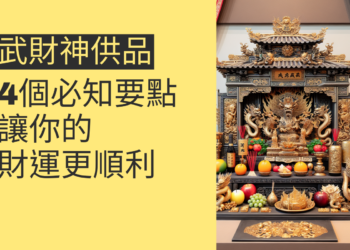
Practices vary by region, but they share a common shape: everyday, simple, sustainable. Most households keep it modest — some food or water set out on particular days, a few words said quietly, saying plainly what’s on your mind. The emphasis usually isn’t on how lavish the offerings are but on whether the attitude is sincere and whether it keeps up over time. Traditionally, showing up only when you’re desperate is considered to accomplish very little, because that isn’t a relationship. It’s a request for help.
The more interesting piece is the part about keeping your word. Some people, when they voice a wish, say in the same breath what they intend to do themselves: the effort they’ll put in, or who they’ll share the benefit with. If it works out, they come back and say so. If it doesn’t, they say that too. That back-and-forth builds a real sense of accountability — you’re not making wishes into thin air, you’re making a promise to someone who keeps a ledger. It’s why people who don’t believe a word of it often still find the practice useful for self-discipline.
Q4: Why does he look so fierce? He doesn’t seem like a bringer of good luck.
That’s the first reaction most American readers have, and it’s fair, because Western luck symbols skew gentle: four-leaf clovers, rabbits’ feet, smiling angels. In East Asian visual language, though, a fearsome image usually signals protection rather than threat. The glaring eyes, the fangs, the flames all point at “he’s blocking something on your behalf,” not “he’s coming for you.”
The deeper reading is that this face is aimed at what’s inside a person — greed, fear, the urge to gamble on a shortcut, the stories you tell yourself. Tradition holds that those are the real reasons wealth drains away, and that gentleness isn’t enough to hold them down. So the fiercer the image, the harder the problem it implies. Think of it as a reminder: what actually needs restraining usually isn’t a competitor out there, it’s the impulse you get at three in the morning right before you make a decision. Once that clicks, the face stops being frightening and starts being a little funny, and even a bit thoughtful.
Q5: Does “money energy needs to circulate” conflict with modern personal finance?
It doesn’t conflict, it just emphasizes something different — and the two fit together better than you’d expect. Modern personal finance is built around accumulation, compounding, and diversification; fundamentally, it manages stock. The traditional view of money energy stresses circulation, sharing, and relationships; fundamentally, it manages flow and network. Healthy finances usually need both. Stock without flow and your resources stagnate. Flow without stock and the first bad surprise knocks you flat.
Worth noting: the tradition never advocated giving everything away. That would cut against this deity’s core role as a guardian of the family estate. What it argues against is the white-knuckle grip — holding everything so tightly you won’t move any of it or let anyone benefit from it — because resources held that way have lost their productive capacity. If you want a modern translation, it’s roughly this: deliberately put some portion of what you have into places that generate relationships and opportunities. Teach someone. Collaborate. Show up. Give some away. That isn’t a moral demand, it’s a bet on long-term returns. People several centuries ago made that argument in the language of gods; you’re free to make it today in your own.