Meet the Civil and Martial Gods of Wealth: Two Kinds of Caishen in Chinese Folk Religion
If your mental picture of Chinese culture stops at dragons, kung fu, and that waving cat in the takeout window (which is actually Japanese), then here’s a name you’ve almost certainly never run into: Caishen, the Chinese god of wealth. He shapes the daily lives of hundreds of millions of people. And in Chinese folk religion, Caishen isn’t one deity at all — he’s a whole roster of them, each with his own backstory, sorted into two clear categories: the civil god of wealth and the martial god of wealth. Together they’re known as the civil and martial gods of wealth. That split isn’t just mythological bookkeeping. It quietly tells you something people worked out a long time ago: wealth doesn’t come in only one shape.
Where Caishen Sits in Chinese Folk Religion
To get Caishen, you first have to get how Chinese folk religion works. There’s no single true god, no scripture, no church hierarchy the way Christianity or Islam has one. Think of it instead as an open, ever-expanding cast of deities — a blend of Daoism, Buddhism, Confucian ethics, and a mountain of local legend. Each deity has a portfolio, like a vast celestial bureaucracy: one handles the imperial civil service exams, one handles childbirth, one handles safe passage at sea, and one handles the kitchen. There really is a Kitchen God, and tradition holds that at the end of the year he reports to heaven on everything the household said and did.
Within that system, Caishen’s portfolio is wealth, business, opportunity, and income. He isn’t the highest-ranking deity, but he’s easily one of the most popular — because money is a problem everybody actually has. What’s striking is how little guilt Chinese folk religion attaches to asking for it. The tension Western culture builds into “money is the root of all evil” barely registers here. Wealth is treated as neutral, even positive. The question was never how much you have. It was how you earned it and how you use it.
One more thing that may land as unfamiliar for American readers: Chinese folk religion isn’t exclusive. The same person can honor Caishen, honor Guanyin, and honor the ancestral tablets, and nobody sees a contradiction in it. It functions more like a cultural practice than an identity — you’ll never hear anyone describe themselves as a follower of Caishen.
Why Caishen Splits Into Civil and Martial
“Civil” and “martial” make up one of the oldest paired concepts in Chinese culture, roughly the difference between governing and campaigning — the brush and the sword, order and force. In the imperial court, civil officials stood on one side of the hall and military commanders on the other. That pairing eventually worked its way into everything, including how deities get sorted.
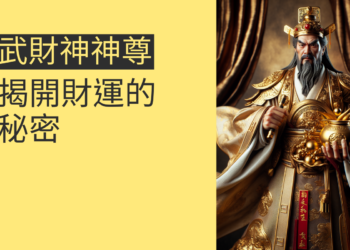
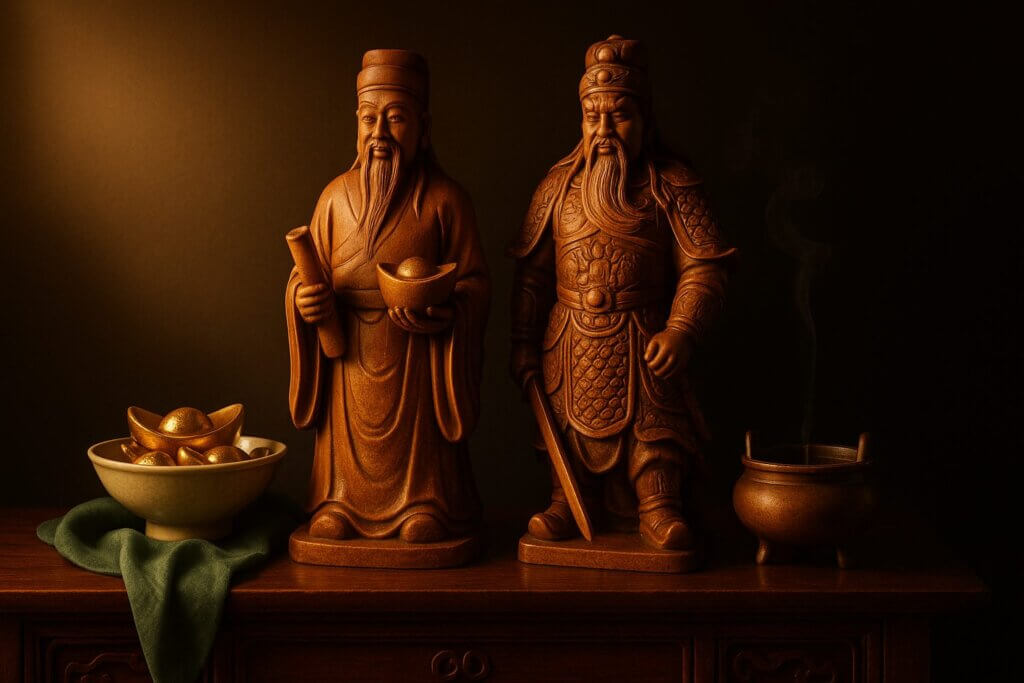
Civil gods of wealth usually started out as court officials. They’re shown in official robes, holding a gold ingot or a ledger book, calm and upright. The wealth they stand for comes from systems, intelligence, good management, and fair distribution — close to what we’d now call managing money and building money. Martial gods of wealth started out as generals. Armor, weapon in hand, a face that means business. The wealth they stand for is the kind that has to be defended, the kind that takes nerve to go after, and — most importantly — the kind that only holds together on trust and integrity.
So the two aren’t rival camps. They’re two faces of the same thing. Traditionally, people in business honored both, because making money takes a head for it (the civil side) while keeping money takes principle and backbone (the martial side). The classification is itself a piece of advice: earning without holding on to it doesn’t work, and neither does nerve without arithmetic.
What Caishen Looks Like, and Who’s Standing Next to Him
Caishen’s image turns up everywhere — folk New Year prints, paper cuttings, the decor in shops — and a few of the visual symbols are worth knowing. The most iconic is the gold ingot (yuan bao), a boat-shaped lump of gold or silver with the ends turned up, an actual currency form from the Ming and Qing dynasties that has since become shorthand for wealth in general. Another is the treasure bowl (ju bao pen), said to multiply whatever you put inside it: drop one coin in and coins keep coming out. It’s an old metaphor for the idea that principal grows itself.
Caishen usually travels with an entourage too, most famously the Wealth-Attracting Boy (zhao cai tong zi) and the Officer of Good Trade (li shi xian guan) — names charmingly literal about the job, one bringing money in, the other making deals go smoothly. Notice that this whole visual vocabulary is neither mysterious nor solemn. It’s ordinary people’s picture of a good life, made concrete. That’s part of what makes Caishen distinctive: he’s thoroughly down-to-earth, carrying very little metaphysical or theological baggage.
From Historical Figures to Deities: The Four Origin Stories Behind the Civil and Martial Gods of Wealth
Here’s the thing that makes Caishen, the Chinese god of wealth, so interesting — it isn’t the divine power people attribute to him. It’s that nearly every figure who holds the title started out as a real or semi-real historical person who got promoted to godhood after the fact. Chinese folk religion runs on a consistent logic: if you displayed some quality to an extraordinary degree while alive, you might be handed a matching portfolio after death. So behind each god of wealth sits a moral fable about what kind of person deserves to be rich. The four figures below are the ones most commonly grouped under the civil and martial gods of wealth.
Bigan: No Heart, So No Favorites
The most widely recognized of the civil gods of wealth is Bigan. He was a royal minister at the end of the Shang dynasty, serving under King Zhou, the most notorious tyrant in Chinese history. The story goes like this: Bigan couldn’t stomach the king’s cruelty and excess, and he said so — repeatedly, and to the king’s face. King Zhou finally lost patience and delivered a line that has echoed for millennia: they say a sage’s heart has seven openings; let’s have a look. He then ordered Bigan’s heart cut out.
None of that sounds like it has anything to do with money. But the popular reasoning is elegant. Bigan no longer has a heart, so he can’t play favorites. A being who is absolutely impartial, incapable of being swayed by personal ties, is exactly the right candidate to hand out wealth. Come to him asking for prosperity and he won’t give you extra because you’re a smoother talker or better connected. Everything goes by the rules.
Underneath that association is a deep popular hunger for fairness. In a society where connections and personal favors decided everything, imagining a god without even a heart to manage the money was its own quiet form of protest. The core value Bigan carries as a civil god of wealth is impartiality.
Fan Li: You Keep Wealth by Giving It Away
The other major civil god of wealth is Fan Li, and of the four, his story lands closest to modern life. Fan Li was a strategist for the state of Yue during the Spring and Autumn period, and he guided King Goujian from the humiliation of a conquered kingdom all the way to revenge. Once the victory was won, he did something almost nobody in his position managed: he resigned and walked away immediately, on the judgment that this particular king was someone you could share hardship with but not prosperity.
He left politics, changed his name, and went into business. Three times he built an enormous fortune; three times he gave it away to the poor and to friends and family, then started over from nothing. Later generations knew him as Tao Zhu Gong, a name that in Chinese comes close to shorthand for “god of business.”
What made Fan Li remarkable wasn’t technique for making money — it was his stance toward it. He treated money as something that moves rather than something you clutch. He was also among the first to grasp the value of the exit: knowing when to walk away matters as much as knowing when to step in. What Fan Li represents is the wisdom and restraint inside wealth.
Guan Yu: The General Who Turned Credit Into Divinity
The highest-ranking of the martial gods of wealth is Guan Yu, a famous general of the Three Kingdoms era and, in the novel Romance of the Three Kingdoms, the embodiment of loyalty and honor. You’ve probably run into his image in a video game or a movie: red face, long beard, the green-dragon crescent blade.
So why did Guan Yu become a god of wealth? He never ran a business in his life. The key is his defining quality — yi, a word that resists clean translation. It bundles loyalty, keeping your word, repaying what you owe, and holding to principle. His most famous act: an enemy tried to buy him with lavish treatment, and when he learned where his old lord was, he sealed up every gift, left his official seal behind, and traveled a thousand miles to find him. He came to be seen as the man who would never break a promise.
And what is commerce built on? Credit. In a traditional society with no courts and no mechanism for enforcing contracts, whether a deal could happen at all came down to whether the other party kept their word. So merchants chose Guan Yu as their patron — not because he was good at making money, but because he stood for the thing that makes making money possible. There’s a nice wrinkle here: Guan Yu is honored by police and gangsters alike, because both sides need a shared agreement about what honor means. What Guan Yu represents is the foundation wealth sits on: credit.
Zhao Gongming: An Accidental Career Change, From Plague to Prosperity
The other martial god of wealth is Zhao Gongming, pictured with a dark face and thick beard, riding a black tiger and carrying an iron whip. His backstory takes a strange turn — in early texts he was actually a god of plague, a figure people feared. Over centuries of Daoist and folk development he gradually changed jobs, picking up responsibility for drawing in wealth, and he came to command a set of subordinates handling attracting money, bringing in treasure, gathering valuables, and turning a profit.
Zhao Gongming’s imagery leans hard on deterrence and protection — the black tiger and the iron whip are there to hold off whatever would take your wealth from you. In the popular understanding, wealth isn’t only something you earn; it’s something you have to defend. Against theft. Against fraud. Against accident, and against the people who mean you harm. That’s the department this martial god of wealth runs.
Line the four of them up and a complete picture of wealth comes into view: be fair (Bigan), be wise enough to let it move (Fan Li), keep your word (Guan Yu), and be able to protect what you have (Zhao Gongming). That’s what the civil and martial gods of wealth are really saying.
3 Ideas About Money Hiding Inside the Traditions
Now let’s talk about how people have traditionally treated Caishen, the Chinese god of wealth. One thing to get straight up front: what follows describes what people have done and still do, and why — it’s not a to-do list for you. Here’s the interesting part. Strip off the religious packaging and almost every one of these customs turns out to be built around a specific, concrete idea about money. And those ideas hold up just fine even if you don’t believe in a single one of the gods involved.
Welcoming the God of Wealth: On Initiative and Timing
The biggest Caishen custom of the year lands during the lunar new year. The fifth day of the first lunar month is traditionally held to be his birthday, and the day is known as welcoming the god of wealth. In some places people get up before dawn, throw every door and window wide open, set off firecrackers, and lay out a full meal — all to be the first household to receive him. In some Chinese cities, the firecrackers in the small hours of the fifth used to be so dense it sounded like a battlefield.
Looked at as culture, the telling detail is the verb: you welcome him, you don’t wait around for him. You open the door, you make noise, you do a specific thing at a specific moment. The idea underneath is simple — opportunity doesn’t walk through a closed door on its own.
The fifth day is also, traditionally, the day shops reopen after the new year break. So welcoming the god of wealth doubles as the opening ceremony for a year of business — it plants a clear marker at the start of the working year. That part is genuinely useful on its own terms: humans need rituals to cut time into pieces, and they need a definite starting line, or the new year just blurs past unnoticed. It’s the same psychology behind New Year’s resolutions or a quarterly planning offsite.
Offerings and Placement: On What You Think Wealth Is
Traditional setups for making offerings to Caishen come with a lot of specifics, and those specifics add up to a whole set of value judgments. Offerings, for instance, are usually sweet, round, and in pairs — candy, fruit, steamed sponge cake. The Chinese word for that cake, fa gao, shares a sound with the word for getting rich, and the cake itself puffs up and rises as it bakes, which reads as growth. Chinese culture loves a good pun, and that kind of wordplay runs through just about every holiday custom there is.
Another common piece of advice: the martial god of wealth is usually placed facing the door, while the civil god of wealth is better off not facing it directly. The reasoning is straightforward. A general’s job is to guard and to fend things off, so he faces outward; an official’s job is to manage and distribute money, so he faces in. The arrangement is really just two different kinds of wealth ability, laid out in space.
What’s more worth noticing is that traditionally, this kind of practice emphasizes consistency and cleanliness over spectacle. The home altar is kept clean, the incense kept burning without long gaps, the manner respectful. Showing up only when you’re desperate — remembering the whole thing the month rent is due — is, in the folk understanding, not how it works. Which is a very practical point wearing religious clothes: wealth responds to steady habits, not to occasional bursts of effort. One unusually disciplined month of tracking your spending won’t make you rich. Ten years of it will change your situation.
Money Energy Has to Move: The Central Idea, and the Least Intuitive One
If you take one idea away from the whole culture around Caishen, make it this: money energy circulates.
There’s a Chinese folk idea worth knowing here — not as a financial rule, but as a cultural lens on wealth. Money energy — the idea that wealth behaves like a current rather than a pile — shows up before the actual money does, in the form of opportunities, connections, momentum, and how much people trust you. In the traditional telling, Caishen handing you money energy is an expression of confidence in you, and what he expects back is that you use it well and pass some of it along.
The key point is that money energy is understood as something that flows, not something you stash. The usual comparison is water: block it and it goes stagnant, keep it moving and it stays alive. So in this framework, the person clutching wealth tightest is the one who ends up watching it go still. That runs against instinct — our reflex is to hide the good stuff away.
One common misreading is worth heading off: sharing, in this sense, does not mean giving away ninety dollars of every hundred you earn. The traditional understanding is much looser than that. Passing a useful idea along to a friend is sharing. Volunteering your time is sharing. Handing your experience, your contacts, or your information to someone who needs it is sharing too. What matters is whether energy is moving outward, not the dollar amount.
And the form of sharing folk tradition rates highest is teaching the people around you how to make their lives better. The reasoning is practical: when the people you help genuinely end up better off, some portion of that comes back to you in one form or another. They remember you. They send opportunities your way. They show up when you need them. That’s a positive loop, and like a snowball, it gets bigger the longer it rolls.
There’s one more piece of folk reasoning that’s genuinely clever: from Caishen’s point of view, a person who is merely rich themselves isn’t all that remarkable — before these figures became gods, rich people were the company they kept anyway. What’s actually worth investing in is the person who can make other people rich alongside them. Back an ordinary person and a dollar returns fifty cents; back that kind of person and a dollar returns ten. The framing makes the gods sound like venture capitalists, but it points at a very real observation: someone who creates value for a whole group of people faces a fundamentally different return structure than someone looking out only for themselves. That’s probably the single most useful line the culture of the civil and martial gods of wealth has to offer a modern reader.
5 Common Questions About the Civil and Martial Gods of Wealth
By now you’ve probably got a rough map of how this belief system fits together. But people meeting it for the first time usually still have specific questions — about how these figures relate to one another, about where the culture ends and the religion begins, and about what a non-believer is supposed to make of any of it. Here are the five that come up most, answered from cultural context rather than doctrine.
How many gods of wealth are there, and why does everyone give a different number?
This is the part that trips up outsiders most: there’s no standard answer to look up. Some say five. Some say two civil and two martial. Some add regional wealth deities and get to well over a dozen.
Here’s the thing — Chinese folk religion has no central authority to certify who counts as legitimate. It grew from the bottom up. People in one place began making offerings to a particular figure, stories of answered prayers spread, the practice widened, and eventually that figure was simply accepted as a god. Different regions, different trades and different dynasties each built up their own version, and those versions were never reconciled, because nobody felt they needed to be.
So “the civil and martial gods of wealth” is less a roster than a way of sorting. Anyone of the scholar-official type, who gained wealth through intelligence and good systems, belongs to the civil side. Anyone of the general type, who gained it through protection and loyalty, belongs to the martial side. The categories hold steady; the names inside them float. That flexibility is exactly why folk religion has survived for thousands of years — it can keep absorbing new figures without fracturing over doctrine.
Which is more powerful, the civil god of wealth or the martial one?
Tradition doesn’t rank them. They handle different stages of wealth. Think of it this way: the civil god of wealth covers earning money honestly, keeping clear books and dividing it fairly, while the martial god of wealth covers holding onto what you’ve earned and going after money in risky conditions.
There’s a practical folk division here. People on a salary, in a skilled profession, whose money depends on planning and accumulation, have traditionally felt closer to the civil god of wealth. People in business, in sales, in trades with real risk and competition, feel closer to the martial one. That’s a shrewd sorting exercise, because it asks you to think about what kind of ability your money actually comes from.
Most people, though, honor both. Nobody in real life needs only one of those skills. Someone who earns brilliantly but can’t hold onto a dime and someone who saves diligently but never dares to make a move are stuck in mirror images of the same problem. Placing the two gods side by side is itself the message: you need both capacities.
Is this a religion? Can I understand it if I’m not a believer?
Good question, and the answer is that it sits somewhere between religion and folk custom — and most people who take part don’t treat it as a statement of faith.
For a lot of Chinese people, welcoming the god of wealth at New Year is closer to cultural participation, the way Americans hang stockings at Christmas or dress up as ghosts on Halloween. You don’t have to believe anything theological to enjoy the atmosphere. Plenty of completely non-religious Chinese people still say “gong xi fa cai” (wishing you prosperity) at New Year and still think the firecrackers on the fifth day are what makes the holiday feel like the holiday.
Same goes for you. The point here isn’t to get you to believe there’s a deity in the sky allocating wealth. It’s to point out that a civilization spent two thousand years encoding its understanding of money into daily life through stories, rituals and images. What’s inside that code — fairness, restraint, credit, circulation — stands up fine without any supernatural premise. You can read the whole thing as anthropology about values and lose nothing.
Why is a warrior like Guan Yu a god of wealth? He seems to have nothing to do with money.
This is the question outsiders raise most often, and it happens to go straight to the heart of the logic.
In the reasoning of Chinese folk religion, what a god presides over comes from the qualities he showed while alive, not from his job description. Guan Yu became the patron of commerce because when merchants asked themselves what business most depends on, the answer they landed on wasn’t sharp arithmetic — it was whether the other party keeps their word.
Consider what traditional commerce was like. Interprovincial trade took months. Payment might go out before goods arrived. No state apparatus guaranteed that a contract would be enforced. Your counterparty was often someone you had never laid eyes on. In that environment, the entire commercial system rested on whether people honored what they said. So merchants collectively made offerings to a general famous for never betraying a trust, which amounted to a shared declaration about their trade: in this business, credit is life.
None of that logic has expired. Modern commerce has courts, credit ratings and smart contracts, and what still makes cooperation happen is trust. Guan Yu’s elevation to god of wealth is, at bottom, a civilization using the form of myth to record its verdict on what business really runs on.
If I don’t make offerings to any god, what’s left in this for me?
Strip away the mythological layer and what remains is a set of remarkably clear-eyed principles about wealth — and they connect to one another.
First, wealth takes two abilities, and you need both: the ability to create it and the ability to protect it. Pairing the civil and martial gods of wealth is a way of insisting on that, and most people are good at only one of the two while rarely being honest with themselves about which half they’re missing.
Second, the foundation of wealth is credit, not technique. Guan Yu’s presence is a reminder that the opportunities you get offered depend, over the long run, on whether other people are willing to trust you. That’s an asset that compounds, and one that’s extremely hard to repair once it’s damaged.
Third, holding on too tightly is how you lose it. Fan Li gave away his entire fortune three times and made it back three times, and what that story is saying is that wealth should stay in motion — give away knowledge, opportunities and experience instead of hoarding them. The folk version of this is generous, too: sharing doesn’t have to mean money. Giving your time, your experience or one genuinely useful idea all count.
Fourth, people who help others get richer are in a different position from the start. That needs no deity to make it work. When the value your abilities create doesn’t land only on you, you start showing up in more people’s options, and the sheer density of opportunity around you changes.
So you can flatly disbelieve that anyone upstairs is keeping the books and still grant the point: a culture that puts fairness, restraint, credit and circulation at the center of wealth has seen something clearly. That’s probably why these old stories are still worth reading today.