Who Is the Red God of Wealth? Three Keys to Understanding This Chinese Deity
Say “god of wealth” to most American readers and they picture a divine ATM. Chinese folk religion has something stranger and more interesting in mind. The Red Caishen — Caishen being the Chinese god of wealth — isn’t a figure who hands out cash. He’s an entire ethics of money wearing a human face: where wealth comes from, where it goes, and who ends up holding it. Here’s the thing, though. You have to drop the wish-granting-machine framing before any of it makes sense. Three ideas will get you inside this piece of culture faster than anything else.
1. What He Governs Is Money Energy, Not Your Bank Balance
There’s a term in Chinese folk belief that resists direct translation: money energy — the idea that wealth behaves like a current rather than a pile. It isn’t money itself. It’s closer to the set of conditions around you that tend to turn into money: meeting the right person, catching a project at the right moment, closing a partnership, being the name someone thinks of first. Money is the result. Money energy is the soil that result grows out of.
So when tradition says the Red Caishen “grants wealth,” the claim isn’t that he slips bills into your pocket. It’s that the opportunities around you multiply and start running smoother. That distinction carries the whole logic of the belief. If what a deity offers is opportunity rather than cash, then how well you handle an opportunity — how gracefully, how honorably — feeds back into whether the next batch shows up at all. Which lands remarkably close to something modern readers already say in secular language: luck is something you can cultivate.
2. Why Red? The Color Is Doing Real Work
Red is the most emotionally loaded color in Chinese culture. It’s tied to fire, to celebration, to the couplets pasted around doorframes at New Year and the red envelopes handed out inside. Red means heat, abundance, energy pushing outward — the exact opposite of quietly socking money away in a savings account.
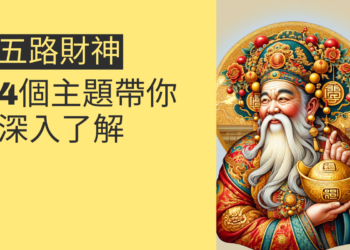
So in the name “Red Caishen,” the color isn’t just costume design. Depictions often show him in crimson robes with a flushed red face, and the point of that image is the kind of wealth he presides over: live wealth, moving wealth, wealth with heat in it. He isn’t a watchman guarding a vault. He’s closer to a fire at your back. And that turns out to be the same idea as the one about money energy needing to circulate — two ways of saying one thing.
3. He’s Not the God of Wealth — He’s One of Many
Here’s where readers raised on a single-deity picture have to make a small mental turn: Chinese folk religion doesn’t have one god of wealth. It has a whole crowd of them. There’s the civil god of wealth and the martial god of wealth, there are traditions assigning different figures to different directions, and there are local versions that circulate in one region and not another. The Red Caishen usually gets grouped with the martial side — pictured riding a tiger, carrying a whip, carrying himself like a guard on duty.
That crowded structure reflects how Chinese tradition sorts wealth in the first place. Money earned through learning and careful planning and money seized through nerve and action are treated as two different substances, so naturally they answer to two different deities. Think of it as a division of labor, not a competition among gods. Once that clicks, you stop asking which god of wealth works best — inside this system, the question is aimed slightly wrong.
From Mortal to God of Wealth: Three Turning Points in the Story of the Red God of Wealth
Here’s something about Chinese deities that tends to catch American readers off guard: a lot of them started out as regular people. Nobody was born divine. They died, and then — because of some virtue, or some deed worth remembering — ordinary families kept making offerings to them, generation after generation, until that recognition hardened into godhood. The figure most often named behind the Red God of Wealth is Zhao Gongming, and his story is anything but a straight line. It takes a few genuinely dramatic turns. What follows are the three that shaped him into the figure people picture today.
The First Turn: A Man Named Zhao Gongming
In the earliest texts, Zhao Gongming is a blurry figure, and at the start he has almost nothing to do with money. He shows up as a man skilled in magic arts, fierce and unbending in temperament. It was the Ming dynasty novel Investiture of the Gods that finally gave him a fully drawn role — he fights on the losing side, wields formidable powers, and is killed in battle. After his death he is enfeoffed with the title “True Lord of the Golden Dragon and the Mysterious Altar of Orthodox Unity,” given command of four subordinates, and put in charge of drawing wealth and good fortune into the human world.
Notice where the emphasis in that title actually falls. Not on wealth. On the “mysterious altar” — an altar is a ritual space, and whoever presides over it is the one who renders judgment. From the moment of his appointment, in other words, arbitration was built into the job description. He doesn’t only hand things out. He also sizes you up to see whether you deserve them.
The Second Turn: From Plague God to God of Wealth
The middle stretch of the story is the strangest part. In older folk legend, Zhao Gongming was regarded as a god who presided over disease and epidemic — someone to be feared, someone who had to be placated. Getting from that role to the figure households eagerly welcome in at New Year took several hundred years of folk imagination to travel.
That shift tells you something about how folk religion actually works. A god’s character isn’t locked down by a single sacred text; it gets rewritten, over and over, by the people who use him. As society moved away from farming and toward commerce, a merchant class emerged that needed a patron of its own — someone who understood fair dealing and could hold a room. A fierce, rule-bound, imposing deity fit that opening naturally, and the position of god of wealth was where he landed. The Red God of Wealth you see today was carved slowly, over centuries, by collective need.
The Third Turn: From Fearsome to Fair
By the Ming and Qing dynasties, his image had largely settled: a black or red face, a black tiger for a mount, an iron whip in hand, majestic and commanding. Alongside attracting wealth, folk tradition attached one more function to him that matters a great deal — “fair dealing, favorable profit.” When people had a business dispute, the stories say, they would call on him to stand as witness.
That detail rewards a second look. In this culture, the god of wealth is also the guarantor of honest dealing. Which means the tradition never accepted the logic of “get rich by any means necessary” — the one who brings money your way is precisely the one watching whether you keep your word. It’s probably the most central thing about the Red God of Wealth, and the thing outsiders miss first.
How People Traditionally Do It: Three Customs and the Logic Behind Them
What follows describes what people traditionally do. It is not a list of things you should do, and that distinction matters. Folk customs are one way an entire culture shows its hand about how it thinks about a subject, and the reasoning underneath them is worth understanding even if you never take part in any of it. Here’s the thing: practices tend to survive for centuries precisely because they carry a fair amount of practical wisdom inside them. Each of the three customs below has a layer you can pull out and use in a modern life.
1. Welcoming the God of Wealth on the Fifth Day: Making a Beginning Official
There’s a lively marker partway through the Lunar New Year: the fifth day of the first month. Tradition holds that this is the day Caishen, the Chinese god of wealth, comes down into the world. Shopkeepers open their doors before sunrise and set off firecrackers — a way of welcoming the god of wealth in, and also a way of declaring the year’s business formally open. In some places there’s even a race to light the first stick of incense, with people competing to be earliest.
Set the deity aside for a second and look at what the custom actually accomplishes: it puts a clear starting line on a new cycle. People genuinely need ritual to mark a transition. Without one, the days blur together and last year’s exhaustion seeps straight into this one. Pick a specific day, get up early, make some noise, clean up the storefront — the psychological effect of that whole sequence is real. It gives you the distinct sense that the old thing is finished and this is where the new thing starts. You don’t have to believe Caishen passes your door at dawn on the fifth day to understand why taking a beginning seriously changes the months that follow.
2. Offerings and the Color Red: Turning an Abstract Promise into a Concrete Act
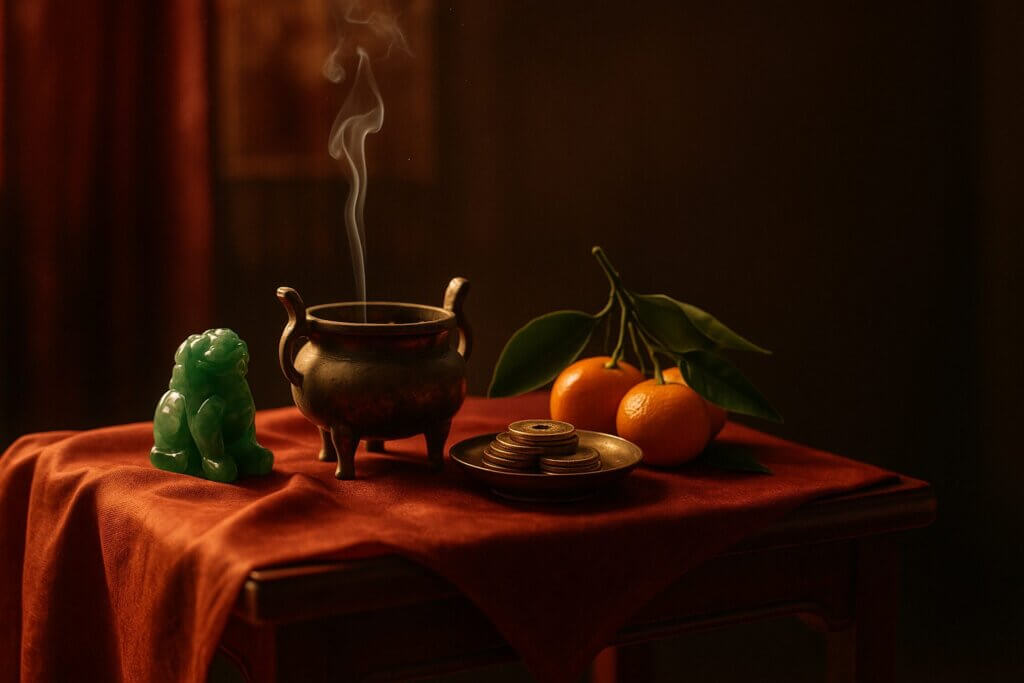
Traditionally, people prepare offerings — usually foods that are sweet, round, and arranged in pairs, set off with red decorations. The symbolism runs deep, much of it built on words that sound alike in Chinese: round stands for completeness, sweet for things going smoothly, paired for not being left on your own. The whole table reads like a blessing written in food.
The idea behind the practice is that an abstract wish, if it never turns into a concrete action, stays a thought that flickered through your head once. Preparing offerings takes time, thought, and a bit of money — you have to go out and buy the things, arrange them, and mean it. That cost is the point. Paying it converts a vague intention into something you’ve visibly treated as serious.
Modern life is full of the same move in different clothes: writing out annual goals in earnest, buying a dedicated notebook for a new project, putting the thing that matters on your calendar. The form changes, the mechanism doesn’t. You use one concrete act to force yourself to admit that this matters to you.
3. Money Energy Has to Circulate: The Most Counterintuitive Idea in the Whole Tradition
If you take only one concept away from all of this, make it this one. There’s a Chinese folk idea worth knowing here — not as a financial rule, but as a cultural lens on wealth. The traditional account goes like this: when Caishen is willing to send money energy your way — the idea that wealth behaves like a current rather than a pile — that’s an expression of trust, and what he’s really waiting to see is whether you’ll use it well and pass some of it along. Money energy is understood as something that moves. Clamp down on it and it stops. Keep it heading outward and it compounds.
The phrase that gets misread here is “give back.” It has never meant that earning a hundred dollars obliges you to hand ninety of it away. The traditional understanding is far looser than that. Sharing a method that worked for you with a friend counts. Spending your time volunteering counts. Passing an opportunity to someone better suited to it counts. What matters is whether the energy keeps flowing outward, not the dollar amount attached.
And within this tradition’s imagination, the most valuable thing you can share is knowledge about how to get better, so the people around you get richer too. Because those people improved through you, part of that cycle is expected to come back around. The traditional framing puts it bluntly: being rich yourself doesn’t impress the gods of wealth — before they became gods, the people they dealt with were already wealthy. The person worth investing in is the one who can make other people wealthy too. Put a dollar into most people and you get fifty cents back. Put a dollar into that person and you get ten dollars. Naturally you’d want to increase your stake.
Strip the deity out and the logic holds up remarkably well today. Your income ceiling depends in large part on how many people are better off because of you — which is another way of describing networks, reputation, and compounding. A folk belief several centuries old, using the term “money energy,” was describing network effects. That’s why the tradition is worth knowing even if making offerings holds no appeal for you at all: it takes generosity and redefines it from a moral obligation into a long-term strategy that happens to serve your own interests. And in this tradition, the measure of whether someone is ready to hold more wealth was never how much they’ve stored up. It was how much they let pass through them, and where they sent it next.
Five Questions People Ask Most About the Red God of Wealth
Once you’ve heard the introduction, the same handful of questions tends to come up — especially from readers who didn’t grow up around any of this. Here’s the thing: those questions are interesting all by themselves, because they land almost exactly on the line where two cultures disagree about what wealth even is. The five answers below fill in details the earlier sections didn’t have room for, so you walk away with a fuller picture of the tradition as a whole.
Q1: How does the Red God of Wealth relate to the civil god of wealth and the martial god of wealth?
Think of it as a division of labor. Chinese folk religion recognizes more than one Caishen, and they sort roughly into a civil branch and a martial branch. The civil god of wealth is pictured as a court official, and he stands for wealth built through intelligence, planning, learning, and patient long-term operation. The martial god of wealth is pictured as a general, and he stands for wealth won through nerve, decisiveness, and competitive drive. The Red God of Wealth generally belongs to the martial branch, with Zhao Gongming as the figure most often named.
That split reflects a pretty subtle observation: in Chinese culture, wealth isn’t treated as one uniform substance. Money earned from teaching, writing, and research really does behave differently from money earned running a shop, working sales, or closing deals — the first accumulates, the second depends on timing and a willingness to move. Different kinds of money, different patrons. So the traditional question was never “which god of wealth works best.” It was “which kind of work am I actually doing?” The answer depends on how you earn, not on which deity outranks which.
Q2: I’m not Chinese and I don’t believe any of this. Is there a point in reading it?
Yes, and probably more than you’d expect. Any culture’s imagination about wealth is a compressed version of that society’s values. Read how Norse mythology handles fate and you learn how those people thought about the things nobody can control. Read how the Red God of Wealth tradition handles money and you learn how Chinese society understood the nature of money itself.
And the answer this tradition gives is genuinely unusual. It doesn’t treat wealth as a purely personal achievement. It treats wealth as something handed to you to pass along properly. Money energy is on loan; it’s entrusted to you, and your job is to keep it moving. That’s a very different starting assumption from the mainstream Western one, where wealth is a private asset you earned and therefore deserve. The value in meeting another assumption isn’t conversion. It’s that you start to see your own assumption as an assumption — one way of framing things, not a fact of nature.
Q3: So does making offerings to the Red God of Wealth actually make you rich?
That one can’t be answered yes or no, because it smuggles in a causal model the tradition itself rejects: perform action, receive result. From inside the tradition’s own logic, ritual was never a transaction. Caishen is understood as a figure who watches a person’s character, their credit, and whether they use resources well — not a vending machine that drops a candy bar when you feed it a quarter. As mentioned earlier, Zhao Gongming’s title carries the sense of presiding over what is fair.
So within this belief system’s own self-understanding, a ritual works more like a declaration. Through a concrete act, you announce — to yourself as much as to the world — that you intend to take the coming year seriously. As for whether wealth arrives, the traditional answer throws the responsibility straight back at you: did you keep your word, and did you pass along some of what you received? It’s a demanding framework, and considerably stricter than outsiders tend to assume.
Q4: Why is belief in a god of wealth so widespread in Chinese society?
Several things overlap here. First, there’s a long commercial tradition behind it. Merchant networks were highly active from the Ming and Qing dynasties onward, a great many people were in business, and people in business wanted a patron who understood the spot they were in. Second, business is uncertain by nature — whether the goods sell, whether the other party pays, whether the timing is right. None of that is guaranteed by effort alone, and when people work in a field that uncertain, they generally need somewhere to put the anxiety.
Third, and this is the one most easily missed: traditional Chinese morality has no objection to seeking wealth. That cuts against the instinct in some cultures that talking about money is a little crude. In this tradition, earning is legitimate; supporting your family and giving back to your hometown were even counted as part of your obligations. The condition is that you earn it honorably. Once that premise is in place, bringing a wish for money openly before a deity isn’t awkward at all.
Q5: Why is the Red God of Wealth so often shown riding a tiger?
It’s one of the most striking details in Zhao Gongming’s iconography. In the legends, his mount is a black tiger. The tiger in Chinese culture stands for ferocity, for guarding a place, and for driving off harmful influences — it’s a symbol of something you don’t want to cross. A god of wealth on a tiger conveys that this is a figure who can hold the room, protect what’s yours, and turn away whatever shows up with no legitimate business being there.
Read symbolically, the pairing is pretty precise. It says wealth requires protection, and protection requires force. Earning the money isn’t enough on its own; you also need the capacity to keep it from being eroded, swindled away, or spent down by your own impulses. A gentle, benevolent deity couldn’t carry that meaning, so the folk imagination settled on a red-faced figure riding a tiger with a whip in hand. The whole design is a sentence in itself: this money arrives with heat, and it stays put.