Who Is the Green Wealth Deity? Three Ideas Behind the Chinese Wealth Gods
If this is your first time with the subject, here’s the thing to get straight up front: in Chinese tradition, Caishen, the Chinese god of wealth, isn’t some celestial accountant assigned to your finances. What you’re looking at is an entire worldview about how money shows up and how it slips away, given a face and a name. The Green Jambhala (lü cai shen) — a green-bodied wealth deity of Tibetan Buddhist origin — is one member of a big, colorful family. To make sense of him, you need three ideas first: what “wealth” means in this framework, how many wealth gods there actually are, and why the Green Jambhala looks the way he does.
Idea One: In the Chinese Imagination, Wealth Is Something That Moves
English tends to describe wealth in terms of accumulation — savings stacking up, assets getting bigger. The traditional Chinese framing runs differently. The term you’ll hear most often is money energy — the idea that wealth behaves like a current rather than a pile. A current arrives and departs. It flows freely, or it gets blocked. When someone is described as having bad luck with money, the traditional reading usually isn’t that they’re broke. It’s that their money energy has gotten stuck: it comes in but won’t stay, or it stays but never grows.
The metaphor sounds mystical, but there’s a very practical observation buried inside it. Money in the real world is never still. It moves through transactions, through trust, through the relationships between people. That’s why, when Chinese tradition talks about the wealth gods, the emphasis rarely falls on how much a deity might hand you. It falls on whether you’ve gotten anything circulating in the first place. This is the first key to understanding the Green Jambhala — and to understanding every other wealth god, too.
Idea Two: There Isn’t Just One Wealth God, and They Have Different Personalities
Chinese folk religion isn’t monotheistic. The gods are a crowded, lively community, and wealth alone has several departments. There’s the civil god of wealth, scholarly in bearing, associated with honest earnings and the ethics of doing business. There’s the martial god of wealth, a warrior figure, associated with loyalty and protection. And there are the Five Paths gods of wealth (wu lu cai shen), each covering wealth arriving from a different direction. Which one a person feels drawn to usually comes down to their line of work, their temperament, and what they’re hoping for.
The Green Jambhala comes from somewhere else entirely — the five Jambhalas of Tibetan Buddhism, a set of wealth deities distinguished by color. There are five: yellow, white, red, green, and black, each with its own color and its own domain. Through centuries of cultural exchange they entered the Chinese folk religious world, and now they sit alongside the civil and martial gods of wealth who were already there. Which makes for a genuinely interesting situation: the wealth gods that Chinese families make offerings to trace back to several different religious traditions, and folk practice has never treated that as a contradiction.
Idea Three: The Iconography — a Green Body and the Jewel-Spitting Mongoose
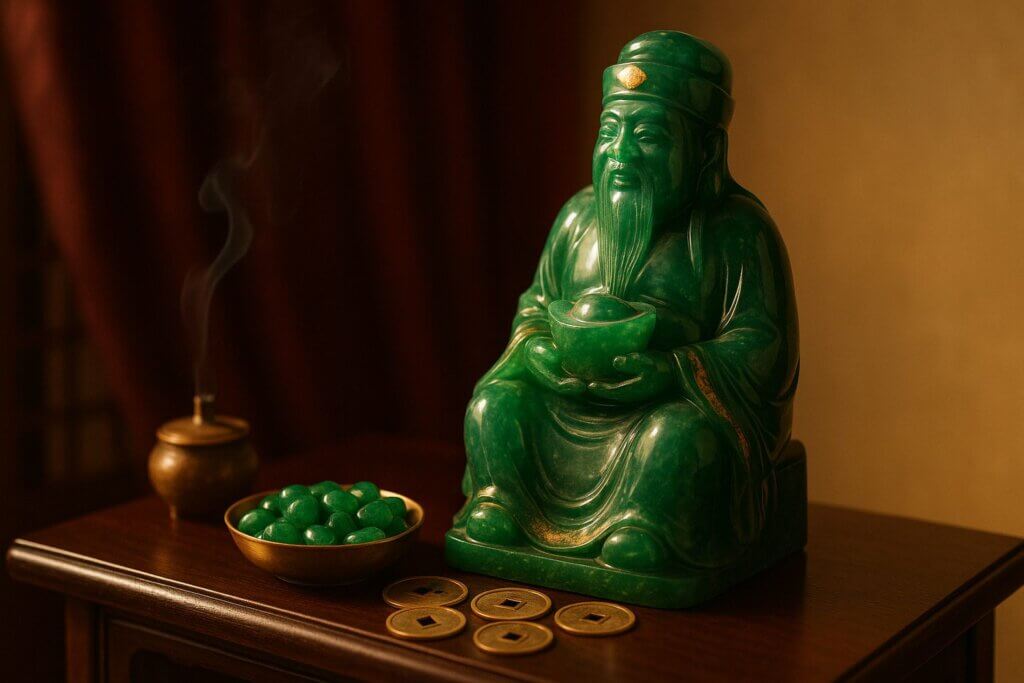
The Green Jambhala is easy to spot. His body is typically green, and his expression isn’t the benevolent, smiling look you might expect from a wealth figure — it’s closer to stern concentration. One hand holds a jewel. The other cradles a small animal: the jewel-spitting mongoose (tu bao shu), a creature said to disgorge gems and treasure from its mouth. That mongoose is practically the signature accessory of Jambhala imagery in general.
Color isn’t decoration in this symbolic system. Green corresponds to action, to enterprise, to the capacity for actually getting something done. So in the traditional reading, the Green Jambhala’s territory leans toward wealth that comes through work: the stretch where talent turns into income and an opportunity turns into a result. That’s why people who start businesses, work in sales, or otherwise have to open their own doors have traditionally felt the strongest pull toward him.
From Dharma Protector to Wealth Deity: Three Stories Behind the Green Jambhala and What They Mean
Almost every deity in Chinese folk religion arrives with an origin story, and those stories are rarely history. They’re what got passed down. The value isn’t in whether you can verify them — it’s in what a culture decided was worth keeping. A handful of Green Jambhala origin accounts circulate more widely than the rest, and every one of them answers the same question: what qualifies a deity to be trusted with wealth in the first place? The three below happen to add up to a complete answer.
Story One: He Didn’t Start Out as a Wealth Deity at All
Here’s one of the more widely told accounts. These figures began as dharma protectors (hu fa) — guardians whose job was to shield practitioners and safeguard the teachings. In the traditional telling, the Buddha came under threat while teaching, a deity appeared to protect him, and afterward was charged with looking after the material needs of ordinary people, so that poverty wouldn’t keep anyone from a settled mind. That’s the moment the wealth portfolio begins.
That starting point matters. Within this tradition, wealth was never the goal — it was the precondition, the thing that lets a person stop scrambling and go do what they ought to be doing. So the Green Jambhala is understood as a backer, not a guy handing out bonuses. Treat him like a slot machine and you’ve misread the job description, at least according to the internal logic of the culture that produced him.
Story Two: The Jewel-Spitting Mongoose and the Treasure Nobody Could Reach
The mongoose story is the more interesting one. As it’s told, enormous quantities of the world’s treasure were being guarded by nagas (serpent beings) — hoarded, watched over, kept out of circulation, out of reach for everybody. After the wealth deity subdued them, that hoarding instinct got transformed: it became a small creature that spits jewels endlessly from its mouth. What had been locked away turned into something that pours out and doesn’t stop.
You can read this as a parable, and it barely needs decoding: hoarding doesn’t generate wealth, releasing it does. Wealth sitting still is classified in the story as a condition requiring subjugation, not a state worth envying. The image still gets cited constantly, and it’s the core unspoken argument running underneath the whole Green Jambhala tradition.
Story Three: Why Green — The Color of Getting Things Done
The five Jambhalas each correspond to a different direction and a different buddha, and the green one lines up with the aspect concerned with bringing work to completion. In this symbolic vocabulary, yellow leans toward abundance and provisions, white leans toward purification and clearing obstacles, and green leans toward the capacity to act: whether you can push something through to the finish, and whether you can convert the ability you already have into an actual return.
So the traditional position of the Green Jambhala isn’t windfall money falling out of the sky — it’s whether the effort you’re already putting in produces results. That distinction comes up constantly when Chinese speakers talk about wealth deities: earned wealth and unexpected wealth are kept clearly separate, and the Green Jambhala sits squarely on the earned side. He’s imagined as an investor, and what he’s evaluating is how you go about your work.
What People Traditionally Do: Three Habits in Green Jambhala Practice, and the Thinking Behind Them
This next stretch is about customs, so let’s be clear about the frame up front: what follows describes what people traditionally do and why they do it. It isn’t a suggestion that you do it too. Here’s the interesting part. Take these habits apart and almost every one of them translates into a thoroughly modern, thoroughly secular attitude toward money. Believe in no deity at all, and these three ideas still hold up on their own.
Habit One: Daily Offerings — Making “Giving” a Muscle Memory
Traditionally, people who feel close to Green Jambhala keep to a few very ordinary motions: a fresh cup of water each morning, a flower set out, a little fruit placed on the home altar. None of it costs much, and the point clearly isn’t the value of the goods. Some people describe it as practice in one specific thing — giving a little of something away every day, on your own initiative, with nothing expected back.
The thinking behind it goes like this. If a person can’t part with even the most trivial thing, their relationship with wealth is probably a tense one. The logic isn’t transactional — I give you water, you give me money — it’s about cultivating a state. Put it in modern language and what it works on is scarcity: that psychological reflex where anything you get, you grip. Making an offering is about the cheapest possible way of telling yourself, every single day, that you have something to give.
Habit Two: Keeping Money Energy Moving — “Sharing” Doesn’t Mean Giving Away 90 Percent
This is the piece of Green Jambhala practice that gets misread most often. The traditional framing is that a wealth deity’s willingness to share money energy with you is itself an act of trust: he’s handing you resources in the hope you’ll use them well and pass something back out. Plenty of people hear “pass something back” and immediately start doing math — earn a hundred dollars, give away ninety. That isn’t what the idea is getting at.
What actually gets emphasized is that the energy has to keep moving, and the forms it can take are wide open. Passing along a good idea you learned is sharing. Giving your time as a volunteer is sharing. Handing an opportunity to the right person is sharing. When what you receive goes back out again, you get a positive loop, and the loop is supposed to snowball — bigger with every turn. Translate that and you land almost exactly on network effects: the value you send out travels through other people and comes back to you carrying more than it left with.
Habit Three: Credit and Being Worth the Investment — This Is What a Wealth Deity Looks At
When Chinese speakers talk about wealth deities, one phrase comes up constantly: whether you’re worth it. There’s a blunt traditional version of this. Getting rich yourself doesn’t impress a wealth deity, because before these figures became gods they spent their lives among rich people already. The person worth investing in is the one who can make other people rich too. If everyone else turns a dollar into a dollar-fifty and you turn a dollar into ten, of course he doubles down on you.
Take the deity out of that passage and it still works perfectly, because what it’s really describing is how credit operates. Someone who does what they said they’d do, who’s willing to route resources to other people, who makes the people around them better off — that person gets more chances, in any era. Not because anyone upstairs is handing out bonuses, but because other people are willing to put things in their hands. That’s the most rereadable part of the whole Green Jambhala worldview: it draws a causal line from character to wealth, and out in the real world, that line genuinely exists. You can decline to believe in any god and still find it hard to argue that people don’t hand their money to those they trust. That’s probably what a few centuries of this tradition leave behind for any reader who picks it up — wealth understood as a relationship rather than a pile of numbers.
Green Jambhala: 5 Questions People Ask
Here are the five questions that come up most often from readers outside the culture. Almost all of them come from a gap in background rather than a gap in procedure — the question is rarely “how do I do this,” it’s “what’s the thinking behind it.” The answers below stay close to the internal logic of the folk tradition, and they fill in context there wasn’t room for earlier. You’ll come away with a fuller picture of what this tradition actually looks like.
Question one: Is Green Jambhala a Buddhist deity or a Chinese folk one?
Both, and that overlap is the interesting part. Green Jambhala comes out of the five-colored Jambhala system in Tibetan Buddhism, but in Chinese communities he got absorbed into a wealth-deity family that already existed, standing alongside homegrown figures like the civil god of wealth and the martial god of wealth. Chinese folk religion has a wide tolerance for this. It doesn’t press very hard on where a deity originally came from; the questions that matter are what he governs, what his temperament is, and whether he suits your situation.
If you grew up inside a monotheistic framework, that blending can be jarring. But it’s an accurate picture of how Chinese religious life works: Buddhism, Daoism and local tradition have coexisted for a very long time, borrowing each other’s imagery and vocabulary along the way. So when you see deities from different origins lined up in the same room, nobody local reads that as a contradiction.
Question two: Why is the treasure-spitting creature a mouse? It looks strange to Western eyes
Strictly speaking it’s closer to a mongoose or a weasel — the Chinese name just settled on “treasure-spitting mouse” (tu bao shu). Its meaning comes straight out of the legend: treasure that had been hoarded and guarded and kept out of circulation was, once subdued, transformed into a small animal that endlessly spits jewels back out. So what the creature stands for isn’t the treasure itself. It’s the shift from wealth locked up to wealth in motion.
Put another way, that little animal is a visual summary of the whole belief. When the deity holds it in one hand, he’s holding the entire idea in one hand: the value of wealth lies in whether it comes back out, not in how well it’s hidden away. If you only remember one detail about Green Jambhala, this is the one that pays for itself.
Question three: If I don’t believe in deities, do these customs still mean anything to me?
They do, probably more than you’d expect. What the tradition is really passing along comes down to three things: wealth moves, so don’t hoard it; sharing creates a cycle, so don’t be afraid to give; and your credibility determines whether anyone hands you resources, so mind your character. Strip the deity off the outside of those three and you’re left with observations about life you can test directly.
Plenty of cultures wrap rules of thumb inside stories. Norse myth talks about fate, the Japanese lucky cat talks about hospitality and chance connection, and Chinese wealth deities talk about the relationship between money and character. You can take the layer of reasoning without taking the layer of belief. For the purpose of understanding a culture, that’s plenty, and it offends no one.
Question four: How is Green Jambhala different from the other colors?
Each of the five has its own emphasis. As it’s traditionally understood, yellow leans toward overall abundance and provision, white toward clearing obstacles and getting out of a jam, red toward relationships and the opportunities that come through people, black toward turning things around in genuinely hard circumstances — and Green Jambhala toward professional momentum and the ability to actually get things finished.
That division of labor reflects something worth noticing: this tradition never treated wealth as a single thing. There are a lot of different ways to be stuck around money. Some people have no opening at all. Some have more work than they can finish. Some are blocked by the people around them. Traditionally, people gravitated toward one wealth deity or another based on where they were stuck at that moment. Which is why, inside this system, picking one reads less like choosing the more effective deity and more like describing your own situation.
Question five: “Share and you’ll have more” sounds like a pep talk. Where does that actually come from?
It comes from a fairly specific chain of reasoning, not from a motivational poster. The thinking goes like this: money energy placed in your hands is a form of trust, and trust is maintained by being used — you pass along what you received, other people benefit from it too, and the cycle closes. Once the cycle is running, the share that comes back around to you grows along with it. And the form of sharing held in highest regard here isn’t money at all. It’s passing a useful idea to the people around you, because that’s what keeps benefiting them over the long haul.
You can read the whole thing as a metaphor about compounding: money compounds through time, while relationships and trust compound through the number of times you give. What ultimately survives from this cultural view is a reminder that holds up in modern life too — one measure of wealth is how much you’re holding, and the other is how many people are doing a little better because of you.