Who Is the Western God of Wealth? Three Basics About the “Gatherer of Treasures”
If this is your first run-in with the idea of a “god of wealth,” set the religion part aside for a second and think of it as a culture’s imagination about money. Norse mythology hands one god the thunder and another the harvest. Japan uses a cat with a raised paw to stand for customers coming through the door. Chinese folk religion did something similar, building out a whole cast of characters to answer two questions everybody has: where does money come from, and how do you keep it? The Western god of wealth is one of the more interesting figures in that lineup — because his job isn’t handing out money. It’s something else entirely.
One of Five: The God Who Stands in the West
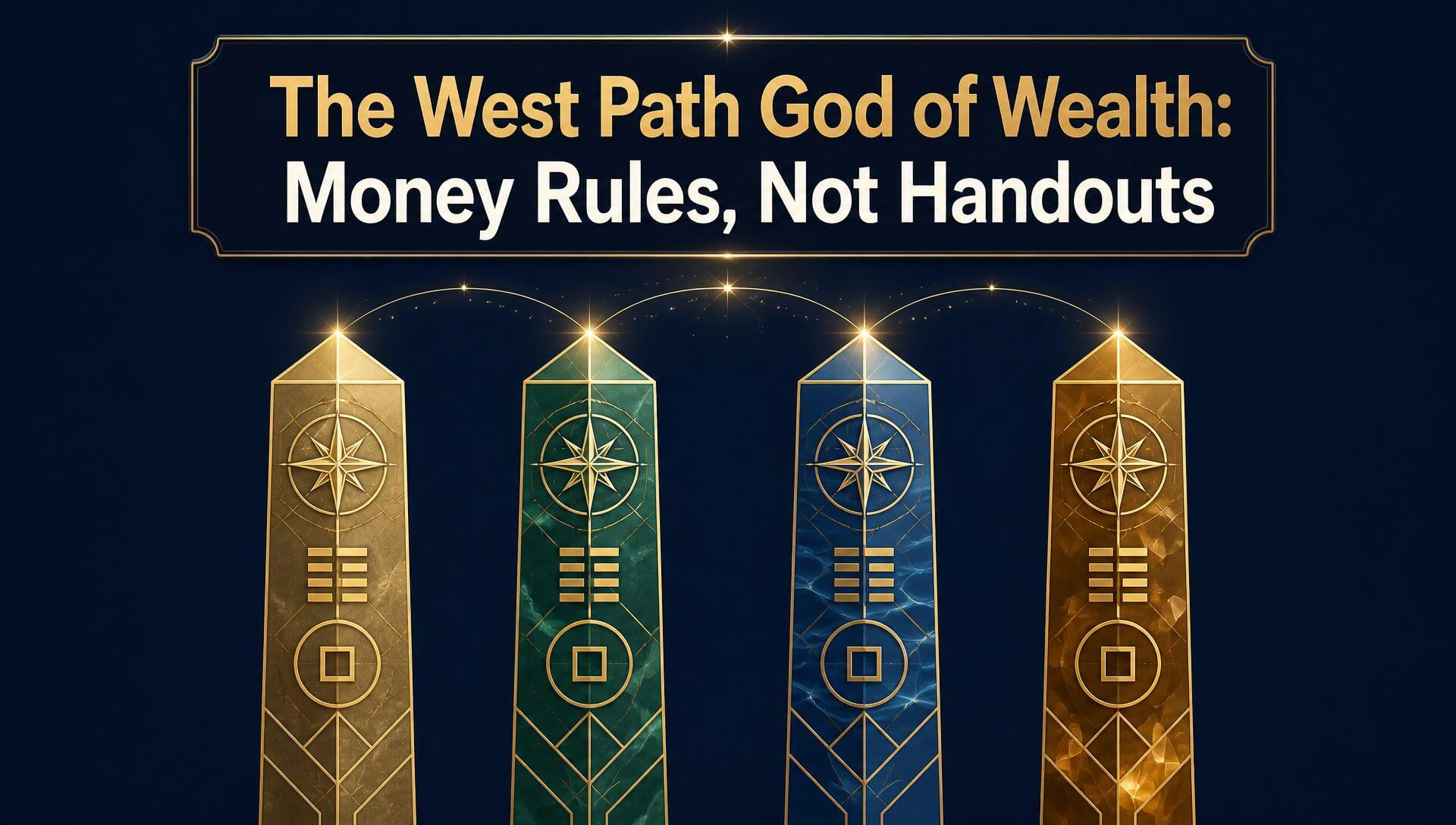
In Chinese folk religion, Caishen, the Chinese god of wealth, is rarely a single figure. He usually shows up as a group. The most common grouping is called the Five Paths gods of wealth (wu lu cai shen): one at the center, and one each for east, west, south, and north. Together, the five directions work like a finance team with clearly divided responsibilities. Here’s the thing — the design of that grouping already tells you how people were thinking. Wealth doesn’t arrive from one direction only. Merchants traveled north and south, east and west, so what they asked for was that every direction stay open.
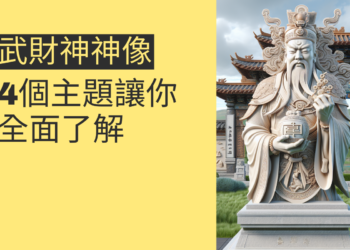
Within that group, the Western god of wealth carries the formal title Nazhen Tianzun (na zhen tian zun), which translates roughly as “the heavenly lord who gathers treasures.” Na means to take in; zhen means what is precious. Put them together and the name means something like “collect what has value and store it well.” Just from the name, you can tell he isn’t the figure behind the fantasy of money falling out of the sky.
“Gathering Treasures” Means Recognizing Value and Bringing It In
To understand why this god was placed in the west, you need the traditional Chinese pairing of the five elements with the compass directions. West belongs to metal, and the season it corresponds to is fall. So what kind of season is fall? It’s the season of harvest, of filling the granary, of bringing in a whole year’s worth of results. It isn’t the season for planting, and it isn’t the season of wild growth. It’s the season for settling the books.
So in folk tradition, the Western god of wealth’s portfolio is understood as three things bundled together: recognizing what has value, filtering out what doesn’t, and preserving what you decide to keep. Translated into modern terms, that’s roughly the ability to appraise, the judgment to choose, and the discipline to actually hold onto money. Within the whole tradition of wealth deities, this is one of the more down-to-earth roles.
What a God of Wealth Gives You Isn’t Money — It’s Money Energy
There’s one more concept worth getting straight up front, or the rest of this will read wrong. In traditional accounts, what a god of wealth hands a person usually isn’t called money at all. It’s called money energy — the idea that wealth behaves like a current rather than a pile. Money energy sits further upstream than cash does: the opportunity, the well-placed person who vouches for you, the news that reaches you early, the call that comes right when it matters. Turning that energy into actual wealth still leaves a long stretch of road you have to walk yourself.
More importantly, tradition treats that money energy as a form of trust rather than a prize. The idea is that resources get placed in your hands because of what someone expects you’ll do with them. That premise is what shapes every custom that follows.
A Tale from the Investiture of the Gods: The Two Turns That Made the West Path God of Wealth
Here’s something most Americans don’t realize about Chinese folk religion: most of its gods weren’t born divine. They started out as people. The West Path god of wealth is one of them — his story comes from a Ming dynasty novel called Investiture of the Gods, which retells the fall of the Shang and the rise of the Zhou as a war among immortals. The book left a deep mark on popular belief, and a surprising number of deities people still make offerings to today got their job descriptions straight from its pages. His story turns twice, and both turns are worth sitting with.
The First Turn: A Mortal Adept Carrying the Treasure-Dropping Coin
In the version that circulated among ordinary people, the West Path god of wealth was a man named Cao Bao, a wandering Daoist adept who traveled with a companion, Xiao Sheng. Between them they carried a single treasure, and its power was oddly specific. It didn’t strike anyone. It did one thing only: it knocked down whatever magical weapon an opponent sent into the air, and every glittering thing flying overhead simply dropped to the ground.
Picture the scene. Your opponent produces his most fearsome instrument, and it lands with a clatter and turns back into an ordinary lump of metal. Later readers pulled a lot of meaning out of that image, and the most common reading is this one: it makes the hollow thing show itself. What looks impressive isn’t necessarily worth anything, and only someone who can tell the difference has any business talking about “gathering treasures.”
The Second Turn: From Enemy to Colleague
The other half of the story cuts against the first. These two adepts originally fought on the side opposing Zhao Gongming, and both died in the fighting. Yet when the gods were finally invested with their offices, the two were assigned as attendants to Zhao Gongming himself — the god who would become the Central Path god of wealth — one given the East Path and the work of “attracting treasures,” the other the West Path and the work of “gathering treasures.” Enemies in life, same department in death.
People took to that arrangement, and they read an attitude into it: wealth isn’t something you get by defeating anyone. In the end, everyone has a post to keep. The East Path draws things in, the West Path holds on to what arrives, and the Central Path coordinates — a division of labor, not a contest. That’s also why, traditionally, hardly anyone makes offerings to just one of them. The Five Paths gods of wealth (wu lu cai shen) are usually taken together.
What People Traditionally Do: 3 Money Lessons Inside the West Path Wealth God Tradition
Here’s the part worth slowing down for. The customs that grew up around Caishen look like pure ritual from the outside, but almost every one of them has a very specific value judgment tucked inside. What follows isn’t a set of instructions for you to copy. It’s the logic laid out in the open — the way people have traditionally thought about this stuff. And even if you don’t believe in gods at all, these three ideas hold up just fine as a modern philosophy of money.
Lesson one: money energy has to flow outward before it can grow
There’s a Chinese folk idea worth knowing here — not as a financial rule, but as a cultural lens on wealth: the god of wealth shares money energy — the idea that wealth behaves like a current rather than a pile — with you because he wants you to put it to good use and turn around and benefit other people with it. Put plainly, you’re accumulating merit on his behalf. So whether or not that energy has turned into actual cash yet, the tradition says you keep passing it along. That’s what makes it compound.
People hear this the first time and often get it backwards, as if the rule were: earn a hundred dollars, give away ninety. That’s not it. The sharing being described is about keeping energy in motion, and the forms it can take are broad. Explaining a good idea you picked up to a friend counts as sharing. Giving your time as a volunteer counts as sharing. The whole point is not letting it dead-end with you.
So how does a modern reader take this one? It’s really a non-zero-sum worldview. People who let resources, knowledge, and connections move outward get found by more opportunities, because word gets around that you’re useful to know. People who hoard everything eventually stop getting knocks on the door. The tradition frames it as money energy; it’s describing the same thing.
Lesson two: your credit matters more than your income
If money energy is a trust placed in your hands, then your credit isn’t a bonus point — it’s the qualification itself. That’s why merchants traditionally treated doing what you said you’d do, never stiffing anyone, and settling the books before year’s end as such serious matters. Within this worldview, those aren’t just business manners. They’re the test of whether you kept faith with what was entrusted to you.
The West Path god of wealth presides over gathering in what’s precious, which makes this lesson especially pointed in his case: what you hold onto isn’t only money, it’s other people’s judgment of you. And that one needs no translation. Credit is the cheapest capital there is, and someone whose word is good will always get better terms than someone who has to be triple-confirmed on everything.
Lesson three: getting rich alone doesn’t score well in this value system
This is the least intuitive of the three, and the one most worth carrying with you. The tradition puts it bluntly: from the god of wealth’s point of view, a person who merely gets rich isn’t especially impressive — before these figures became gods, the people they dealt with were wealthy anyway. What actually earns regard is being someone who makes other people rich too.
And the reasoning is thoroughly practical. Backing someone else might turn a dollar into a dollar fifty; backing you turns a dollar into ten, because you take resources and multiply them. Then, when the ideas you pass along genuinely improve life for the people around you, part of that circuit swings back to you — not by mysticism, but by network effect. The more people who benefit from the value you create, the more thickly opportunities come back your way.
Line all three up and you’ll see that this tradition’s picture of wealth isn’t “make an offering and money appears.” It’s a code of conduct: keep things moving, keep your word, and set your sights on what you can do for other people. And the square the West Path god of wealth occupies in that scheme — recognizing value, then holding onto it — happens to be exactly the piece a lot of people are missing. You don’t have to believe in any god to hold it up as a mirror and see what looks back.
5 Common Questions About the Western Path God of Wealth
A few questions tend to come up at this point — especially if you’re coming to this with zero cultural background. The five below are the ones people ask most, and the ones that get garbled most easily. Every answer is framed as “here’s how people have traditionally thought about this,” not as a set of instructions. Think of it as supplementary reading on how another culture talks about money.
Q1: What makes the Western Path god of wealth different from the other four?
It comes down to the job description. The Five Paths gods of wealth (wu lu cai shen) are a set of roles. The Central Path oversees the whole operation. The Eastern Path, “summoning treasure,” leans toward pulling opportunity and resources in. The Southern and Northern Paths correspond to attracting wealth and to profitable trade. The Western Path, “gathering the precious,” handles everything that happens after the money shows up — recognizing it, sorting it, keeping it. Put it in corporate terms: the Eastern Path is business development, the Western Path is finance and risk management. That’s also why tradition rarely talks about any single path on its own. In this way of imagining wealth, someone who only knows how to attract and never how to hold on loses the money anyway, and someone who only knows how to hold on and never dares to move ends up with a business that never grows. The complete financial picture is all five read together.
Q2: I don’t believe in any of these deities. Is there a point in reading this?
Yes, and that’s exactly how this was written. You can read the wealth-god tradition as financial ethics wrapped in story: it takes abstract principles — that sharing comes back to you, that keeping your word is a form of capital, that people who help others get rich go further themselves — and turns them into characters, plots, and holidays, so they could be handed down across generations by people who couldn’t read. Strip out the deity layer and the behavioral advice still stands on its own two feet. Honestly, the value of a lot of folk religion isn’t in the supernatural part at all. It’s in how densely it packs centuries of observation about what kinds of people end up with money and what kinds of people can’t hold on to it. Read it as an old piece of behavioral research and it gets genuinely interesting.
Q3: When do people traditionally think about the Western Path god of wealth?
Usually around specific points on the calendar. The stretch around Lunar New Year, the day a shop opens for business, the settling-up days at the start and middle of the month — those are traditionally when the gods of wealth come to mind. What they share is that each one marks the beginning or end of a chapter. Which makes sense: when you have to take inventory, make a decision, or account for the stretch of time ahead, wanting a ritual that steadies you is a pretty human impulse. Because the Western Path carries the imagery of the fall harvest and the filling of the granary, it comes up especially often around closing the books. Some people use these moments to straighten out their accounts too, and check whether the money they’re owed has actually landed — the ritual feeling and the practical financial work turn out to be two sides of the same thing.
Q4: “You have to share to have money energy” — isn’t that just a pitch for donations?
This is the most common misreading, and the traditional framing is actually pretty clear on it: what matters isn’t the amount, it’s the circulation. Giving away ninety percent of what you earn is not what the idea asks for. Keeping the energy moving through you is. So the forms sharing can take are broad — passing a genuinely useful idea along to a friend counts, spending your time helping with something counts, writing up what you’ve learned so the people coming after you can use it counts even more. The form held in highest regard is sharing the good ideas you’ve picked up so the people around you live better for it, because that’s the loop with the widest reach and the longest life. Boiled down: it’s a rule about attitude, not about what percentage you tithe.
Q5: Isn’t this whole idea just rich people comforting themselves?
That’s a fair challenge, and it deserves a straight answer. Folk ideas like this one do carry the limits of their era. They formed in a society where commercial credit depended almost entirely on personal reputation, they have nothing useful to say about structural inequality, and they should never be turned into a way of blaming people in hard circumstances for “not being generous enough.” But one part of it hasn’t aged a day: it moves the yardstick for wealth away from how much you’ve stockpiled and toward how many people are better off because of you. In an era where it’s very easy to treat a number as the only scoreboard, the fact that a culture several hundred years ago defined success this way is worth pausing on. And the thing the Western Path god of wealth is said to govern — being able to recognize what’s actually precious — is, in the end, asking the same question.