Meet the Laughing Buddha: Three Identities Stacked Into One Statue
Walk into a Chinese restaurant, an Asian grocery store, or a friend’s entryway anywhere in the US, and odds are you’ve spotted him: a round, bare-bellied Buddha grinning ear to ear. Most people figure that’s the Buddha. It isn’t. In Chinese folk religion, that cheerful little guy carries a surprisingly tangled identity — at least three layers of meaning stacked on top of each other — and the wealth-attracting layer is both the newest and the most down-to-earth of the bunch. Here’s the thing: to understand how the Laughing Buddha got tied to money in the first place, you have to peel those three layers apart.
Layer One: The Future Buddha of the Buddhist Scriptures
In orthodox Buddhism, Maitreya (from the Sanskrit, roughly “loving-kindness”) is a buddha who hasn’t made his entrance yet. The scriptures place him in a realm called Tushita Heaven, where he is said to be practicing and teaching, and where he’ll stay until the far, far future — a point measured in hundreds of millions of years — when he descends into the human world as the next buddha after Shakyamuni.
So strictly speaking, Maitreya’s role in Buddhism is closer to a savior-in-waiting. That setup comes with built-in optimism: the world may be a mess right now, but a buddha full of loving-kindness is on his way. And that “things will get better” temperament turned out — almost by accident — to line up neatly with the way people imagine wealth.
Worth noting: the Maitreya of the scriptures is neither fat nor laughing. That big-bellied figure you know? Chinese tradition added him later.
Layer Two: The Buddha of Joy in Folk Religion
Chinese folk religion is a remarkably flexible system. Unlike the Abrahamic traditions, it doesn’t center one exclusive god — it works more like a pantheon that keeps expanding. Buddhist figures, Daoist figures, historical people, local heroes: all of them can be absorbed, each taking charge of one department of daily life. There are gods for exams, for childbirth, for safe passage at sea, and, naturally, for money.
The role Maitreya plays in folk religion is the embodiment of joy. He doesn’t judge, he doesn’t punish, and he doesn’t even carry much dignity or gravitas. His defining trait is simply that he laughs. There’s an old saying about him: a belly big enough to hold what the world can’t stomach, a mouth that opens into laughter at everyone the world finds laughable. That captures exactly the feeling the statue gives off — generous, unbothered, entirely unclenched.
Layer Three: A Symbol of Prosperity in the Culture of Seeking Wealth
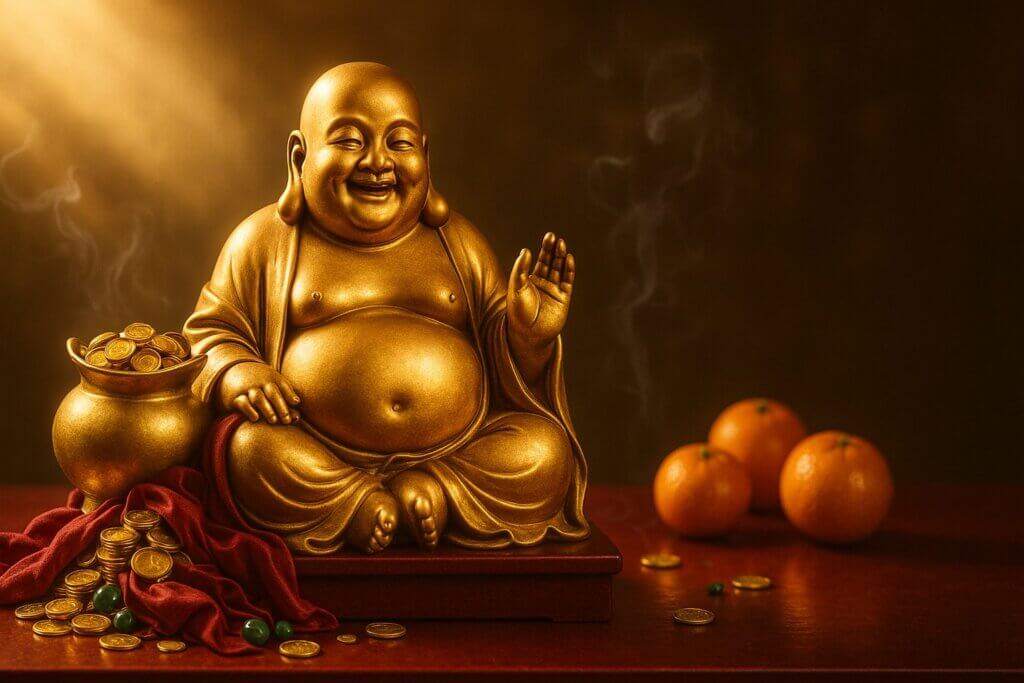
Once commerce took hold, the figure picked up yet another identity. From the Ming and Qing dynasties onward, merchant guilds rose and market towns flourished, and business people needed something to pin their hopes on. Maitreya’s image fit almost too well: the permanent smile stood for making money through goodwill, the big belly stood for capacity and broad-mindedness, and the gold ingot or cloth sack he’s often shown holding pointed straight at wealth itself.
Little by little, “the Laughing Buddha brings wealth” became its own folk concept, separate from the rest. It isn’t quite the same as orthodox Buddhist devotion to Maitreya, and it doesn’t come with a formal job description the way Zhao Gongming or Guan Yu do as gods of wealth. It’s more of a shared popular understanding: this figure represents an ideal state of earning money with a generous disposition. That distinction matters — from day one, this was never a symbol for chasing a windfall. It was a projection of a certain kind of business character.
From Eccentric Monk to Wealth Symbol: 3 Turning Points in How the Budai Buddha Took Shape
Here’s the wild part about this statue: its face belongs to a guy who actually lived. Chinese sculptors never carved Maitreya the way the Indian scriptures describe him. Instead, they took a wandering monk from the Five Dynasties period and decided he was Maitreya walking around in human form — and over the centuries, that monk’s body and personality shoved the scriptural version right out of the frame. It’s a great story about mistaken identity hardening into tradition, and it explains exactly where the wealth association came from.
Budai: A Monk Nobody Could Figure Out
According to the accounts that have come down to us, a traveling monk showed up in the Zhejiang region during the Five Dynasties period. Nobody knew his real name or where he came from. He was fat, his robes were a mess, and he hauled a cloth sack everywhere he went, dropping into it whatever people handed him. So that’s what they called him: the cloth-sack monk (budai heshang).
His behavior resisted every category people tried to put him in. He’d lie down and sleep in the snow, and the snow wouldn’t settle on him. He predicted the weather. He said things that made no sense at the time and turned out to make perfect sense later. When someone asked him about the dharma, he set the sack down. When they pressed him, he shouldered it again and walked off. That near–performance art style of teaching is actually classic Chan: letting go and taking up the burden, both of it delivered entirely through gesture.
What he was best known for, though, was his temper — or rather, his total lack of one. Kids tugged at him, laughed at him, climbed up onto his belly, and he just laughed right along with them. That capacity to be untouched by insult turned out to be the single most valuable asset in the whole image.
The Verse He Left Behind Settled the Question
The story turns at the moment of his death. He’s said to have sat down on a rock and left behind a verse: “Maitreya, the true Maitreya, divides himself into a hundred million bodies, showing himself to the people of this age again and again, and the people of this age never recognize him.” Which is to say — Maitreya is Maitreya, he keeps appearing right in front of you in one form after another, and not one of you can tell.
Then he was gone. The verse amounted to announcing his own identity. People looked back on it and concluded that the odd monk had been Maitreya come down to earth all along, and starting in the Song dynasty, temples began sculpting Maitreya in his likeness: heavy, belly bared, laughing, sack never far from hand. The lean, solemn figure imported from India had been replaced by the flesh and blood of a Chinese monk.
Culturally, this was localization taken all the way. An abstract idea from a foreign religion got poured into a body Chinese people found familiar, approachable, even a little ridiculous — and that approachability is precisely why it worked. He wasn’t up on a pedestal looking down. He was in the marketplace, standing with everybody else.
How the Cloth Sack Became a Money Bag
The thing that actually tied him to wealth was the sack. In Chan terms, the sack originally stood for carrying the troubles of all beings: whatever anyone threw at him, he took it. But abstractions are hard for ordinary people to feel much affection for, and what ordinary people saw was a lot simpler than that — a bag, stuffed full, and a man who was clearly delighted about it.
So the contents of the bag gradually got reimagined as gold and silver. A gold ingot (yuanbao) appeared in his hand. A ju bao pen — a treasure bowl said to multiply whatever is placed inside it — appeared at his feet. Some versions add five rowdy children scrambling over him, standing for a house full of descendants and money arriving from all five directions. A sack for carrying other people’s suffering became a sack full of money. It’s a slightly comic piece of translation, but it’s an honest reflection of what regular people actually cared about.
And that’s where the whole idea of the Budai Buddha as a wealth figure comes from: no scripture authorized it. Several hundred years of ordinary people imagining it together did. It’s folk culture’s collective answer to the question of what kind of person ends up rich — someone who laughs, who can absorb a lot without taking offense, and who is as willing to give as he is to receive.
What People Traditionally Do, and the 4 Ideas Behind Those Practices
Now for the customs themselves. One thing to be clear about up front: what follows is a description of what people traditionally do, not a set of instructions for you. In plenty of Chinese households, some of these practices are genuine belief, some are pure habit, and some are basically decoration. The part worth taking away is the thinking behind each one — because that reasoning holds up even if you don’t believe in any deity at all.
Where the Statue Goes Is Really a Question About Where Your Attention Goes
Traditionally, this figure is placed facing the front door or facing the main living space. The stated reason is to let him “greet the money energy coming in through the door,” and there’s a related idea that Caishen likes to see people coming and going. Some families put him in the living room, or near the register in a shop, rather than in a bedroom or a storage closet.
Strip away the mystical wrapping and this custom is a piece of spatial psychology. The first thing you see when you walk through your door sets your state before you’ve registered it. An object with a smile on its face greeting you produces a completely different mood than a stack of unpaid bills greeting you. Tradition puts it as “harmony breeds wealth,” and arranging your day so that harmony is the first thing you look at is a genuinely practical form of self-management.
There’s a second point of care, too: keeping the figure clean. A dusty statue is considered disrespectful, and it’s also said to block wealth. The real-world logic here is even more direct. A corner that’s been collecting dust for months usually says something about the overall state of how its owner is living. People whose finances are a mess rarely have tidy homes.
Rubbing the Belly, Keeping the Smile: Treating Emotion as an Asset
In a lot of places there’s a habit of rubbing the belly of a laughing Buddha figure for good luck. Others make a point of going to look at that smiling face when things aren’t going their way. Anthropologists call this kind of behavior a tactile ritual, and every culture has some version — rubbing a lucky coin, knocking on wood, wearing the same socks to every game.
The idea underneath it is that your emotional state affects the quality of your decisions. Financial choices made by an anxious person are, statistically, not the same as ones made by a relaxed person. Anxious people sell at the bottom, get hijacked by a sense of urgency, and accept terms that don’t serve them. Traditional culture packaged this into four characters — “harmony breeds wealth” — but it’s the same observation. Your emotional state is itself part of your financial assets.
The big-belly symbolism is worth unpacking as well. “A big belly can hold anything” translates, in business terms, into a set of very concrete questions: Can you sit with uncertainty? Can you absorb a small loss? Can you work with people you don’t particularly like? That capacity directly determines how many opportunities are available to you. Small-minded people end up on narrow roads.
What’s Going Through Someone’s Mind While Making Offerings: A Conversation About Credit
Traditionally, people standing in front of Caishen don’t just ask for money. The more common pattern is to start by reporting on where things stand — what you’re working on, what obstacles you’ve hit — and only then to state the wish. It usually closes with a promise: if this works out, here’s how I’ll give back. Some people pledge to do good; some pledge to help others.
What does that structure resemble? A conversation with an investor. You don’t walk into an investor’s office and say “give me money.” You explain what you’re building, what you need, and how you intend to return the favor. And within this cultural imagination, Caishen is understood as someone who takes credit extremely seriously: he remembers what you said, and he watches whether you followed through.
So there’s a powerful folk concept of “repaying the vow” — once things work out, you go back and complete what you promised, no defaulting. On the surface that’s a religious obligation. What it actually trains is something entirely worldly: doing what you said you would do. And credit happens to be the core currency of the world of wealth. Over the long run, nobody’s financial scale exceeds the scale of their credibility.
Why the Emphasis Is on Circulating Rather Than Hoarding
This is the most counterintuitive part of the whole wealth-seeking tradition, and the part most worth an American reader’s attention. You’d assume that asking for wealth means asking to take more and hold onto more. But in this tradition’s understanding, the money energy Caishen gives you is fundamentally an expression of trust — he’s handing you resources because he expects you to use them well and to send something back out into the world through good works.
Put plainly: Caishen distributes wealth to you so you can accumulate merit on his behalf. Which means that whether or not that money energy ever converts into actual cash, you’re expected to share what you received, and only then does it compound. The most commonly misunderstood piece here is that sharing does not mean donating ninety dollars out of every hundred you earn. It means letting the energy move outward. Telling someone else about a good idea you learned is sharing. Being willing to spend your time volunteering is sharing.
And within this framework, the most valuable kind of sharing is passing what you’ve learned to the people around you so that they become prosperous too. Because they got better off through you, part of that cycle circles back around to you. From Caishen’s point of view, a person like that is especially worth doubling down on — put a dollar into most people and you get fifty cents back; put a dollar into you and it might return ten.
There’s a blunter folk saying for this: getting rich yourself isn’t impressive. Before these figures became deities, the people they moved among were already wealthy — they’ve seen plenty of that. The person who can make other people rich is the one actually worth investing in. That idea is, at bottom, describing the same thing modern language calls network effects and positive-sum games.
Five Questions People Ask Most About the Laughing Buddha and Wealth
By this point, a handful of practical questions tend to come up — especially if you didn’t grow up around any of this, where a few details are genuinely easy to scramble. The five below cover the usual sticking points: who this figure actually is, whether any of it collides with another religion you already practice, and where the line sits on cultural appropriation. The answers work the way the rest of this has — describing how the tradition sees things, not handing you marching orders.
Is the laughing, big-bellied Buddha the same person as Shakyamuni, the founder of Buddhism?
No, and honestly, that’s the mix-up. The historical founder of Buddhism was Shakyamuni (Siddhartha Gautama), an Indian prince who lived somewhere around the sixth century BCE, and traditional images show him lean, eyes closed, seated in serene composure. The laughing figure with the exposed belly is Maitreya — the future Buddha of the scriptures, whose familiar Chinese form was fixed by Budai, a monk of the Five Dynasties period.
The difference runs deeper than the artwork. Within Buddhism, Shakyamuni represents an awakening already completed; Maitreya represents a hope that hasn’t arrived yet. And the folk idea of the Laughing Buddha as a bringer of wealth has nothing to do with Shakyamuni at all. It isn’t scriptural Buddhism either — it belongs to a layer that popular religion built on its own.
Worth noting in passing: Chinese usage sometimes slides between calling him a buddha and calling him a bodhisattva. Strictly speaking he hasn’t attained buddhahood yet, so bodhisattva is the correct title — but everyday usage calls him a buddha anyway. That looseness about titles is itself a pretty good portrait of how folk religion operates. It cares about the relationship, not the rank.
Does he belong in the same category as China’s “official” wealth deities?
Not really. Chinese folk religion has a large and clearly divided cast of wealth deities. Among the most prominent is Zhao Gongming, a martial god of wealth from the Daoist system, imposing in appearance and pictured riding a black tiger. There’s also Guan Yu, a general from the Three Kingdoms era who became a god of wealth because merchants saw him as the embodiment of loyalty and keeping one’s word. The civil side generally points to figures like Bigan or Fan Li, associated with intelligence and skillful management.
These deities hold defined posts. They typically have temples, feast days, and settled conventions for making offerings. Maitreya’s situation is the odd one out — he was never formally enrolled in the wealth-deity system, yet his image suited the role so well that people adopted him as a symbol of prosperity anyway.
So he functions more like an unofficial good-luck symbol: low barrier to entry, relaxed in feel. Think of Zhao Gongming as the department head with the formal title, and Maitreya as the person everyone in the office likes, who can strike up a conversation anywhere. Both are dealing with wealth. The style couldn’t be more different.
Traditionally, do people believe this actually works?
The answer has more layers than you’d expect. Across Chinese communities, attitudes toward customs like this run an enormously wide spectrum. Some people are sincere believers who trust that the deity really does respond. Others participate culturally, treating it as family tradition and something you do at New Year. Still others take it as decoration and a pleasant omen, in roughly the same spirit as an American hanging a horseshoe over the door.
Here’s the more interesting part: all three attitudes often live inside the same person without any friction at all. A shrewd businessperson may spend the day running rigorous financial analysis and still light a stick of incense in the shop that evening. In this culture, reason and ritual aren’t treated as opposites — they handle different layers of the problem. One handles the arithmetic. The other handles state of mind and meaning.
If you press on whether it works, the more honest framing is that most of the value of these customs sits in how they shape behavior. People who emphasize circulation share more readily. People who emphasize credit keep their promises. People who emphasize good humor are easier to work with. Those traits move a person’s financial trajectory on their own, no supernatural explanation required.
I’m not Buddhist and I don’t believe in gods. Is there anything here for me?
Yes — possibly more than a believer gets, because you’re not caught up in the details of ritual and can see the underlying structure more easily.
Strip away the theological shell and this culture is answering a question anyone can recognize: how should wealth be treated? The answer it offers is that wealth isn’t a static thing to be hoarded but an energy that needs to move; that the precondition for getting it is being trusted, and the key to keeping it is honoring your word; and that the real multiplier isn’t how much you’ve stashed away but how many people you’ve made better off.
You can test every one of those without believing in any deity. Ask yourself: when was the last time you gave away useful knowledge for free? Have you delivered on what you promised? Are the people around you better off for knowing you? The answers have nothing whatsoever to do with whether you believe in the laughing figure on the shelf.
Is putting this statue in my home cultural appropriation?
This one deserves a straight answer, particularly in an American context. The more useful test usually isn’t “are you allowed to own this” but “do you understand what it is.”
Looking at it from within Chinese cultural habits, symbols like this have always been outward-facing and hospitable. Folk religion has never stopped absorbing outside elements — Maitreya himself came from India and was reshaped by the Chinese into the form we know now. The system’s character is inclusive rather than exclusive, and sharing its symbols is generally seen as a good thing rather than an offense.
What actually makes people uncomfortable is a different scenario: treating it as an exotic knickknack with no content, or getting his identity wrong and doubling down on your own version anyway. The difference is one of attitude. If you know that this is Maitreya, know why he’s laughing, and know that the sack was originally for carrying other people’s troubles, your understanding already runs deeper than that of plenty of people who grab one off a shelf. What a culture has to fear has never been being shared — it’s being flattened into an empty ornament.
In the end, the view of wealth that grew out of this laughing figure hands us a perspective very unlike the mainstream story. In an environment used to understanding wealth as accumulation, ranking, and competition, it argues that wealth is fundamentally about relationships and movement — how much you’re trusted, and how much passes through you on its way to someone else. It doesn’t promise to make you rich, and it hands you no operating manual. It simply raises a possibility: that measuring how wealthy someone is might involve more than what they’re holding onto, and might also include how many people were there to catch what they let go.