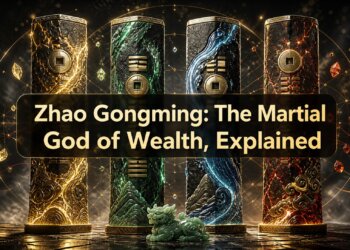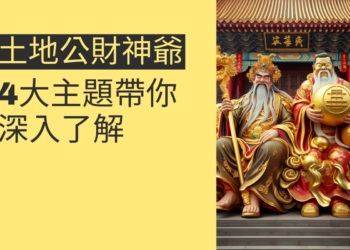
Meet Him First: 3 Pieces of Background on the Black God of Wealth
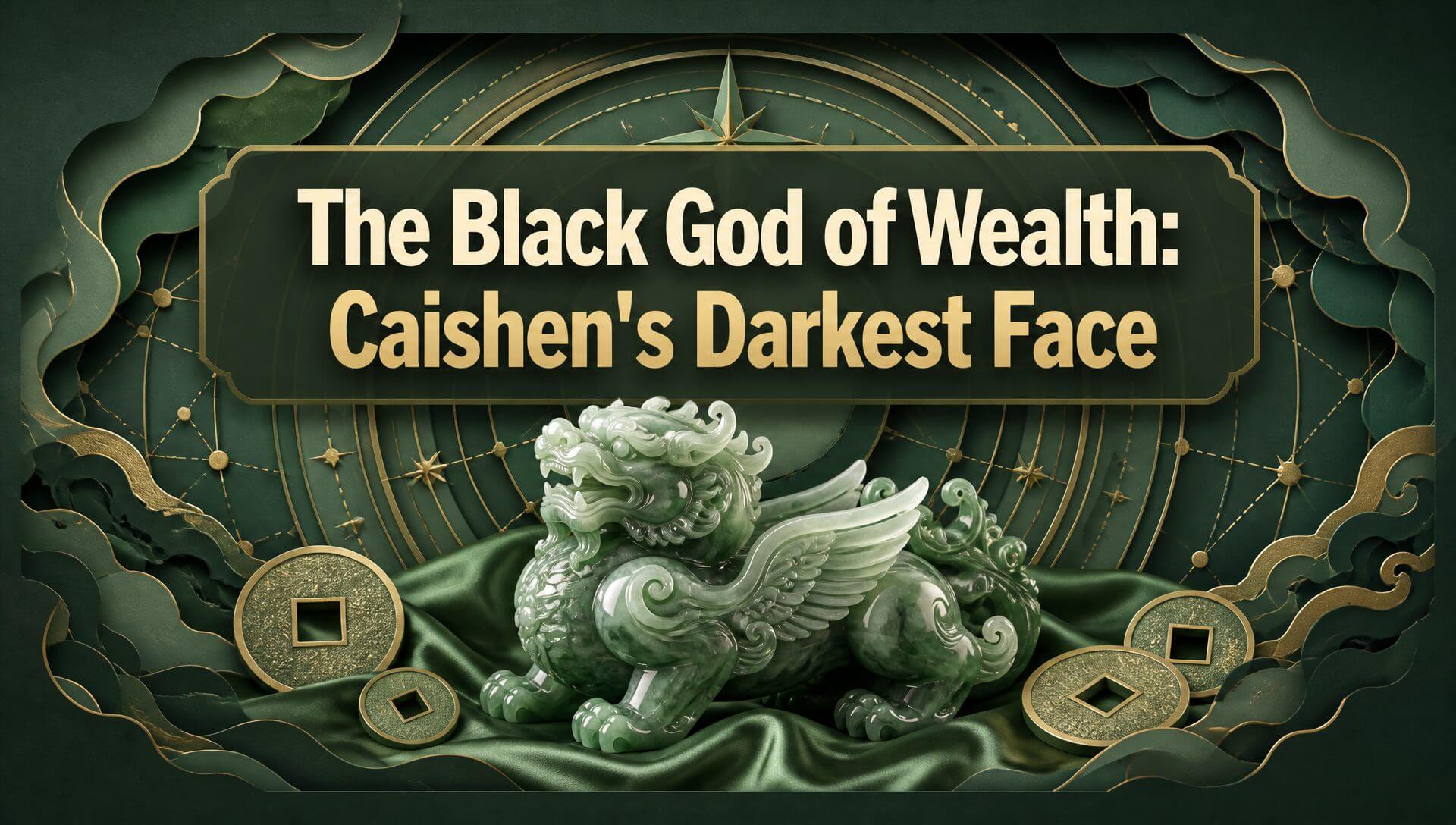
If this is your first time running into the word “Caishen,” here’s your bearing. Caishen, the Chinese god of wealth, isn’t one all-powerful figure handling money as a side gig. In Chinese folk religion, wealth is a whole specialized field, staffed by a full roster of deities who split the work among themselves. The Black God of Wealth is one of them — the most visually striking of the bunch, and the one outsiders misread most often. This section skips ritual entirely. It puts him back in the spot he actually occupies, so you know what a Chinese speaker is picturing when that name comes up.
Caishen Isn’t One Deity — He’s a Whole Department
In Chinese folk religion, the world of the gods runs a lot like a vast bureaucracy, and that’s a real departure from Greek or Norse mythology. These aren’t giants acting on temper and appetite. They’re closer to civil servants: job titles, assigned territories, performance reviews. Wealth gets carved up into several posts. One deity oversees money earned through honest business. Another handles windfalls and unexpected gains. Another watches over how money energy moves through a particular locality — money energy being the idea that wealth behaves like a current rather than a pile. Another minds commercial contracts and credit. The Black God of Wealth sits toward the guarding-and-governing end of that lineup, which means his concern isn’t only whether the money reached you. It’s where the money came from, and whether you have what it takes to hold onto it.
That division of labor gives away something worth noticing: in this culture, “money” was never one undifferentiated thing. Money you earned in business, money you inherited, money you won at a card table, money somebody pressed into your hand — folk tradition files those under completely separate categories. Different origins, and different odds of sticking around.
Why “Black”? What the Color Is Doing Here
American readers hit the name “Black God of Wealth” and the first instinct is usually that it sounds ominous. But in the Chinese color vocabulary, black carries almost the opposite freight it does in the West. Black corresponds to water, and water in traditional thinking is the emblem of wealth itself — it flows, it pools, it looks yielding and still wears through stone. Black also stands for gravity, fairness, and refusing to play favorites, the way a judge is imagined.
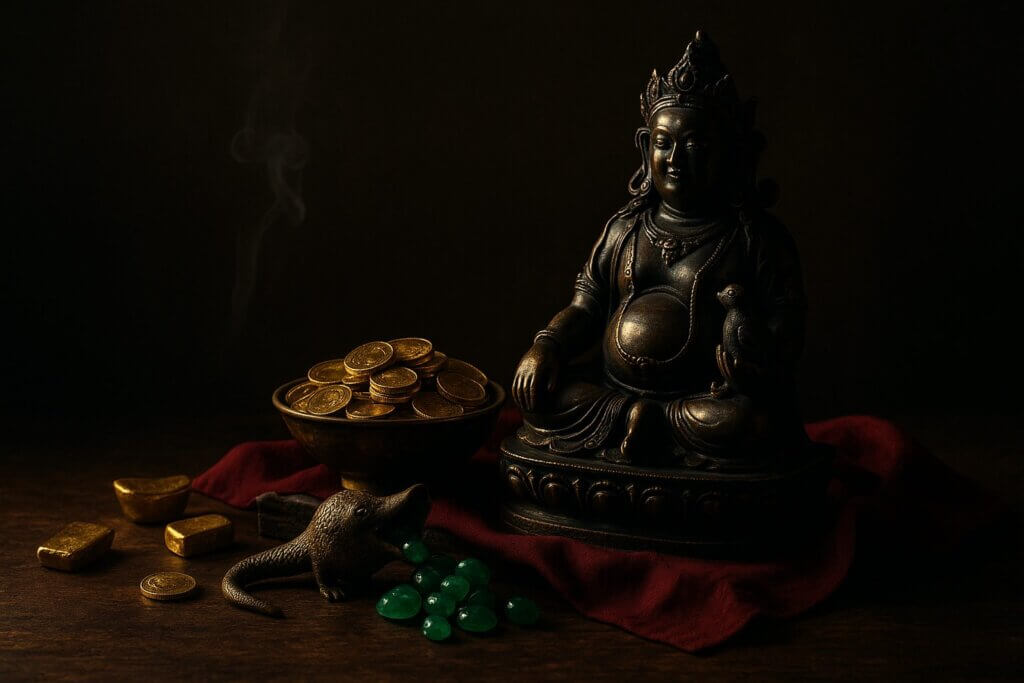
So “black” here doesn’t point at evil. It points at authority. The Black God of Wealth is traditionally depicted with a dark complexion, a stern expression, and a powerfully built frame — less the kindly gift-bearer than an auditor you’re not going to talk your way past. That image is itself an argument: wealth, in this tradition, comes with rules attached.
What He Governs Is Money Energy, Not Exactly Cash
The single most important word for understanding the Black God of Wealth is money energy. It resists direct translation. The closest English gets is something like “momentum that can turn into money” — opportunity, connections, reputation, being visible at the right moment, the push that carries a deal across the finish line. Money energy isn’t money. But money energy converts into money.
Within this framework, the cash in your hand is the result; money energy is the cause. You probably know someone who seems to have help wherever they turn, with opportunities showing up unasked. And you know the other kind, too — someone with nothing wrong on paper who keeps falling one step short. The traditional reading is that the first person’s money energy runs strong and the second person’s runs thin. What the Black God of Wealth is understood to govern is that upstream thing, not the bills downstream. The distinction matters, because it sets the logic behind every custom that follows: what people are after has never been money falling from the sky. It’s getting that current to swing their way.
From Man to God: The 3 Turning Points in Black Caishen’s Origin Story
Chinese folk religion has one feature that catches most American readers off guard: a lot of its gods started out as actual people. They weren’t born divine. They did something in life, left behind a certain kind of reputation, and got promoted onto the altar by generation after generation of people who kept telling the story. The origin of Black Caishen — a black-faced form of Caishen, the Chinese god of wealth — is exactly that kind of story, a mortal working his way up. There’s more than one version floating around, but nearly all of them turn on the same three moments, and those three moments add up to an instruction manual for a whole set of values.
Turning point one: in life, he got a raw deal
In the more widely told accounts, the figure behind Black Caishen was a man who managed money — military pay, grain stores, the treasury. The versions differ on the details but agree on the character: scrupulously honest, immune to favors, exacting about the books down to the last line item. And then, because he wouldn’t look the other way and wouldn’t take his cut, he was framed, pushed out, and came to a bad end.
That’s a counterintuitive way to open a story about wealth. You’d expect a god of money to come with a success story attached — some figure who got spectacularly rich and left behind a playbook. Instead the tradition hands you a man who lost out precisely because he played it straight. But here’s the thing: that’s the whole point. Folk belief chose to put someone who had been chewed up by the world of money in charge of the world’s money. The unspoken argument is that he knows what money does to people, and knowing it is exactly what makes him impossible to buy.
Turning point two: cleared after death, then appointed from above
The middle of the story is usually the vindication. The truth about his case comes out, people realize he had been innocent the whole time, and the anger on his behalf starts to build. Folk narrative has a standing logic for this: when justice doesn’t arrive in time down here, it gets settled on another level. So he’s handed a divine post. You kept the books clean when the books were human — now go keep the bigger ones.
Buried in that is a belief that runs deep in Chinese culture: a person’s character is an account. Short term, the ledger may not balance at all. Long term, it always gets reconciled. What he lost in life becomes the source of his authority afterward. Which is why the traditional attitude toward this god was never “he’ll play favorites and slip me something.” It was closer to “he knows better than anyone who has earned what.”
Turning point three: from auditor to giver
Once he becomes a god, the picture of Black Caishen softens. The stern investigator gradually turns into a figure who actively hands things out — but the condition attached to the handout never changes. Traditionally, the idea was that he grants money energy — the idea that wealth behaves like a current rather than a pile — not because you’ve been well behaved, and not because you make better offerings than the family down the street, but because he likes your odds. He figures the money will do more in your hands than it would sitting somewhere else.
This is the core idea in the whole tradition around Black Caishen, and the most recognizably modern one: giving you a share of wealth is an investment, and it’s an extension of trust. Investments get judged on results. Trust can be squandered. Framed that way, the whole belief stops sounding like a transaction with a deity and starts sounding like a description of a long-term working relationship — which is roughly how reputation and credit actually operate, deity or no deity.
What People Traditionally Do, and the Three Ideas Behind It
What follows is a description of custom, so read it as anthropology, not as a how-to. These are the things people have habitually done — and avoided doing — in front of this deity for several hundred years. The gestures themselves aren’t the interesting part. Here’s what is: every gesture comes attached to a reason you can state in plain English, and those reasons hold up even if you don’t believe a deity exists at all.
Circulation Comes First: What Comes In Has to Go Back Out
The idea that comes up most often around the Black Jambhala is that money energy has to keep moving. Traditionally, people believed that receiving wealth isn’t the end of the transaction — you have to send it onward for it to grow. That gets misread as some kind of rule about giving away ninety dollars out of every hundred you earn, but that isn’t the claim at all. What you share doesn’t have to be money.
Telling a friend something useful you know is sharing. Giving your time to volunteer work is sharing. Handing a good opportunity to the person better suited to it is sharing. The point is that the energy has somewhere to go, not that a particular dollar amount leaves your account. Traditionally, the most valuable thing you can pass along is said to be a way of thinking about wealth itself — teaching the people around you to handle money better, so their lives improve too. Because their improvement has your fingerprints on it, part of that good fortune is understood to circle back to you.
Set the deity aside and the underlying point is genuinely solid. Wealth in the real world runs heavily on network effects. People you’ve helped remember you. Knowledge you’ve given away builds your reputation for you. Opportunities you’ve passed along make you a node other people route through. Hoarding turns you into a dead end; circulating turns you into a hub. And a hub catches the next opportunity far more easily than a dead end ever will.
Credit Is the Real Currency: The Fear Isn’t Poverty, It’s Breaking Your Word
Among the traditional taboos attached to the Black Jambhala, the one that gets emphasized hardest isn’t whether your offerings were sincere enough. It’s whether your words and your actions line up. Do what you said you’d do. Pay back what you borrowed. Keep clean books. Don’t skim small advantages off other people. The folk formulation is blunt: this deity can tolerate almost anything except being deceived.
That fits his origin story exactly. Someone who died because he held to the rules is, once deified, going to care about rules more than anything else. So traditionally people say a promise made in front of him carries extra weight — and the point isn’t fear of punishment. It’s the reminder that how you treat your own spoken word is, functionally, your credit limit in the marketplace.
If anything, this holds up better now than it did then. Your income ceiling depends enormously on how many people are willing to trust you with nothing backing it up — willing to pay in advance, willing to hand you the project, willing to make the introduction. Credit is the foundational infrastructure of wealth, and the only way to build it is to spend a long time not cheating.
Being Rich Alone Doesn’t Impress Anyone: Lifting Others Does
There’s a third idea that comes up constantly and that outsiders tend to miss entirely: in this tradition, simply having money yourself isn’t considered impressive. The reasoning is stated very plainly — before these figures became deities, the people they dealt with were already wealthy. They’ve seen plenty of rich people. What earns a second look is someone whose wealth pulls the people around them up too.
Put it in investment terms: put a dollar into most people and you might get fifty cents back; put a dollar into someone like that and you get ten. So the traditional claim is that once a person’s money energy starts spilling over and lifting others, the deity doubles down. That isn’t a moral lecture. It’s a judgment about efficiency.
You don’t have to believe anything supernatural to see the structure here. Someone who benefits only themselves has influence that stops at their own edges. Someone who makes everyone around them better off gets bet on again and again by the entire system. People several hundred years ago described this in the language of deities. We describe it today with networks, leverage, and compounding. Same observation, different vocabulary.
5 Common Questions About the Black God of Wealth
You’ve probably got a feel for the shape of this tradition by now. Still, coming to it cold raises questions — some about vocabulary, some about how the whole idea is meant to be taken in the first place. Here are the five that come up most, answered in plain language, to tie the earlier pieces together.
Question 1: How is the Black God of Wealth different from the other wealth deities?
Temperament, mostly. Chinese folk religion has more than one wealth deity, and some are pictured as warm and approachable — a smiling old man, the sort of figure people imagine as a generous grandfather. The Black God of Wealth sits at the stern end of that spectrum. Think auditor. One who doesn’t do favors.
That difference shows up in what people expect from him. With the friendlier figures, the story tends to center on asking and being blessed. With the Black God of Wealth, it centers on whether you qualify. One is like receiving a gift; the other is more like passing an inspection. He’s also widely understood to have a protective side — not just bringing money in, but helping you hold on to what you already have and keeping it from leaking away for no good reason. For anyone running a business, that second part usually matters more than the first.
Question 2: Does “black” mean he’s connected to dirty money?
No. It’s the most common misreading, and it comes from colors carrying different associations in Chinese than they do in English. In Chinese symbolism, black connects to water, to depth, and to impartial justice — not to evil or illegality. Water as an image for wealth flowing and pooling is very old. And the strictness black stands for belongs to the same family as the folk image of the judge of the underworld, or of anyone who enforces the law without bending it.
His origin story makes the point on its own: the defining trait of this deity is that he can’t be bought. Someone who was destroyed for refusing to take part in corruption ends up placed in charge of wealth. The whole arc points toward incorruptibility, not toward shortcuts. Rather than saying black stands for the illicit, it’s closer to say it stands for the fact that there’s no room to negotiate here.
Question 3: Is any of this useful if you don’t believe in deities?
Yes — and probably more than you’d expect. You can read the entire body of wealth-deity belief as a psychology of money wrapped in story. The questions it works on are concrete ones: where money comes from, what kind of person manages to keep it, and why some people spend a lifetime chasing it and stay one step short.
Take the deity out and the frame underneath still holds up. Treat your credit and reputation as assets, keep money moving, expect generosity to pay back over a long horizon, and separate the outcome from the conditions that produce the outcome. All of that is testable against ordinary modern experience. The value of a cultural tradition often isn’t whether it’s literally true; it’s that it compresses centuries of observed patterns into a form that’s easy to remember and easy to pass along. You’re free to take just the pattern.
Question 4: Traditionally, did people believe that making offerings brings money?
It was never that simple, and the tradition itself keeps pushing back on that reading. The god of wealth is described as someone who evaluates, watches, and judges whether you’re worth investing in — and the whole point of setting him up that way is that making offerings or not isn’t the deciding factor. What kind of person you are is.
A closer reading is that these customs work as a scheduled reminder to check in on yourself. At certain points in the year, you stop and think about whether you’ve broken your word to anyone recently, whether you’ve paid back what you owed, whether you’ve been keeping every advantage for yourself. Taking that inventory changes how a person behaves, all on its own. Less “ask a god for money,” more “put a checkpoint on the calendar.” And judging by results, people who do that kind of accounting usually are in better financial shape.
Question 5: How does this view of wealth differ from the usual American one?
The differences are mostly about time and about the unit of measure. The mainstream American story about wealth leans individual and fast: find the opening, take the risk, scale quickly. The picture of success is usually one person breaking through a limit. The Chinese story leans relational and cumulative — your wealth is set by where you stand in a web of people, and that position is earned slowly, by not making mistakes over a long stretch.
The other clear difference is that it assumes a very long ledger. What you do today doesn’t necessarily settle today; it may come back to you ten years out. Same goes for the corner you cut today — it gets deducted somewhere you weren’t watching. A worldview built on a long ledger makes it harder to gamble away your reputation for a short-term gain. The two views don’t actually conflict. One is good at explaining how to sprint, the other is good at explaining how not to crash, and together they cover more ground than either does alone.
Looking back at all of it, the most interesting thing about the Black God of Wealth may not be whether he can hand anyone money. It’s what kind of character this tradition chose to represent wealth with: not a generous figure who grants every request, but an observer who reads the books carefully and remembers every entry. When a culture imagines its god of wealth that way, what it’s really saying is that money was never only money — it’s a long-running record of how you’ve treated people. Whether you believe in deities is one question; this angle on wealth is worth reaching for the next time you have a financial decision in front of you.