Meet the Five Paths gods of wealth: 3 things to know, starting from zero
If you’ve never run across the word “Caishen” before, here’s the place to start: Caishen is the Chinese god of wealth, a guardian of prosperity in Chinese tradition. But he’s a far more domestic figure than, say, a Norse god brooding in some distant hall. He doesn’t live in a faraway palace — he gets invited into the living room, or set up next to the register at the front of a shop. And the Five Paths gods of wealth (wu lu cai shen) are the most widely known grouping of them all. To understand them, you need three things: where gods of wealth sit in Chinese folk religion, what “five paths” actually refers to, and which type of wealth god this one is.
1. What a god of wealth is, within Chinese folk religion
Chinese folk religion works nothing like a monotheistic faith. There’s no single scripture, no unified church. It behaves more like a public database people have been adding to for two thousand years. The division of labor among the gods is startlingly fine-grained — there are gods for the imperial civil service exams, for childbirth, for medicine, for the kitchen stove, and, naturally, for money. That specialization wasn’t designed from the top down. It maps onto an ordinary person’s real list of worries. Whatever people feared most, a matching god eventually showed up.
A god of wealth is money anxiety made concrete. In a farming society with no social insurance, no bank credit, and one bad harvest standing between a family and ruin, wealth seemed to come and go on forces nobody controlled. People wanted something to aim their effort at beyond the effort itself. So Caishen isn’t purely a religious object of devotion. He works more like a cultural device: he turns abstract luck into something you can address directly.
2. Why “five paths”: wealth arriving from five directions
The “path” in “five paths” means direction — east, south, west, north, and center. It comes from the classical Chinese idea of five directions, a cousin of the five elements (metal, wood, water, fire, earth) inside the same cosmology. In that framework the world isn’t one undifferentiated blob. It has structure: every direction carries its own attribute, its own guardian, its own energy.
Which makes the meaning of the Five Paths gods of wealth refreshingly plain: whichever direction your money comes from, someone’s watching over it. Traditionally, merchants loved this idea most, and no wonder — a merchant’s money genuinely does arrive from every side. Goods from the south, customers from the north, a business partner out west. Appealing to all five paths amounts to hoping every possible revenue stream stays open, with no single one blocked. That instinct — don’t stake everything on one source — is the same thing we now call diversifying risk. It’s just wearing the language of myth.
3. Civil versus martial: which kind is this one
Chinese tradition has more than one god of wealth, and they sort roughly into two camps. The civil god of wealth is usually a historical figure remembered for integrity, intelligence, or commercial skill. The imagery is scholarly, and the point is wealth built through talent and character. The martial god of wealth shows up as an armored general with a weapon in hand, and the emphasis shifts to protection — not just helping you earn it, but helping you keep it, so nobody cheats you out of it or takes it by force.
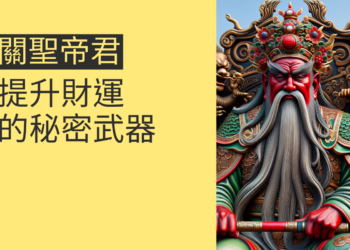
Zhao Gongming, the central figure among the Five Paths gods of wealth, is the definitive martial god of wealth. He’s typically shown with a black face and a thick beard, an iron whip in his hand, standing on a black tiger. He looks nothing like a financial advisor and everything like a bodyguard. That visual choice is itself an argument: in the traditional imagination, wealth isn’t something that quietly grows while it sits there. It has to be actively pursued, and it has to be fiercely defended.
From Ascetic to God of Wealth: The 3 Stories Behind the Five Paths Gods of Wealth
The Five Paths gods of wealth (wu lu cai shen) didn’t arrive fully formed one afternoon. This figure got built over centuries, layer by layer, out of Daoist scripture, popular fiction, and stories people passed around by word of mouth. Think of a beloved comic-book character who gets rebooted every generation — each era hands him whatever it happens to need. The three stages below are, more or less, the character-design history of this deity.
1. Zhao Gongming: From Plague Spirit to Guardian Lord
When Zhao Gongming first turns up in the written record, he isn’t a friendly presence at all. He’s counted among the deities who govern plague — the kind of visitor you’d rather have walk on past your door. That arc isn’t unusual in folk religion. Plenty of deities who ended up kindly started out as terrifying forces, because fear is the first thing people have to deal with.
As Daoism organized itself and absorbed these local figures, Zhao Gongming’s standing got revised upward. He became a guardian of the Daoist altar and picked up titles like Xuantan Zhenjun (Perfected Lord of the Dark Altar). He went from something you had to appease to someone you could actually entrust with things. That’s a bigger step than it sounds — if he’d stayed a plague spirit, the later identity as a god of wealth would never have gotten off the ground.
2. How the Novel Investiture of the Gods Wrote Him Into the Role
What really pushed Zhao Gongming into the popular imagination was the Ming-dynasty supernatural novel Investiture of the Gods (Fengshen Yanyi). In the story he’s an ascetic with formidable magical skill, and in the climactic scene where the gods receive their appointments, he’s granted the office of Golden Dragon Ruyi Zhengyi Longhu Xuantan Zhenjun, put in command of four subordinates, and given authority over trade and commerce in the human world. The novel’s reach was enormous. It worked like a blockbuster movie, settling in one stroke what this deity looked like and what he was in charge of for the next several hundred years.
Here’s the detail worth sitting with. In the novel’s own framing, the god of wealth’s portfolio reads: to welcome good fortune, to pursue fugitives and recover what is lost, and to handle merchants, trade, and the seeking of profit. In other words, what he governs is the order of transactions — not conjuring money out of thin air. Wealth is imagined as something already in circulation, something that needs a keeper of the rules. That idea went on to shape the entire body of custom that grew up around him.
3. How Four Subordinates Add Up to “Five Paths”
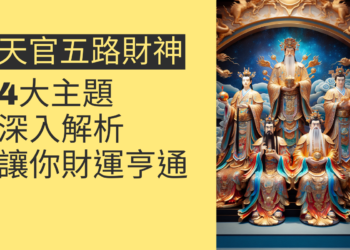
Zhao Gongming’s four subordinates have names that are almost endearingly plain: Summoning Treasure (Zhaobao), Receiving Valuables (Nazhen), Attracting Wealth (Zhaocai), and Turning a Profit (Lishi). Each is matched to one of the four directions, and with Zhao Gongming at the center, all five positions are filled — which is exactly how the grouping known as the Five Paths gods of wealth took its final shape. That last name, Lishi, refers to business profit and to an auspicious start, and to this day Chinese shopkeepers opening up for the day will still talk about “asking for a lishi,” a good-luck opening for the register.
Pairing one principal deity with four subordinates who each have a clearly defined job is a common structure in folk religion, and it reflects how people picture organizations working. Money is too complicated for one figure to handle alone; you need a team. You can also read it as a plain-spoken piece of business instinct. A complete stream of income takes several different functions working together — pulling in new customers, holding on to inventory, closing the deal on price, and turning all of that into profit. Pull out any one of them and the whole thing stops running.
Traditional Customs and the 3 Money Ideas Behind Them
This next part is about how people have traditionally treated the Five Paths gods of wealth (wu lu cai shen), and what sits underneath those practices. The point isn’t for you to copy any of it — these are living practices inside someone else’s culture, not a to-do list. What’s interesting is what’s left once you strip away the religious packaging: a few judgments about money that still hold up.
1. Welcoming the god of wealth on the fifth day of the first lunar month: a ritual about timing
The busiest moment for welcoming the god of wealth in the Chinese lunar new year lands on the fifth day of the first month. Traditionally the day is called “breaking the five.” The new year period comes with a long list of prohibitions — no sweeping the floor, no taking out the trash, no needlework — and on the fifth day all of it lifts at once and businesses reopen. Some people have everything ready before dawn, the idea being to get there ahead of everyone else.
Take the mythology out and the custom is doing something pretty practical: it sets a clear, ceremonial starting line for going back to work. You don’t drift back into working mode. At a moment everyone around you agrees on, you press start, deliberately. Annual goal-setting and the Q1 kickoff meeting are the same category of thing, functionally speaking. People need rituals to mark a turn, or time smears into one undifferentiated stretch.
2. Offerings and sincerity: why the form isn’t really the point
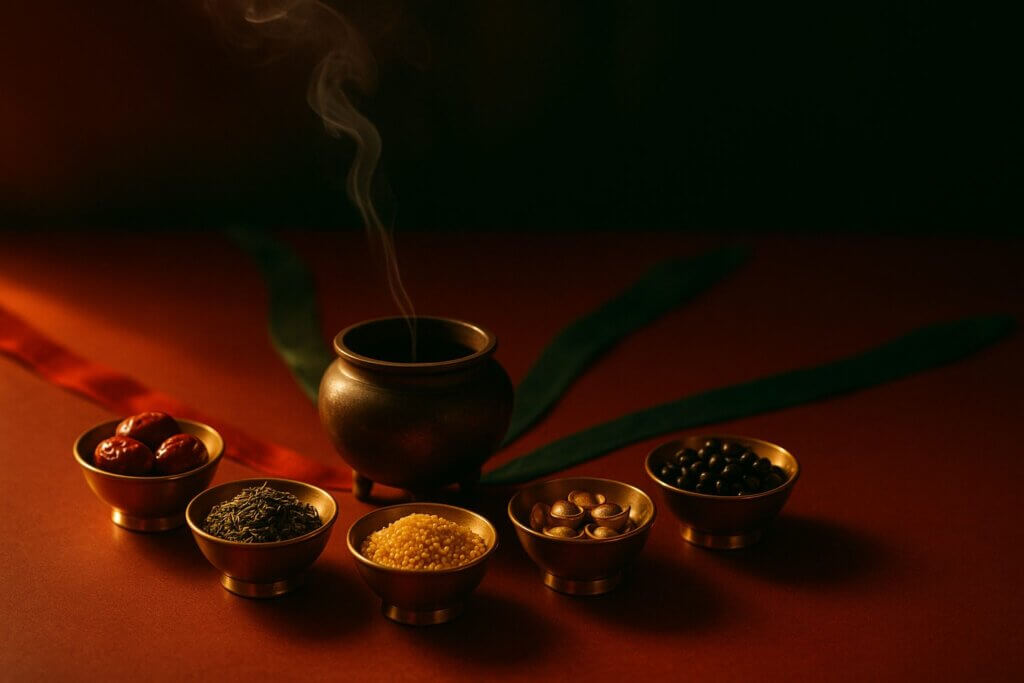
Traditionally, the offerings people prepare are mostly foods chosen for what they suggest: sweet things for sweetness, fruit still on the stem for a harvest that came in heavy, and steamed sponge cake (fa gao), whose name carries the word for “prosper.” Some families go all out. Others pour a single cup of plain tea and start talking. Ask someone from an older generation about it and the answer comes back with surprising consistency — a sincere heart is enough.
That sounds like reassurance for people who aren’t devout enough, but it actually gives away the core of the whole thing: the ritual’s real audience is you. Preparing the offerings is time spent sorting out your own thoughts, and saying the wish out loud turns vague anxiety into a specific sentence. “I want the shop to stay steady this year” and “I’ve been so stressed lately” are two entirely different mental states, and only the first one has a shot at turning into action. Traditionally, too, almost nobody asks and then walks away — nearly every version of the custom assumes you go home and work harder, and that the gods help the people who are willing to move.
3. Money energy wants to move: sharing, credit, and compounding over the long run
Of everything in the culture around the Five Paths gods of wealth, this is the part most worth carrying across cultures. There’s a Chinese folk idea worth knowing here — not as a financial rule, but as a cultural lens on wealth: money energy — the idea that wealth behaves like a current rather than a pile — is something Caishen extends to you as a mark of trust, and what he expects back is that you use it well and let it flow out again. The point was never what percentage you give away. Nobody’s asking you to earn a hundred dollars and donate ninety. It’s whether the thing is in motion at all. Passing along useful knowledge, an opening, an introduction: that’s flow. Giving your time to volunteer work: also flow.
There’s a fairly shrewd judgment sitting behind that idea. Being rich by yourself isn’t especially impressive; the person worth backing for the long haul is the one who makes the people around them better off too. The first kind of wealth stops at a single point. The second creates an entire loop, and some portion of what goes around that loop eventually comes back to you. That’s also why credit and reputation get treated as wealth in their own right — your word has to be good, and if you took the money, you deliver the goods. In a merchant society with no courts to fall back on, reputation is the only thing that makes a transaction happen twice, and transactions that happen over and over are where wealth actually comes from.
So even if you have no intention of making offerings to anyone, this way of seeing things hands you a good question to sit with: is my money, my knowledge, my time sitting still, or is it moving? Is my prosperity happening only to me, or is anyone else better off for it? The stories about the Five Paths gods of wealth have been around for centuries, and what’s left at the bottom isn’t miracles — it’s a conclusion a lot of merchants arrived at over a very long run of experience: wealth likes places where things move, and it likes people who keep their word. Whether you believe that conclusion doesn’t much matter. It tends to prove itself.
5 Common Questions About the Five Paths Gods of Wealth
Here’s the thing about running into an unfamiliar culture: the big concept is rarely what trips you up. It’s the small “wait, so does that mean…” questions. These five come up the most — how these deities relate to the other gods of wealth, where the date comes from, and the one American readers tend to ask flat out: how is any of this different from the mindset behind buying a lottery ticket?
Q1: Are the Five Paths gods of wealth the same as “Caishen” in general?
Not quite. Caishen is a category, not a single figure — several gods of wealth with different origins live under that heading, much the way “saint” in Catholicism names a category rather than one particular person. The Five Paths gods of wealth (wu lu cai shen) refers specifically to a set of five: Zhao Gongming at the head, plus four wealth-attracting subordinates assigned to the east, south, west, and north. Alongside them sits the civil god of wealth tradition, usually built around historical figures known for incorruptibility or business sense. Some regions also fold in figures like Tudigong, the local earth god, or Guan Yu when the subject is money. As for which one is more “effective” — folk religion has no standard answer, and the choice usually tracks regional tradition, family habit, and line of work. Merchants tend to favor the martial god of wealth; scholars tend to favor the civil god of wealth. That split says a lot on its own: what people are really picking is the kind of prosperity they identify with.
Q2: Why the fifth day of the first lunar month, specifically?
It comes down to the rhythm of the lunar new year. From New Year’s Eve through the fourth day, tradition packs the household with taboos, and a lot of ordinary activity simply stops. On the fifth day the taboos lift — the day is called “breaking the five” (po wu) — and it’s traditionally when businesses reopen their doors. Putting the welcoming of the god of wealth on that day ties the asking and the getting-back-to-work into one moment. You’re not petitioning for good luck and then wandering off to figure out what comes next; you finish and roll up your sleeves right away. Some people deliberately get up before dawn, and the folk explanation is that you want to beat everyone else to it. That competitive streak is a pretty honest reflection of how commercial life actually feels: opportunity is finite, and whoever moves first gets there first.
Q3: I’m not Chinese and I don’t believe any of this. What’s in it for me?
Read it as anthropology. Every culture builds its own way of talking about money, and the way a culture talks about money reveals what it actually believes. In the stories around the Five Paths gods of wealth, wealth is described as something that moves rather than something you pile up; success is defined as the ability to bring other people up with you, not just to post good numbers of your own; and the foundation of a deal rests on credit and reputation rather than on the contract. You don’t need any religious framework to take those judgments and hold them up against your own money habits. That’s why the reasoning behind each custom is spelled out here — so someone who believes none of it still walks away with something.
Q4: Isn’t making offerings to a god of wealth just hoping for something for nothing?
It’s an easy misreading, but the logic inside the tradition runs the other way. Nearly every version assumes the same premise: the help goes to people who are already in motion. Notice that the day for welcoming the god of wealth is the day work resumes, not a day off. Notice, too, that folk attitudes toward windfalls are actually pretty wary — older generations tend to say that what comes fast leaves fast. More to the point is the idea covered earlier: money energy is entrusted to you, and it keeps growing only if you let it circulate and give some of it back. That’s conditional trust, not a winning ticket. If you want an analogy, it’s closer to praying for things to go smoothly than to praying to hit the jackpot.
Q5: How is this different from a lucky cat or a four-leaf clover?
The difference is whether there’s an account of why. A lucky charm is usually just a symbol — you don’t have to understand it, you only have to carry it. The Five Paths gods of wealth come with a full narrative: origins, personalities, and defined jurisdictions, plus a whole explanation of how wealth is supposed to work — money should move, credit should be kept, and people who help others deserve to be topped back up. That makes it less a device for requesting good luck and more a set of values wrapped in a story, handed down through the same festival actions repeated year after year. It’s also why the tradition is still alive in a heavily urbanized present: people may no longer literally believe in the black tiger and the iron whip, but the instincts about how money ought to be regarded have stuck around.