Meet the Martial God of Wealth: The “Gatekeeper of Money” in Chinese Folk Religion, and 3 Things to Know First
Walk through any American Chinatown, duck into a restaurant or grocery store, and there’s a good chance you’ve spotted a fierce-looking statue posted up behind the register — thick black beard, dark face, a steel whip in one hand, often a tiger under his feet. That’s not a door god. It isn’t Guan Yu either, though the two get mixed up constantly. Odds are you’re looking at the martial god of wealth, one face of Caishen, the Chinese god of wealth. Before you file him away as “the Chinese money god,” here are three basic ideas that’ll help you see him for what he actually is.
He isn’t the only god of wealth — he’s the warrior in a whole family of them
Chinese folk religion has something in common with Greek or Norse mythology: the gods come in groups, with the job divided up, instead of one figure holding all the cards. Wealth works the same way. The role gets split among several deities, and the split you’ll hear about most often is between the civil god of wealth and the martial god of wealth.
The civil god of wealth is usually dressed as a court official, holding a ruyi scepter (ru yi) or a gold ingot, mild and unhurried in his bearing. He stands for steady paychecks, business income, wealth built by playing inside the rules. The martial god of wealth comes out of the warrior tradition instead — armor on, weapon in hand — and he stands for the kind of wealth you have to fight for, take risks for, and then hang onto. Traditionally, merchants, salespeople, shop owners, and anyone competing hand-to-hand in the marketplace were seen as a natural match for the martial god of wealth, while salaried folks on a white-collar track leaned toward the civil one.
The classification itself is worth sitting with for a second. It reflects a real observation: there’s more than one way to make money, and different ways of making it call for different traits in the person doing it. Assigning a deity to each economic role was folk culture’s way of turning an abstract work ethic into something you could actually point at.
Why does a god of wealth carry a weapon? Keeping money matters as much as making it
People seeing a statue of the martial god of wealth for the first time are usually a little thrown. Why does a god of wealth look ready to take somebody’s head off, and why is he armed? In the West, the symbols of wealth run soft and abundant — cornucopias, gold coins, sheaves of grain.
The Chinese folk imagination of wealth, though, has included defense from the very beginning. Earning money doesn’t mean keeping it. In traditional society, traveling merchants had to watch out for bandits, shopkeepers for customers who never paid their tabs, families for spendthrift relatives and lawsuits. The steel whip in his hand and the black tiger under his feet aren’t about attacking anyone — they’re about standing guard. Guarding the wealth that already made it through the door, and guarding against everything that quietly drains it away.
So in the folk understanding, the martial god of wealth is working two jobs. One is drawing wealth in, keeping the income flowing. The other is holding wealth, so what comes in doesn’t leak right back out. In traditional thinking the two are inseparable: if you can earn but can’t hold, older generations wouldn’t have called that managing money at all.
The statue works as a reminder, not just an object of devotion
If you’ve never made offerings to a deity, the part that’s hardest to wrap your head around may be why you’d put a statue there in the first place. Here’s the thing — there’s a psychological mechanism at work that’s a whole lot more universal than religion: visible objects change where your attention goes.
Traditionally, a statue of the martial god of wealth was placed somewhere visible in the shop, usually along the path you walk coming in the door. It’s there every day, so every day it nudges the owner on a few questions — whether today’s business was done honestly, whether customers got a fair shake, whether the rules worth keeping got kept. Believers would say the god is watching. Someone who doesn’t believe can just as easily call it a device for making values visible, functionally no different from a company’s principles framed on an office wall or an athlete’s slogan taped inside a locker.
Once you see it at that level, the whole tradition stops feeling so mystical. The statue is just the entry point; what actually gets handed down is a full set of ideas about how to earn money and how to treat people.
From Mortal to Wealth God: The Two Main Origin Stories Behind the Martial God of Wealth, and Why His Face Is Black
Here’s the thing about deities in Chinese folk religion: a lot of them weren’t born divine. They were people who lived in a way later generations refused to forget, and over time, one generation of offerings after another, they got promoted. The martial god of wealth came up the same way. His backstory shifts depending on which region and which dynasty is telling it, but two versions have traveled further than the rest. The point of these stories isn’t to settle which one is historically true. It’s that people got to choose who would represent wealth — and the choice they made says a lot about what kind of rich person they thought was worth admiring.
Version One: Zhao Gongming, Rider of the Black Tiger
The most common identification of the martial god of wealth is Zhao Gongming. In legend he started out as a recluse cultivating the Dao in the mountains. Later, in the mythological novel Investiture of the Gods, he got written up as a commander leading troops into battle — riding a black tiger, carrying an iron whip. In that story he’s eventually defeated and killed, but after death he’s appointed to divine office, presiding over a team of subordinates responsible for attracting wealth, bringing in treasure, gathering valuables, and securing profit in trade. In other words, he’s management. He runs the wealth department, and different revenue streams report to different people under him.
What’s interesting is that making people rich was never his only job. In the traditional accounts, he also presides over fairness: if a deal goes bad, if someone gets cheated, if a debtor walks away from what he owes, the wronged party can appeal to Zhao Gongming for a just outcome. That detail matters enormously. It amounts to saying that the god of wealth is also the god of honest dealing — you can’t defraud someone with one hand and ask him to make you rich with the other, because within the portfolio of a single deity those two requests cancel each other out.
So why the black face? The folk explanation is blunt: black stands for uprightness, for a figure who doesn’t soften his words and can’t be talked around. A god who’s easy to persuade can be moved by anybody. A god who’s hard to persuade is the one who can actually hold the room. In Chinese opera, black has always been the color of the incorruptible official, the one no bribe reaches. Putting that face on the god of wealth is a way of signaling that flattery doesn’t work on him.
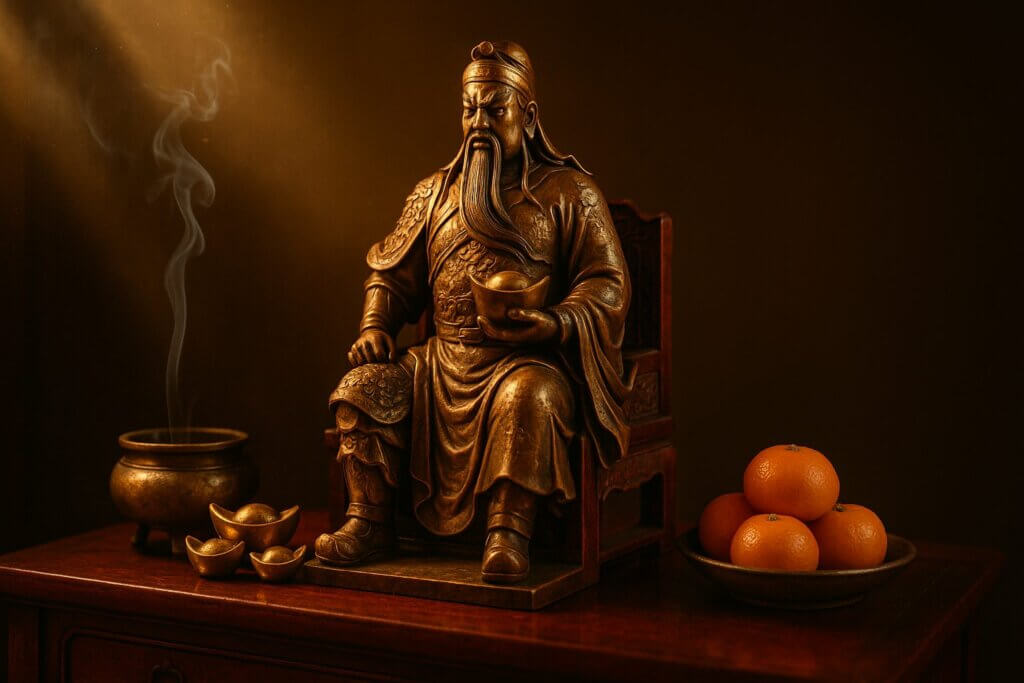
Version Two: Guan Yu, From Loyal General to Patron of Merchants
The other figure widely treated as the martial god of wealth is Guan Yu, the Three Kingdoms general. His path to godhood is easier to trace. He was a real historical person, known for loyalty and for keeping faith with his sworn brothers. His reputation kept growing after his death, successive imperial courts kept stacking titles onto his name, and he ended up as one of the most widely honored deities in all of Chinese folk religion.
Which raises an obvious question: how does a general famous for warfare and loyalty become the god merchants make offerings to? The standard explanation is credit. What a business fears most is a counterparty whose word means nothing, and the entire core of Guan Yu’s reputation is that what he said he would do, he did. Legend also credits him with a head for accounts and even with inventing a bookkeeping method — most of which was almost certainly pinned on him by later generations. But the real reason merchants picked him was that personality: a promise from him was as good as gold.
You can translate this into modern terms easily enough. In an era before courts, enforceable contracts, and credit scores, a commercial society needed a shared moral guarantor. Everyone making offerings to the same deity — one famous specifically for keeping his word — was a way of saying “we all play by the same rules here.” As social engineering goes, that’s remarkably practical.
What Both Stories Share: Neither God Got the Job for Being Rich
Put the two lineages side by side and something worth sitting with shows up. Neither Zhao Gongming nor Guan Yu was elevated to god of wealth because he was good at making money. One is known for fairness, the other for keeping his word.
That’s a real departure from how many cultures picture wealth. People didn’t hand the role to the richest figure in their history; they handed it to the ones whose character they trusted. The value judgment buried in that choice is this: what makes wealth legitimate is how you came by it, not how much of it you came by. A statue of the martial god of wealth sitting in a shop is, in its own way, the owner announcing to everyone who walks in which set of rules he considers himself bound by.
How People Have Traditionally Treated the Martial God of Wealth: 3 Customs and the Thinking Behind Them
Here’s where the framing matters. What follows is a report on what people have traditionally done and why — not a suggestion that you go do it. If none of it lands as belief for you, that’s no big deal. The valuable part was never the ritual; it’s what the ritual is teaching. This culture took a set of genuinely sophisticated ideas about money and wrapped them in a set of very concrete actions.
Custom One: Daily Incense and a Greeting — Putting Your Attention Back on “How Am I Earning Today?”
Traditionally, people who keep a statue of the martial god of wealth at home or in a shop light incense at a set time each day. Some say a few words silently while they do it: a report on how things are going, thanks for a stretch that went smoothly, or an admission of whatever is currently weighing on them.
Culturally, the habit works a lot like a daily recalibration. It makes you stop for three minutes before the day gets loud and think about how you actually make your living. It puts you in front of the questions you tend to skip: Did that invoice ever get paid? Why did that customer stop coming in? Did I make money this month, or does the revenue just look good?
Some people describe this as communicating with a deity. Strip the deity out, though, and the structure still holds — a fixed time, a fixed place, a symbol to face, and a few minutes spent sorting out your relationship with money. The modern weekly financial review, or sitting down with your books to see what really happened, does almost exactly the same job. It just doesn’t come with the stick of incense.
Custom Two: “Zuo Ya” on the 2nd and 16th — Redistributing What You’ve Earned
Chinese businesses have long observed a custom on the 2nd and 16th of each lunar month: offerings get prepared and set out, a practice called zuo ya (literally “making teeth,” a twice-monthly offering day for merchants). Afterward the food is usually shared out among the shop staff and the family, who eat it together. In earlier eras this was often one of the few days in a month when a shop hand got a good meal. The year-end version, wei ya, is the big one — a banquet closing out the year, and the day bonuses get handed out and employees get rewarded.
The logic underneath runs deeper than the party suggests. It ties making offerings and distributing money into a single event — the same occasion on which you ask for wealth is the occasion on which you hand wealth to the people working alongside you. Asking and giving back aren’t two separate acts. They’re two sides of one motion.
In the traditional telling, this connects to a core idea: money energy — the idea that wealth behaves like a current rather than a pile — has to keep moving. A deity’s willingness to send money energy your way is understood as an act of trust: he’s investing in you, expecting you to use the resource well and keep it flowing outward. Wealth that only comes in and never goes out amounts, in this framework, to damming a stream — give it enough time and the water goes stagnant, then dries up. So zuo ya isn’t only about making offerings. It’s closer to opening the floodgates on a regular schedule.
Custom Three: Sharing Counts for More Than Getting Rich Alone — the “Bring People Up With You” Logic
There’s a layer of folk thinking about Caishen that gets misread all the time. People assume “giving back” means donating money, and a lot of it — earn a hundred dollars, give ninety away. That isn’t what the tradition actually says.
What gets emphasized isn’t the amount. It’s whether the energy keeps circulating. And sharing takes many forms:
- Passing on what you’ve learned about handling money well to the people around you
- Giving your time to something that genuinely helps someone else
- Handing someone just starting out an opening, a lead, or an honest word
All of it counts. And the form traditionally considered most valuable is passing the good ideas you’ve worked out yourself along to family and friends, so their lives get easier too. The reasoning here is thoroughly practical: because they got on their feet through you, part of that loop comes back around to you. Your network deepens. Your reputation improves. More of the people near you end up in a position to do something for you in return.
Put more bluntly: in this framework, one person getting rich on their own isn’t especially impressive. Before becoming a deity, a god of wealth already spent his life among capable people — he isn’t short on people who know how to make money. What gets valued, what’s considered worth doubling down on, is the person who brings everyone around them up too. Put a dollar into most people and you might get fifty cents back; put a dollar into someone like that and you get ten. That’s how money energy is said to snowball.
5 Common Questions About the Martial God of Wealth
When people new to this tradition start asking about Caishen, the questions almost never start with “how do you make offerings?” They start somewhere more basic. Is this superstition? What does any of it mean if you don’t believe? And does a centuries-old idea about wealth have anything useful to say about money now? Here’s a run at five of those questions, answered without assuming you hold any particular belief. The goal is to make the cultural logic make sense, not to sell you on it.
Question 1: What actually separates the martial god of wealth from the civil god of wealth?
The clearest difference is in the imagery, and in the kind of wealth each one stands for. The civil god of wealth is depicted as a court official in formal robes, holding a ruyi scepter, a gold ingot, or an account ledger. He represents money that arrives on schedule — steady, predictable, stacked up step by step. Paychecks, land, a family business built over decades. The martial god of wealth is depicted as a general in armor with a weapon in hand, and he stands for money that has to be fought for: wealth that carries risk, that you have to go out and win, and that you then have to defend on your own.
Traditionally, people chose based on how they earned a living. Shopkeepers, traders, salespeople, anyone competing head-to-head in a market tended toward the martial god of wealth. People on a fixed salary, in clerical or academic work, leaned toward the civil one. You’ll also find households that keep both, for the simple reason that most families have more than one source of income.
What makes this split interesting is the assumption underneath it: wealth is not one substance. Steady money and hard-won money demand different temperaments, carry different pressures, and expose you to entirely different risks. Assigning them to two separate deities is a way of saying: figure out which kind of money you’re actually making before you start deciding how to manage it.
Question 2: Isn’t a statue of the martial god of wealth just a statue? Why does tradition treat it as such a big deal?
Treated as decor, sure — it’s a statue. But within folk religion it’s understood as something you invite in. Not an object you buy and set down, but a presence that’s welcomed, given a place, and dealt with as part of daily life. The distinction is a little like the one you already make about an old family photograph. Physically it’s a piece of paper, but what it carries is the reason you don’t shove it in a drawer without thinking.
The more practical function is that it gives a set of abstract values a fixed address. Fair dealing, keeping your word, letting money move — ideas like these are easy to drop the moment life gets busy, if they live only in your head. Put a figure somewhere you walk past every day, and you get reminded every day.
Even if you believe none of it, the phenomenon is worth noticing: people seem to need physical objects to hold abstract commitments in place. Wedding rings, trophies, monuments, the mission statement painted on an office wall — all of them run on the same mechanism.
Question 3: Is the underlying claim here that making offerings makes you rich?
Judged by the tradition’s own stories, the answer is no, and pretty emphatically so. As noted earlier, none of the figures elevated to god of wealth — Zhao Gongming for fairness, Guan Yu for keeping his word — got there by being good at making money. The job description includes settling commercial disputes and punishing deception, which means that within this system you can’t cheat your customers and make offerings your way to a fortune. That’s like asking a judge to throw out your case and perjure himself for you on the same afternoon.
The traditional framing is closer to trust and investment. Money energy is directed your way because you’re judged likely to use it well. Use it well and keep it moving outward, and more follows. Use it badly, or let it flow in and never out, and the arrangement ends there. It reads as a conditional partnership, not a coin-operated wishing machine.
In practice, of course, plenty of people approach it in exactly the “make an offering, hit the jackpot” spirit. Every faith produces that simplified version of itself. It just isn’t what this particular tradition set out to say.
Question 4: I’m not religious. Is there anything in this for me?
Set the deities aside and the tradition still leaves you with at least three ideas that stand on their own.
First, money is supposed to move. Hoarding isn’t the same thing as safety. A sum of money that enters no cycle at all — not invested, not spent on learning, not spent on relationships, not spent on making yourself more capable — is quietly losing real value the whole time it sits there. That intuition predates modern finance by centuries, and it points in the same direction.
Second, credibility is an asset. The entire Guan Yu tradition rests on treating “he does what he says he’ll do” as a form of wealth you can accumulate. Over the course of a career, whether people are willing to work with you a second time usually matters far more than the price you negotiated the first time.
Third, lifting the people around you pays you back. That isn’t a moral lecture, it’s an observation about networks: the more capable people there are in your orbit, the more opportunities reach you. The tradition puts it as the god of wealth deciding to increase his investment in you. In modern language, it’s compounding, applied to relationships.
Question 5: Why does the tradition insist that money can’t only flow in? Doesn’t that contradict saving?
It doesn’t, because the two are talking about different things. What the traditional idea of circulation objects to isn’t saving — it’s closure. Treating your wealth as a pool that’s allowed to rise and never allowed to leave you.
The zuo ya custom (a ritual meal shared with staff on set days of the lunar month) shows what’s really meant. On the same day merchants asked for prosperity, they fed their workers and handed out bonuses. That isn’t spending money; it’s putting wealth back into the system that produced the wealth in the first place — the people. Workers who are fed well and treated with respect are the ones who stay another year. In current terms, it’s reinvestment in labor and relationships.
So “flow” is much closer to circulation than to consumption. Saving matters, obviously; it’s part of holding onto what you have, and the steel whip in the martial god of wealth’s hand means exactly that. But a person who only guards and never releases, only collects and never gives, is understood in this tradition to have dammed the channel. Wealth here was never a still pond. It’s a river, and a river stays clean because it keeps going.
Look back at that dark-faced figure with the whip standing behind the register, and you can probably see why it’s there. It isn’t necessarily promising anyone a fortune. It’s planting a judgment several centuries in the making: wealth should come to you honestly, be held securely, and be kept in motion. It’s an old idea about money. You can decline to believe in the god behind it and still find that the judgment holds up.