Who Are the Five Paths Gods of Wealth? Start With 3 Basic Ideas
If Caishen, the Chinese god of wealth, is brand new to you, here’s the easiest way in: think of him less as one guy and more as part of an entire crew of deities in Chinese folk religion whose assigned beat is money. This isn’t a single supreme figure the way Western mythology usually runs. It’s a system — with directions, assigned duties, and distinct personalities. This section covers three things: who the Five Paths gods of wealth are, what “five paths” actually refers to, and what “five paths gold” — a phrase you’ll run into constantly — really is.
1. Caishen Isn’t One God. He’s a Whole Department.
In Chinese folk religion, the heavens are organized something like a sprawling civil service. One deity handles land, another handles the imperial exams, another keeps the register of the living and the dead — and wealth is Caishen’s portfolio. The interesting part is that “Caishen” was never one person. The tradition recognizes a martial god of wealth, a civil god of wealth, and gods of windfall money, each matched to a different way of earning. A shopkeeper, a salaried official, and someone making speculative trades were not, traditionally, making offerings to the same figure.
That division of labor reflects a very practical view of the world: money doesn’t come from one place. Income earned through skill, income earned through relationships, and income that arrives on luck were treated as different in kind, so it followed that different deities would oversee them. It’s the same instinct behind the modern habit of separating active income, passive income, and speculative gains — just described in a different vocabulary.
2. “Five Paths” Means East, South, West, North, and Center
The “five paths” in Five Paths gods of wealth (wu lu cai shen) is about space. The traditional idea is that wealth arrives from every direction, so alongside the central figure, each of the four compass directions has its own deity presiding over money coming from that quarter — five in total. One common naming has them as Attracting Wealth in the east, Bringing Treasure in the south, Gathering Riches in the west, Turning Profit in the north, and the Dark Altar at the center. The names themselves read like a catalog of everything abundance was imagined to look like.
Mapping wealth onto the compass tells you something about the societies that did it — farming and trading societies, where goods moved by road and by water and business ran north or south. Which direction money came through your door was a concrete question, not a poetic one. So “five paths” lands closer to “every possible route.” Don’t camp on one road waiting for money to show up. That’s the oldest hint buried in the name.
3. Five Paths Gold: Paper That Stands for an Exchange
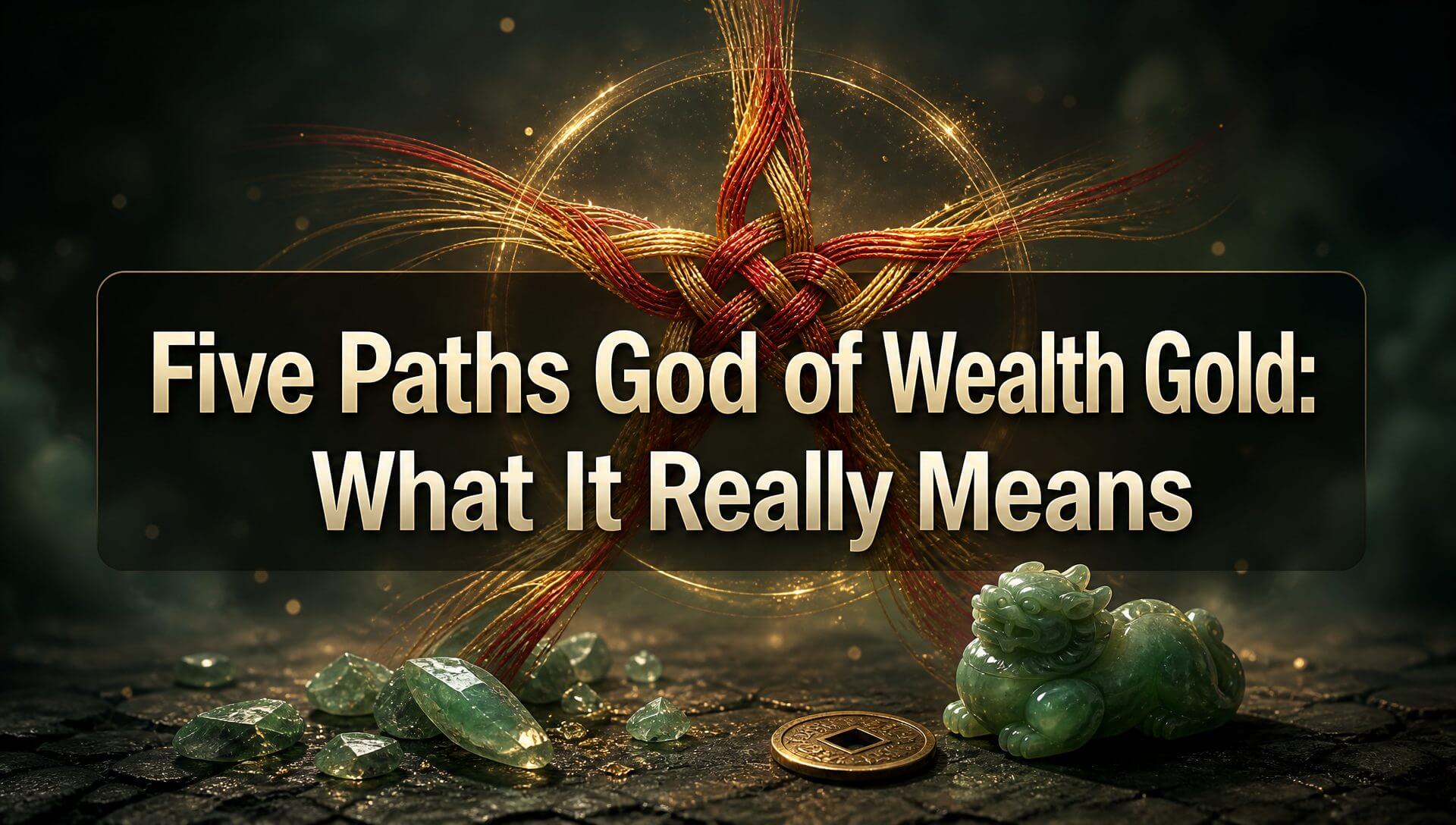
Five paths gold (wu lu cai shen jin) is a joss paper printed with images of the gods of wealth — one branch of the broader tradition of spirit money in Chinese ritual culture. Traditionally, families making offerings to the Five Paths gods of wealth set out this joss paper and burn it once the ceremony is finished, sending intention and resources across to the world the deities occupy. If you’re coming to this cold, with no background in the culture, the easiest mistake is to read it as cash meant to buy a god’s cooperation.
In the folk understanding, though, five paths gold works more like a reply letter. You received care first; now you answer it in a form that can be seen, so the relationship runs in both directions instead of being one long request. Notice what that rules out right from the start: taking without giving. That principle runs underneath every custom that follows.
From People to Gods: Two Story Lines Behind the Five Paths Gods of Wealth
Chinese deities share a quirk that’s easy to miss: a huge number of them started out as actual people, or at least as people who were believed to have lived. The gods of wealth are no exception. Their legends braid together historical figures, Daoist scripture, and plain street gossip, which is why the versions multiply and contradict each other so often. This section follows the two main story lines. What you’re watching, over a few centuries, is a culture slowly converting “a character worth admiring” into “a divinity who governs money.”
1. Zhao Gongming: From Mountain Ascetic to the Martial God of Wealth Who Guards the Wealth Reservoir
The figure at the center of the Five Paths gods of wealth (wu lu cai shen) is generally identified as Zhao Gongming. In the earliest sources, his image isn’t especially appealing — he reads closer to a deity presiding over plague and the underworld, with a distinctly fearsome darkness about him. Later, propelled by the novel Investiture of the Gods, he was rewritten as a Daoist warrior-god riding a black tiger and carrying an iron whip, and after falling in battle he was invested with authority over summoning good fortune and chasing down runaway debts. Only then did his image swing toward wealth.
That turn from plague god to god of wealth is worth a second look. In traditional society, the force that could make you rich and the force that could wipe you out were understood to be one and the same force — markets, timing, and other people’s intentions have always cut both ways. Picking a god with real gravity, one who could suppress trouble and collect on debts, to take charge of money amounts to an admission that wealth takes order and discipline, not just luck.
2. The Other Four Paths: A Map of Wealth Assembled from Different Temperaments
The backstories of the other four path gods are much hazier, and the accounts shift from region to region. Some places invite in historical figures known for their head for money; others simply name them after auspicious phrases about attracting money and bringing in treasure; in some cases the same title points to entirely different people depending on the province. That lack of uniformity is the point, honestly, because it shows how folk religion actually gets made: nobody issued it from the top down, it got assembled a line at a time by ordinary people over several hundred years.
Grouping five gods of markedly different temperaments into one set has the effect of breaking wealth apart instead of leaving it as a single image. One path governs money earned honestly through business, another carries a whiff of the unexpected windfall, another emphasizes holding onto the family estate you already have. Traditionally, when people made offerings they would prepare joss paper for all five paths and honor all five directions together, and the meaning was that no single path gets neglected — which is, in its own early way, a concept of diversification.
What People Traditionally Do: The 3 Ideas Behind Five Paths Wealth Joss Paper
This next stretch is about customs, but the customs aren’t really the point — the reasoning underneath them is. None of these practices bind anyone who doesn’t believe in them, and yet each one carries a specific judgment about money. Here’s the interesting part: set the deities aside for a second, and most of what’s left still holds up against a modern career, a small business, or a household budget. Three ideas sit at the heart of the tradition.
1. Opening the Door: Wealth Treated as a Guest You Have to Invite
During Chinese New Year there’s a custom known as welcoming the god of wealth. Some families open the door early on a particular morning, light incense, invite Caishen, the Chinese god of wealth, into the house, and set out Five Paths joss paper as a gesture of respect. The detail that matters most is the door itself. The traditional picture isn’t someone sitting still and waiting for money to fall out of the sky — it’s someone actively opening the house up so that money energy, the idea that wealth behaves like a current rather than a pile, has somewhere to travel.
Translate that image into modern terms and it comes out as: opportunity needs an entrance. Whether people can find you, whether you can explain what you actually do, whether you keep up the relationships you have no immediate use for — all of that is opening the door. The custom uses a very physical gesture to make a plain point. Wealth has never once shown up at a house that’s shut tight.
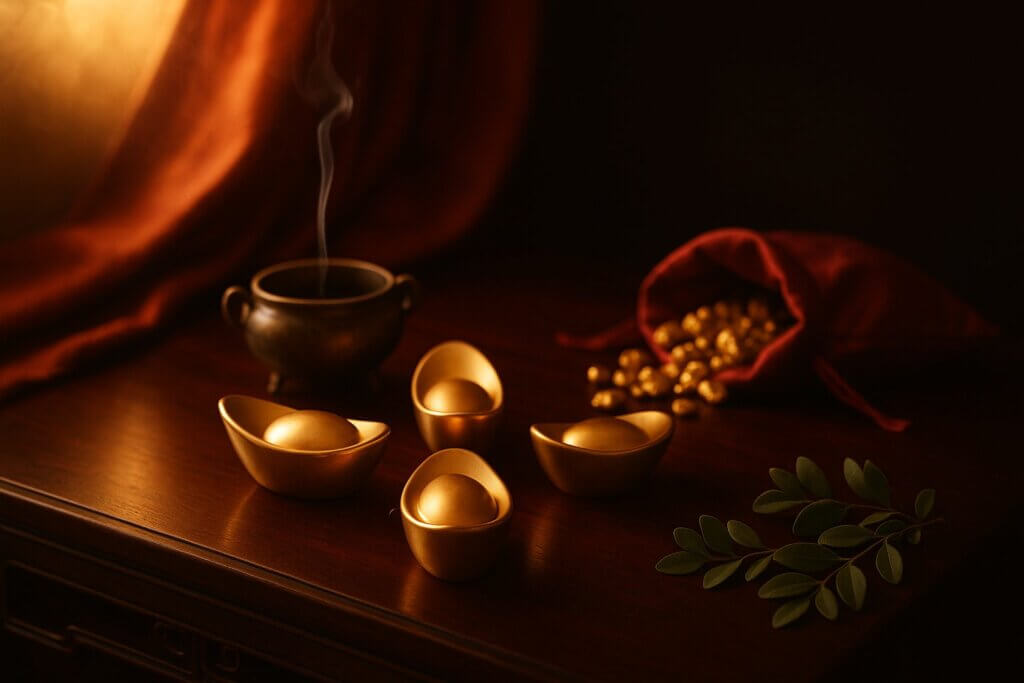
2. Circulation Beats Hoarding: Money Energy Has to Roll Out to Roll Back
There’s a Chinese folk idea worth knowing here — not as a financial rule, but as a cultural lens on wealth: Caishen giving you money energy is understood as an act of trust, and what he’s said to be looking for in return is that you use the resource well and pass some of it along. In that telling, wealth is routed through you so more good can be done with it, and the current only grows if you’re willing to let it flow outward. Burning Five Paths joss paper is the gesture that stands for sending something out rather than putting it away.
The common misreading is that this means handing over ninety dollars out of every hundred you earn. The traditional version is far looser than that. Volunteering your time counts as circulation. So does passing along a good idea you picked up to a friend. The logic is honestly pretty shrewd — when the people around you are better off because of you, some portion of that comes back to you eventually, and the whole thing compounds like a snowball.
3. Borrowing and Repaying: An Old Training Course in Credit
In some regional traditions there’s a practice of borrowing wealth from Caishen: while making offerings, a person states a specific financial wish and agrees to come back once it’s been fulfilled, to repay the vow with a fresh round of offerings and Five Paths joss paper. The weight of the whole arrangement sits on the repayment, not the request. Whether a person actually does what they said they’d do is what the tradition is really watching.
What that amounts to is a credit culture held together by belief, in an age with no credit bureaus. If you keep your word to a party you can’t even see, you’re hardly going to stiff the partner sitting across the table from you. For a modern reader, this may be the most usable piece of the whole tradition: long-term compounding in wealth comes less from any single stroke of luck and more from whether other people are willing to work with you a second time.
5 Common Questions About Five Paths Wealth Gold and the Caishen Tradition
By now you’ve probably picked up on the fact that this tradition is really a set of attitudes about money. Still, if you’re running into it for the first time, a few practical questions tend to surface: Is this a religion? Is there anything here for someone who doesn’t buy any of it? Here are the five questions that come up most, answered as cultural background rather than as advice about what anyone ought to do.
Q1: What is Five Paths wealth gold actually made of, and how does it differ from ordinary joss paper?
Five Paths wealth gold (wu lu cai shen jin) is one variety of joss paper used in Chinese offering customs. It’s typically a sheet printed with images of Caishen or auspicious characters, sometimes finished with gold leaf or a gold-ink design. Traditionally, joss paper comes in different grades depending on who the offering is directed to. Paper for deities is called “gold,” while paper burned for ancestors or other recipients carries different names and specifications, and the categories aren’t interchangeable.
What sets it apart from ordinary joss paper is the occasion and the recipient it stands for. Five Paths wealth gold is used specifically for offerings to the gods of wealth, and the “five paths” part means all five directional gods are honored at once, with no favoritism toward any single one. Here’s the thing, though: the material isn’t the point. It’s the attitude the object encodes — a piece of cultural design that turns gratitude into something you can see and hold.
Q2: Is the Caishen tradition a religion? How does it relate to Buddhism and Taoism?
Strictly speaking, it belongs to Chinese folk religion — a form of belief that grew up organically in Han Chinese society, without unified doctrine, scripture, or organization. It borrowed heavily from the Taoist pantheon and its rituals, and it has traded ideas with Buddhism along the way, but on its own it works more like a set of cultural habits carried through everyday life than a religion with hard boundaries.
That’s why so many Chinese people can take part in several traditions at once without feeling the least bit of contradiction. For a lot of them, making offerings to Caishen doesn’t declare a whole worldview so much as mark a seasonal occasion, a family ritual handed down through generations — not unlike an American family that isn’t especially devout but still treats the Thanksgiving table as something that matters.
Q3: Are the Five Paths gods of wealth the same thing as Japan’s lucky cat or Seven Lucky Gods?
They’re relatives, not twins. Several of Japan’s Seven Lucky Gods do trace back to Chinese and Indian origins, which tells you something about how long East Asian traditions have been flowing into one another. But the way those seven got grouped into a set, the imagery of them arriving by boat, and the role they play in Japanese society all reflect a thorough local reworking.
The lucky cat (maneki-neko) is much more recent — a mascot of storefronts and restaurants backed by a few Edo-period folk tales rather than any divine status. The Five Paths gods of wealth, by contrast, have defined portfolios, an assigned direction each, and a whole vocabulary of offering practice around them. Setting them side by side is genuinely interesting: you get to watch different cultures land on their own concrete forms for the same wish, which is simply to live with a little more room to breathe.
Q4: Doesn’t this encourage greed? Is wanting wealth treated as a bad thing?
That’s most people’s first instinct, but the traditional attitude is more nuanced than you’d expect. This tradition doesn’t flinch at the desire for wealth; it takes for granted that wanting a good life is legitimate. What it puts weight on is how the wealth is obtained and what happens to it afterward. The phrase “take it by the right way” carries real force here, and in the traditional stories, money gotten by illegitimate means rarely ends well for the person holding it.
More to the point is the idea covered earlier: getting rich on your own isn’t considered especially impressive, and the person who brings others up along with them is the one traditionally seen as worth backing. Read that way, the tradition isn’t so much encouraging greed as attaching a condition to wealth — you have to show that resources in your hands will generate more movement, not less.
Q5: I don’t believe any of this. Is there anything in these traditions for me?
Strip out the deities entirely and three fairly durable ideas are still standing. First, opportunity requires you to open the door yourself; it doesn’t go hunting for people who’ve shut themselves in. Second, resources that sit still stop growing, whether that’s money, knowledge, or the people you know. Third, long-term prosperity is built on credit — whether someone is willing to work with you a second time counts for more than any single stroke of luck.
People a few hundred years ago had no personal finance books to read, so they packaged what they’d learned into festivals, offerings, and stories that could survive across generations who couldn’t read. You don’t have to believe the gods of wealth are real to see what those people were trying to preserve: a whole philosophy of money built on circulation, integrity, and sharing, tucked into a stack of paper called Five Paths wealth gold and passed quietly along for a very long time.